


Poland
GdyniaLublinSzczecinPrzemyślGdańskPoznanSopotTorunŁódźKatowicePiwnicza-ZdrójChałupyKolobrzegOlsztynKrakowWrocławHelNowy TargKłodzkoJurataWładysławowoWalbrzychRzeszówKielceBialystokZakopaneWarsaw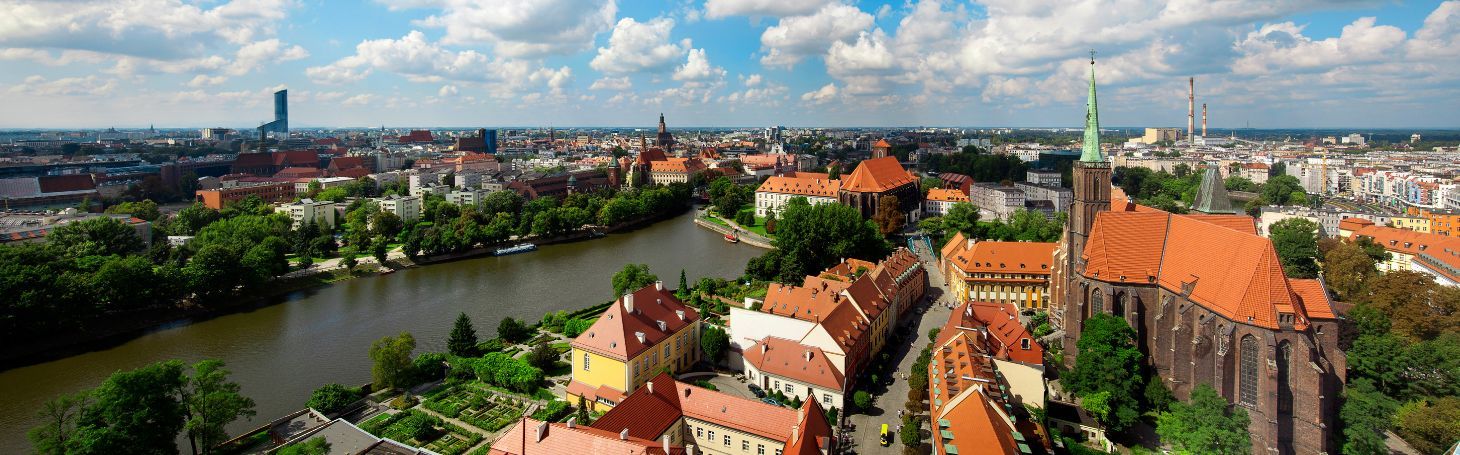
Train to Wrocław – connections, tickets and travel guide
Wrocław lies on more than 130 islands and has one of the largest market squares in Poland. On Ostrów Tumski you'll see the Gothic cathedral, and in the Centennial Hall architecture listed as a UNESCO World Heritage Site. In the evening, take a stroll along the Oder River, where the boulevards and bridges reveal the city's unique layout.
Fast facts - Wroclaw by train
-
Destination station: Wrocław Główny train station, 105 Józefa Piłsudskiego St.
-
Best time to go: April-May and September - smaller crowds than in summer, lower accommodation prices
-
Local transport: trams and buses from MPK Wrocław; a single ticket costs a few zlotys, a daily ticket costs a dozen or so
-
Character of the city: lively gastronomy in the centre and on the Nadodrze, over 100 bridges over the Oder and many walking routes between the islands
-
How much to spend: a weekend (2 nights) is enough to visit the Market Square, Ostrów Tumski and Panorama Racławicka; 3 days is more than enough to visit Hala Stulecia and the Nadodrze district.
-
Practical tip: over 600 dwarves - small bronze figures hidden by pavements, on walls and under street lamps - are scattered around the city; they are a free attraction for all ages and you can download an app on your phone with a map of them
When to go to Wrocław
The best choice is April–May or September, when daytime temperatures are 14–19°C and tourist traffic remains moderate.
| Month | Daytime temperature | Weather | Tourist traffic |
| January | 2°C | Frosty, possible snow | Low |
| February | 3°C | Cold, short days | Low |
| March | 8°C | Cool, first signs of spring | Low |
| April | 14°C | Mild, increasingly sunny | Moderate |
| May | 19°C | Warm, long days | Moderate |
| June | 22°C | Warm, occasional thunderstorms | High |
| July | 25°C | Hottest, possible heatwaves | High |
| August | 24°C | Warm, afternoon thunderstorms | High |
| September | 19°C | Mild, golden autumn | Moderate |
| October | 13°C | Cooler, colourful parks | Moderate |
| November | 7°C | Cloudy, rainy | Low |
| December | 3°C | Cold, Christmas market | Moderate |
Spring (March–May)
-
The Botanical Garden and Szczytnicki Park are in bloom from mid-April – you'll see magnolias, azaleas and cherry blossoms.
-
Wrocław Non Stop is a spring city festival with concerts and outdoor events in the centre.
-
Daytime temperatures in March reach 8°C and 19°C in May; from mid-April a light jacket is sufficient.
-
Tourist traffic remains moderate, so it is easier to plan visits to the main attractions.
Summer (June–August)
-
The Wrocław Jazz Festival in July attracts music lovers from all over Poland.
-
The Market Square and Ostrów Tumski are then visited by the most tourists, so it is worth booking accommodation in advance, especially for weekends.
-
It is up to 25°C during the day and evenings remain warm; the multimedia fountain at the Centennial Hall operates daily.
-
Accommodation prices in high season can be 30–50% higher than in spring and autumn.
Autumn (September–November)
-
The Brave Festival in September attracts an international audience interested in art and music.
-
South Park and Szczytnicki Park turn golden and red from mid-October.
-
Daytime highs in September are 19°C, and from November onwards you are more likely to encounter cloudy and rainy weather.
-
Accommodation prices return to pre-season levels, so it's easier to plan a weekend getaway.
Winter (December–February)
-
The Christmas market on Market Square is one of the largest in Poland and runs throughout December.
-
During the day it is 2–3°C and in the evenings there is frost, so warm clothing is essential every day.
-
Outside December, tourist traffic is the lowest of the year, so it is easier to visit attractions without queues.
-
The Racławice Panorama and museums fit well into a plan for frosty days.
Getting to Wrocław by train
You can get to Wrocław directly from Warsaw, Kraków, Poznań, Katowice, Gdańsk and Gdynia.
From Poznań to Wrocław
-
You can get from Poznań Główny station to Wrocław Główny in 1.5 hours.
-
Connections allow you to leave in the morning and return in the evening on the same day.
From Katowice to Wrocław
-
From Katowice to Wrocław you travel 2 hours without changing trains.
-
There are regular connections on this route throughout the day.
From Kraków to Wrocław
-
From Kraków Główny to Wrocław Główny you travel 3 hours.
-
You can leave Kraków in the morning and arrive in Wrocław before noon.
From Warsaw to Wrocław
-
From Warsaw Central to Wrocław Główny you travel 3.5–4 hours.
-
EIP trains are faster than IC trains.
From Gdynia and Gdańsk to Wrocław
-
The journey from Gdynia to Wrocław takes 4.5 hours, while the journey from Gdańsk is several minutes shorter.
-
There are regular direct connections on this route.
Buy your ticket on PolishTrains without registering – enter the route, choose the connection and pay. You receive your ticket by email and SMS, and an SMS reminder with a link to your ticket arrives 30 minutes before departure. The earlier you buy, the more choice of seats and the better the price. If you change your plans, you can return your PKP Intercity ticket up to 20 minutes before departure and exchange it up to 30 minutes before departure; see our ticket refunds and exchanges page for details. When travelling with your family, check out the offers for travelling together and discounts with the Large Family Card.
Getting around Wrocław
You get around Wrocław mainly on foot, by tram and bus. Świdnicka Street leads from the railway station straight to the Market Square, so you can get there in about 15 minutes. Trams and buses of MPK Wrocław serve the whole city. A single ticket costs a few zlotys, and a daily ticket costs a dozen or so. If you make several journeys a day, a day ticket will be more convenient - you can buy it from the ticket machine at the stop or from the mobile app.
The main attractions lie within a few kilometres of the station. The Market Square, Ostrów Tumski, Panorama Racławicka and Centennial Hall are all connected by foot and tram. The Wrocław Urban Bicycle operates seasonally - a good option if you want to travel between the islands and along the Oder. You'll find bike stations at the train station, on the Market Square and around the main attractions.
Taxi and ride-hailing apps are available at the station, so it's easy to get back with more luggage or late at night from Nadodrze. If you're looking for accommodation, hotels and flats around Market Square and Świdnicka Street allow you to get around mainly on foot. With early or late trains, accommodation options near the station itself also work well.
Where to stay overnight:
-
Market Square and Świdnicka Street area - central location, ability to move mainly on foot, higher accommodation prices
-
Nadodrze - less touristy atmosphere, lower prices, good access to local restaurants and cafés
-
Railway station area - convenient for early or late trains, good starting point for sightseeing
What to see in Wrocław - highlights
Wrocław Market Square
One of the largest town squares in Poland - a 3.7 hectare square surrounded by townhouses from various eras. The Gothic Town Hall in the centre of the square is accessible for a fee. It takes 30-45 minutes to walk around the Market Square itself and 45-60 minutes to visit the interior of the Town Hall. In the evening, the townhouses are illuminated and the restaurants on the square serve dinner until late.
Ostrów Tumski
The oldest part of Wrocław, located on an island between the arms of the Oder River. St. John the Baptist Cathedral - entrance to the nave is free, while entrance to the observation tower is charged. From the tower you will see a panorama of the city and the river. In the evening, a lighthouse keeper manually lights the gas lanterns on the island's streets - the only such place in Poland. A walk around Ostrów Tumski takes an hour.
Racławicka Panorama
The Racławicka Panorama is a 114-metre-long 19th century panoramic painting depicting the Battle of Racławice. There is an entrance fee. During the summer season and at weekends, tickets can sell out in advance, so it's worth buying in advance through the museum's website. The tour takes 45 minutes, including a multimedia show before entering the rotunda.
Centennial Hall (UNESCO)
The Centennial Hall is a modernist building from 1913 and is a UNESCO World Heritage Site. There is a fee to enter - inside, an exhibition about the history of the building and interactive displays await. Next to the hall is the Pergola with a multimedia fountain, which is free of charge and operates seasonally from May to October. Evening fountain shows with light and music last several minutes.
Wrocław dwarves
More than 600 bronze figurines are scattered all over the city - along pavements, on the walls of buildings and under lamp posts. Each dwarf has a name and a story. You can download an app on your phone with a map of the dwarves, which guides you from figurine to figurine. It's a free attraction that turns a walk through the city into an outdoor game and works well with children.
Plan for day 1
- Morning: Wrocław Market Square and the interior of the Town Hall (1.5 hours)
- Morning: walk to Ostrów Tumski and St John the Baptist Cathedral (1 hour)
- Afternoon: Racławicka Panorama (45-minute tour + walk)
- Evening: dinner near Solny Square or in Nadodrze district
Plan for the weekend (2 nights)
You can arrange the first day in the same way as the plan for day 1. On the second day, in the morning, take the tram to Centennial Hall and Szczytnicki Park - on the way, have a look at the Japanese Garden, where entrance is charged and the facility operates seasonally from April to October. The Centennial Hall tour, park walk and Japanese Garden take a total of 3-4 hours. In the evening, head to Nadodrze, where you'll find local restaurants, cafés and kraft beer bars, and there are fewer tourists than in the city centre.
Food and shopping in Wrocław
What to eat
Żurek served in a bread bowl – you'll find it in restaurants on Market Square and on Świdnicka Street.
Goose prepared in various ways – in autumn, from September to November, roast goose with apples or red cabbage appears on menus.
Pierogi with local fillings – for example, with buckwheat groats and white cheese; served by several traditional restaurants in the centre.
Where to eat:
-
Market Hall on Piaskowa Street – a historic building from 1908, open every day; in the morning you can buy fresh vegetables, fruit, cheese and cold cuts from local producers; the biggest selection is before noon
-
Nadodrze – local pubs, speciality cafés and craft beer bars; a less touristy atmosphere than on Market Square, with lower prices; in the evening the district comes alive and fits perfectly into a second day of a city break
-
The area around Solny Square and Świdnicka Street – a wide choice of restaurants from Polish through Italian to Asian cuisine; a good destination for lunch between sightseeing, as these places lie on the route from Market Square to the Racławice Panorama
Souvenirs
-
Dwarf figurines – in various sizes; available in shops on Market Square and in the streets of the Old Town
-
Lower Silesian crystal glass products – available in shops on Market Square and in the streets of the Old Town
-
Craft beer – in the Nadodrze area there are several local breweries with their own bars where you can try beers not available elsewhere; especially worthwhile if you like IPAs and sour beers
-
Larger shopping – Pasaż Grunwaldzki or Galeria Dominikańska; both shopping centres are close to the city centre
How much does Wrocław cost? Approximate costs
Wrocław is clearly more affordable than Warsaw and Kraków, especially outside the peak season of July, August and December.
| Category | Budget | Mid-range | Comfortable |
| Accommodation (1 night) | 80–120 PLN | 200–300 PLN | 400–600 PLN |
| Food (1 day) | 60–80 PLN | 100–150 PLN | 200–250 PLN |
| Local transport (1 day) | 10–15 PLN | 15 PLN | 30–50 PLN |
| Attractions (1 day) | 20–30 PLN | 50–70 PLN | 80–100 PLN |
| Total | 170–245 PLN | 365–535 PLN | 710–1000 PLN |
Accommodation makes the biggest difference to your budget – you will pay more near Market Square than near the railway station or in Nadodrze. If you plan several paid attractions in one day, add the Town Hall, Centennial Hall and the Japanese Garden to your budget.
Frequently asked questions
Check out where else you can go by train in Europe
Czech Republic
BrnoOstravaPragueOlomoucNetherlands
RotterdamAmsterdamFrance
LilleToulouseBordeauxNiceDijonLyonParisMarseilleParisAvignonSwitzerland
Château-d'OexLucerneSt. MoritzZurichLuganoBrocMontreuxInterlakenSankt GallenGenevaBernBellinzonaBaselAustria
InnsbruckVienna