

Poland
GdyniaLublinSzczecinPrzemyślGdańskPoznanSopotTorunŁódźKatowicePiwnicza-ZdrójChałupyKolobrzegOlsztynKrakowWrocławHelNowy TargKłodzkoJurataWładysławowoWalbrzychRzeszówKielceBialystokZakopaneWarsaw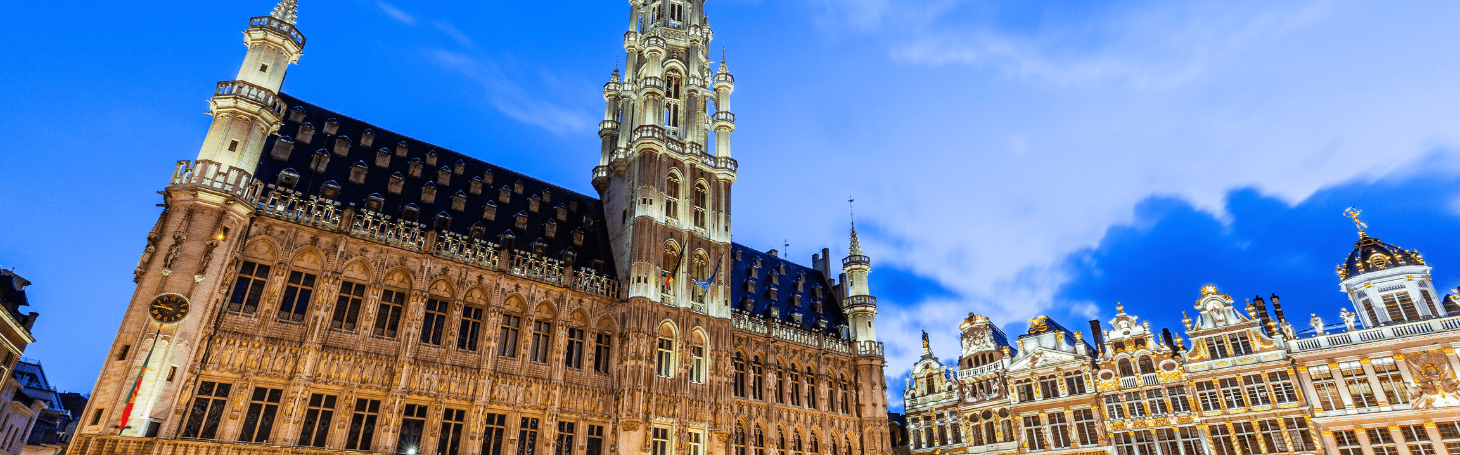
Brussels train - connections, tickets and itinerary
Bruxelles-Central station is in the city centre and you can walk to the Grand Place in just a few minutes. From Poland, you can reach Brussels with one change in Germany, usually in Berlin. Belgium is part of the Schengen area, so all you need is a valid identity card or passport. To compare the available one-change itineraries from Poland and check the required travel documents, PolishTrains provides route details before booking.
Fast facts - Brussels by train
-
Currency: Euro (EUR). Payment cards accepted almost everywhere.
-
Local transport: metro, trams and buses of the operator STIB/MIVB. A single ticket is a few zlotys, a daily ticket a dozen or so. For several journeys a day, it is better to buy a day ticket.
-
How much to go for: a weekend (Friday evening - Sunday) is enough for the Grand Place, the Atomium, the Royal Museum of Art and a walk around the Sablon. For a more leisurely tour, plan 3 days.
-
Best time to go: ideally choose May or September. The daytime temperature is 15-21°C and there are fewer tourists than in July and August. When booking international travel, PolishTrains lets you enter contact details without creating an account and sends the ticket by e-mail and SMS.
When to go to Brussels
The best choice is May or September - the daytime temperature is 15-21°C, the days are long and there is less tourist traffic than in summer.
| Month | Daytime temperature | Weather | Tourist traffic |
| January | 6°C | Cool, short days, possible precipitation | Low |
| February | 8°C | Cool, progressively longer days | Low |
| March | 12°C | Spring warming, variable precipitation | Moderate |
| April | 16°C | Pleasant, parks in bloom | Moderate |
| May | 21°C | Warm, long days, little rain | Moderate |
| June | 24°C | Warm to hot, long evenings | High |
| July | 26°C | Warmest, possibly very hot | High |
| August | 26°C | Hot, some restaurants may be closed | High |
| September | 21°C | Warm, shorter days, fewer tourists | Moderate |
| October | 16°C | Cooler evenings, colourful foliage | Moderate |
| November | 11°C | Cool, start of the Christmas market season | Moderate |
| December | 8°C | Cold, Christmas markets in full swing | Moderate |
Spring (March–May)
-
In March and April it is easier to visit the city centre without the summer crowds.
-
The city's parks, including the Parc du Cinquantenaire and the Parc de Bruxelles, look great from April onwards.
-
In May, daytime temperatures reach 21°C, so you can plan long walks and evening sightseeing.
-
This is a good time for a city break if you want moderate temperatures and lower accommodation prices than in summer.
Summer (June–August)
-
June, July and August are the warmest months, with long evenings.
-
In summer, the Grand Place and the main attractions see the highest tourist traffic.
-
Accommodation prices in the centre are higher than in spring and autumn.
-
In August, some restaurants operate shorter hours, so it is worth checking opening times before visiting.
Autumn (September–October)
-
September combines pleasant weather with less tourist traffic than the summer holidays.
-
In October, the daytime temperature is around 16°C, so exploring on foot is still very comfortable.
-
In autumn, the parks and avenues in the upper part of the city look particularly beautiful.
-
It is a good choice if you want to combine sightseeing with museums, cafés and a quieter city pace.
Winter (November–January)
-
From the end of November to the beginning of January, Christmas markets operate at the Grand Place and Place Sainte-Catherine.
-
In December, the city draws visitors with its festive atmosphere, illuminations and food stalls.
-
January and February are the quietest months in terms of tourist traffic.
-
Outside the Christmas market period, accommodation prices are among the lowest of the year. After arriving at Bruxelles-Central, PolishTrains helps you plan the final walk to the Grand Place and onward city travel using STIB/MIVB.
Getting to Brussels by train
You will get to Brussels with one change in Germany, usually in Berlin. Most often you take the PKP Intercity train first and then change to a Western European connection.
From Poznań to Brussels
-
From Poznań you travel approximately 11-12 hours.
-
You usually change trains in Berlin or Hannover.
-
Departing in the morning allows you to reach Brussels in the evening of the same day.
-
You change trains at the same station.
From Wrocław to Brussels
-
The route from Wrocław takes you via Berlin or Dresden to Brussels.
-
You drive approximately 12-13 hours.
-
You arrive at Bruxelles-Central station in the morning on the night departure.
-
You change trains at the same station.
From Katowice to Brussels
-
From Katowice to Brussels you travel approximately 13-14 hours.
-
The route goes via Wrocław or Berlin.
-
On the way you change trains at the same station.
-
Options with an evening departure and morning arrival are also available.
From Krakow to Brussels
-
From Krakow you travel approximately 14-15 hours.
-
The most common route is via Wrocław and Berlin.
-
You can leave in the evening and arrive in the morning.
-
You can change trains in Berlin or Wrocław.
From Warsaw to Brussels
-
The drive from Warsaw to Brussels takes about 15-16 hours.
-
The typical route takes you through Berlin.
-
You can choose a day option with a late evening arrival or an overnight option with a morning arrival.
-
At Berlin Hauptbahnhof station, you change trains for the connection to Belgium.
Reservation of a seat is compulsory for the section abroad. You buy your ticket on PolishTrains without creating an account - you enter your e-mail and phone number and receive your ticket by e-mail and SMS. 30 minutes before departure you get an SMS with a link to your ticket. The earlier you buy, the better the price and the greater the choice of seats. Details can be found on the page describing the rules for refunds and exchanges - at PKP Intercity, refunds are possible up to 20 minutes before departure and exchanges up to 30 minutes before departure.
Transport on site in Brussels
Bruxelles-Central (Brussel Centraal) station at Place de la Chapelle 1 is centrally located. You can walk to the Grand Place in a few minutes and major attractions such as the Manneken Pis, Galeries Saint-Hubert and the Cathedral of Saint Michael and Saint Gudula are close by.
You can reach further points of the city by metro, tram or bus by the operator STIB/MIVB. Take the metro to the European Quarter and the European Parliament, and the tram to the Atomium. Check the latest information on routes and fares before you go.
A single ticket is a few zlotys and a daily ticket a dozen or so. For several journeys a day, it is better to buy a day ticket. You can buy your tickets from vending machines at metro stations and points of sale.
Uber and Bolt operate in Brussels. A ride within the city centre costs an approximate 35-65 PLN and works well in the evening or with luggage.
You get around Brussels on foot and by public transport.
Where to stay:
-
Grand Place / Lower Town - the most convenient base for tourists. The main attractions are within walking distance and there are plenty of restaurants and cafes around.
-
Sablon (Upper Town) - a quieter and more elegant district. Here you will find art galleries, antique shops and chocolatiers.
-
European Quarter - a good option for a longer stay or business trip. Close to the European Parliament and the Parc du Cinquantenaire.
STIB/MIVB night buses also run after midnight, so you'll return to your hotel without a taxi after an evening out.
What to see in Brussels - highlights
Grand Place (Grote Markt)
UNESCO-listed market square with townhouses from the 17th-18th centuries and the Gothic town hall. The tour takes 45-90 minutes. Admission to the market is free. Enter before 9am or after 6pm - the square is almost empty in the morning, and in the evening the illuminated townhouses look different from the daytime.
Atomium
A futuristic structure from 1958 - 9 metal spheres connected by tubes, with an observation deck at 102 metres. The tour takes 60-120 minutes. There is an entrance fee. Plan your visit at the end of the day - from the top sphere you'll see the illuminated city.
Royal Museum of Ancient Art
Collections of Flemish and Dutch paintings from the 13th to 18th centuries - Bruegel, Rubens, van der Weyden. The tour takes 2-3 hours. There is an entrance fee. The museum stands close to the Royal Palace, so both places are worth combining in one day.
Manneken Pis
A 55-centimetre bronze sculpture from the 16th century - a symbol of Brussels. The tour takes 10-15 minutes. Admission is free. The sculpture stands a few minutes' walk from the Grand Place. It is smaller than many people expect, but has more than 1,000 costumes in which it is regularly dressed up.
Galeries Saint-Hubert
An indoor shopping mall dating back to 1847 - glass roof, neo-Renaissance architecture, chocolate shops and cafés. The tour takes 60-90 minutes. Admission is free. If the weather is rainy, it's worth a look as you'll pass cafes and chocolate shops along the way.
Cathedral of St Michael and St Gudula
A Gothic cathedral from the 15th-18th centuries with impressive stained glass windows and high arches. The tour takes 45-60 minutes. Admission is free. The cathedral is a few minutes' walk from Bruxelles-Central station, so you can have a look here as soon as you arrive or just before you leave.
Plan for day 1
Start in the morning at Grand Place - before 9am the square is quiet and it 's easier to take photos without the crowds. From there, head to the Rue des Bouchers area for lunch and then walk through Galeries Saint-Hubert. On the way, take a look at the Manneken Pis and the Cathedral of Saint Michael and Saint Gudula. In the afternoon, take the tram to the Atomium and climb to the observation deck before dark. In the evening, return to the Grand Place to see the illuminated townhouses.
Plan for the weekend
Day 1: Start at the Royal Museum of Ancient Art and the Royal Palace in the morning. For lunch, go to the Sablon district, where you'll find quieter restaurants and fewer tourists. In the afternoon go to the Atomium. In the evening, return to the centre for jazz or a beer in one of the bars on the Grand Place.
Day 2: Devote the morning to the Grand Place, Galeries Saint-Hubert and chocolate shopping. If you have time before you leave, have another look at the cathedral, as it's a short walk from the station.
Eating and shopping in Brussels
What to eat
Belgian fries (frites) - twice-fried, crispy, served with mayonnaise or other sauces. You can buy them at small outlets called frituren - a few zloty a portion. You will find such places all over the city centre. Belgians treat frites as a separate dish rather than a side dish.
Moules-frites (mussels with fries) - Belgium's national dish. Served in large portions in restaurants on the Rue des Bouchers and around the Grand Place. Prices in the centre are touristy, and you'll find quieter and cheaper options in the Sablon or Marolles districts.
Belgian waffles (gaufres) - two styles: Brussels (thinner, rectangular, with icing sugar) and Lyon (smaller, with caramelised sugar, more crunchy). You can buy them from street vendors in the Grand Place for a few zlotys. Versions with fruit and chocolate cost a little more.
Carbonnade flamande - meat stewed in dark Belgian beer with onions - the Belgian equivalent of goulash. You'll find this dish in traditional restaurants off the main square. The Marolles district serves it in a more local version.
Belgian chocolate - pralines with ganache, truffle and fruit. Brands Godiva, Neuhaus and Leonidas have shops in the centre, and Galeries Saint-Hubert is one of the most convenient places to shop. The quality is clearly superior to the usual supermarket chocolate. A box of pralines is one of the best gifts to take away.
Belgian beer - Trappist (Chimay, Westmalle, Westvleteren), Lambic (wild fermentation, characteristic of Brussels), Witbier (wheat, light). Each beer is served in a dedicated glass, so it's worth ordering several varieties and comparing flavours. You'll find hundreds of varieties in the bars along the Grand Place.
Where to eat:
-
Rue des Bouchers - traditional seafood restaurants, touristy and more expensive. It's worth a visit here once for the atmosphere, but for everyday eating it's better to choose quieter areas.
-
Sablon - a quieter neighbourhood with higher quality and elegant cafés and chocolatiers.
-
Marolles - local cafes, fewer tourists and a more authentic atmosphere. A flea market on the Place du Jeu de Balle operates here on Sundays.
Souvenirs
-
Belgian chocolate - in boxes, available in shops in the centre and in Galeries Saint-Hubert.
-
Trappist or Lambic beer - in speciality shops.
-
Packaged waffles - Galeries Saint-Hubert and the Grand Place area are the most convenient places to shop for souvenirs.
How much does Brussels cost? Indicative costs
Below are indicative costs for one day's stay in Brussels in three variants.
| Category | Budget | Medium | Comfort |
| Accommodation (1 night) | 150-200 PLN | 250-400 PLN | 450-700 PLN |
| Food (3 meals) | 110-170 PLN | 200-280 PLN | 350-460 PLN |
| Local transport | 12-15 PLN | 12-15 PLN | 30-36 PLN |
| Attractions | 60-75 PLN | 100-125 PLN | 270-350 PLN |
| Total | 332-460 PLN | 562-820 PLN | 1100-1546 PLN |
The budget variant assumes a hostel or private room, food from stalls and small bistros, a day ticket for transport and entrance to the Atomium. The medium variant includes a three-star hotel, a restaurant for lunch and dinner, and a visit to the Atomium and the Royal Museum of Art. The comfort option includes a four-star hotel, elegant restaurants in the Sablon, a three-day transport ticket and additional attractions.
In May and September, you will pay less for accommodation than at the peak of the summer season.
The earlier you buy your train ticket, the better the price and the greater the choice of seats.
Fries and waffles from street vendors cost a few zlotys per portion.
Frequently asked questions
Check out where else you can go by train in Europe
Czech Republic
BrnoOstravaPragueOlomoucNetherlands
RotterdamAmsterdamFrance
LilleToulouseBordeauxNiceDijonLyonParisMarseilleParisAvignonSwitzerland
Château-d'OexLucerneSt. MoritzZurichLuganoBrocMontreuxInterlakenSankt GallenGenevaBernBellinzonaBaselAustria
InnsbruckVienna