



Poland
GdyniaLublinSzczecinPrzemyślGdańskPoznanSopotTorunŁódźKatowicePiwnicza-ZdrójChałupyKolobrzegOlsztynKrakowWrocławHelNowy TargKłodzkoJurataWładysławowoWalbrzychRzeszówKielceBialystokZakopaneWarsaw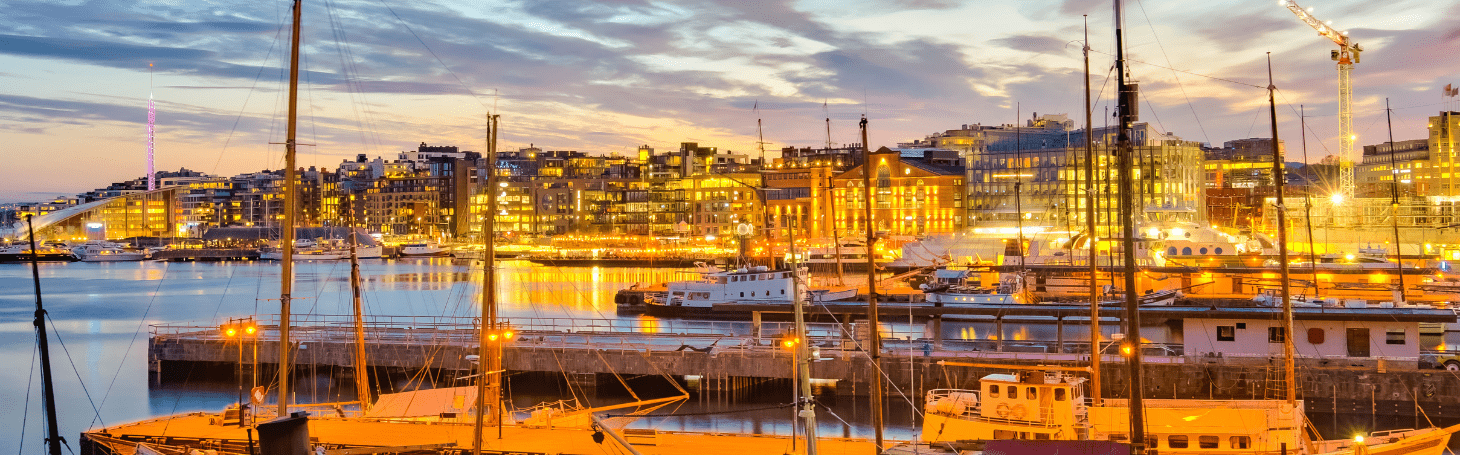
Train to Oslo - connections, tickets and itinerary
Oslo S train station (Oslo Sentralstasjon) at Jernbanetorget 1 is located in the heart of the city – you can walk to the Opera House, Akershus Fortress and Karl Johans gate in just a few minutes. Norway is part of the Schengen area, so as an EU citizen you can enter with an identity card. The journey from Poznań to Oslo takes about 19 hours, and from Warsaw about 21 hours.
Fast facts - Oslo by train
-
Currency: Norwegian krone (NOK). Norway does not use the euro, and you can pay almost everywhere with your card.
-
Local transport: metro (T-bane), trams, buses and ferries are operated by the operator Ruter. A single ticket is a dozen or so zlotys, and a daily ticket is several dozen zlotys.
-
Best time to go: June-August, when it is 20-23°C during the day and you benefit from a very long day. May is a good time for a city break - it's green, and on 17 May the city hosts Constitution Day celebrations.
-
How much to go for: a weekend (2-3 nights) is enough for the main attractions of the centre. With 4-5 days add the Bygdøy peninsula and a fjord cruise.
-
Practical tip: tap water in Oslo is drinkable and of good quality, so you don't need to buy bottled water.
When to go to Oslo
The best choice is May or summer, as the daytime is warm then and the long day makes it easier to explore the city and the Oslofjord islands.
| Month | Daytime temperature | Weather | Tourist traffic |
| January | 0°C | Frosty, short days, snow | Low |
| February | 1°C | Cold, snow possible, sun sets early | Low |
| March | 5°C | Cool, snow possible, days lengthening | Low |
| April | 11°C | Spring, parks in bloom, occasional rain | Moderate |
| May | 17°C | Warm, green, Constitution Day on 17 May | Moderate |
| June | 20°C | White nights, sun sets very late | High |
| July | 23°C | Warmest, bathing in the fjord | High |
| August | 21°C | Warm, music festivals | High |
| September | 16°C | Mild, autumn colours, fewer tourists | Moderate |
| October | 10°C | Cooler, first rains | Low |
| November | 4°C | Cold, rainy, short days | Low |
| December | 1°C | Frosty, Christmas markets | Moderate |
Spring (March–May)
-
In March it is still cold and snow is possible, but the days lengthen rapidly.
-
In April, the parks begin to bloom and temperatures reach 11°C.
-
In May it is up to 17°C during the day, and on 17 May at Karl Johans gate there are parades and Constitution Day celebrations.
Summer (June–August)
-
In June you enjoy white nights and the sun sets very late.
-
July is the warmest month, up to 23°C, and residents bathe in the Oslofjord and on the islands.
-
In August there are major music festivals and the weather is still ideal for walks and cruises.
Autumn (September–October)
-
In September it is around 16°C during the day and autumn colours appear in the parks.
-
In October it is cooler and rains more often, so a waterproof jacket comes in handy.
Winter (November–February)
-
November is dark and rainy, making it the least appealing month for a typical city break.
-
Christmas markets are open in December and the city centre is well lit.
-
In January and February, Oslo is a good choice if you want to combine sightseeing with cross-country skiing or ice skating in the surrounding area.
Getting to Oslo by train
You will travel to Oslo with transfers via Germany and Scandinavia, ending your journey at Oslo S station in the city centre.
From Poznań to Oslo – approximately 19 hours
-
From Poznań Główny station you travel via Berlin, Copenhagen and Malmö.
-
You change trains at major stations: Berlin Hauptbahnhof, København H and Malmö Central.
-
You cross Denmark and Sweden via the bridge over the Øresund.
-
On the section from Sweden to Norway, checks take place on the train and an identity card is all you need.
From Warsaw to Oslo – approximately 21 hours
-
From Warsaw Central station you travel via Berlin, Hamburg and Copenhagen.
-
Waiting rooms, refreshments and information boards are available at interchange stations.
-
If you leave in the morning, you arrive in Oslo the following day before noon.
-
The section from Warsaw to Berlin takes about 5.5 hours.
From Gdańsk to Oslo – approximately 22 hours
-
From Gdańsk Główny station you can travel via Berlin and Copenhagen, or choose the option with a ferry to Sweden and an onward journey via Stockholm.
-
The rail option takes you through major interchange stations in Germany and Denmark.
-
With the ferry option, you spend the night in a cabin and continue by train towards Oslo in the morning.
From Kraków to Oslo – approximately 23 hours
-
From Kraków Główny station you travel via Warsaw or Wrocław, then onwards via Berlin and Copenhagen.
-
Via Warsaw, it is easier to arrange a connection for the first leg to Germany.
-
Via Wrocław, you avoid changing trains in the capital and continue in the same direction through Germany.
From Wrocław to Oslo – approximately 24–25 hours
-
From Wrocław Główny station you travel via Berlin, Hamburg and Copenhagen.
-
The section from Wrocław to Berlin takes about 4–5 hours.
-
If you leave in the afternoon, you arrive in Oslo the following evening.
Seat reservations are compulsory on the international leg. You can buy your ticket on PolishTrains without registering, and after purchase you receive it by email and SMS. Thirty minutes before departure you receive an SMS with a link to your ticket, so you do not need to search your inbox. The earlier you buy, the better the price and the greater the choice of seats. The rules for refunds and exchanges depend on the carrier operating the relevant leg – check the refund and exchange policy. With PKP Intercity, you can request a refund up to 20 minutes before departure and an exchange up to 30 minutes before departure.
On-site transport in Oslo
You get around Oslo's city centre mainly on foot, and you can reach further districts by metro, tram, bus or ferry.
All public transport in Oslo is operated by Ruter AS. The metro (T-bane), trams, buses and city ferries operate under one ticketing system. A single ticket is valid for 60 minutes and includes transfers within zone 1 – you can buy one from a ticket machine at the station or from Narvesen and 7-Eleven kiosks. If you make several journeys a day, a day ticket is more convenient – it costs several tens of zloty and includes unlimited travel for 24 hours.
| Option | Travel time to the centre | Indicative cost (PLN) |
| On foot from Oslo S station | You are already in the centre | 0 zł |
| Metro or tram (zone 1) | A few minutes | Around 15 zł |
| Taxi, Uber or Bolt | A few minutes | Several tens of zł |
| Flytoget from Gardermoen Airport | About 20 minutes to Oslo S | Over 100 zł |
The Oslo Pass combines unlimited public transport with free entry to more than 30 museums and attractions. It costs several hundred zloty for 24 hours and is worth it if you plan to visit several paid museums on the same day.
Taxis and the Uber and Bolt apps are available in Oslo. They can take you from the station to further districts in just a few minutes.
Where to stay:
-
Sentrum – closest to the station and main attractions, so for a short stay you can see most places on foot.
-
Grünerløkka – an artistic neighbourhood with independent cafés and bistros, a short tram ride from the centre.
-
Frogner – a quiet, green area near Vigeland Park, ideal for families.
-
Aker Brygge – modern waterfront buildings by the fjord, seafood restaurants and views of the Opera House.
Gardermoen Airport is 60 km from the centre. The Flytoget express takes you to Oslo S station in about 20 minutes.
What to see in Oslo - highlights
Vigeland Park (Vigelandsparken)
More than 200 sculptures by Gustav Vigeland stand in an open park – from the monumental Monolith to the fountain with bronze figures. Admission is free. The visit takes about 1.5–2 hours. The best light is in the early morning or at sunset.
Oslo Opera House (Operahuset)
The white Carrara marble building has a roof accessible to visitors and a viewing terrace overlooking the fjord. Entry to the roof and foyer is free. The visit takes about 30–45 minutes. In the evening the building is illuminated and looks stunning from the Bjørvika waterfront.
Akershus Fortress (Akershus Festning)
The medieval fortress dating from the 13th century stands on a hill above the fjord. Entry to the fortress grounds is free, and from the walls you can see the Opera House, the harbour and the Oslofjord. The Armed Forces Museum and the Norwegian Resistance Museum are located on site. A full tour of the complex takes about 1.5–2 hours.
MUNCH Museum (Munchmuseet)
This is the largest collection of Edvard Munch's works in the world, including several versions of The Scream. The modern building stands above the fjord, and on the top floor there is a café with panoramic views. Admission is paid, but free for under-18s. The visit takes about 2 hours.
National Museum (Nasjonalmuseet)
This is the largest art museum in Scandinavia. The collection features Norwegian and European art from the Middle Ages to the present day. Admission is paid, but free for under-18s. The visit takes about 2 hours.
Fram Museum (Frammuseet)
The museum houses the original polar ship Fram, which Fridtjof Nansen and Roald Amundsen used on their polar expeditions. You can go on board and below deck, and the exhibition is interactive. The museum is located on the Bygdøy peninsula. Admission is paid. The visit takes about 1.5 hours.
Plan for 1 day
-
Morning: start at Vigeland Park, when there are fewer people in the paths and it is easier to take in the sculptures.
-
Late morning: head to Grünerløkka for lunch on Thorvald Meyers gate.
-
Afternoon: walk along Karl Johans gate from the Royal Palace towards the centre and choose between the National Museum or Akershus Fortress.
-
Late afternoon: climb to the roof of Oslo Opera House and take in the views over the fjord from Bjørvika.
-
Evening: visit the MUNCH Museum or sit down for dinner at Aker Brygge.
Weekend plan
Friday evening: upon arrival at Oslo S, have dinner at Aker Brygge by the fjord.
Saturday: Vigeland Park in the morning → lunch in Grünerløkka → MUNCH Museum → walk through Sentrum to Akershus Fortress → dinner in the centre.
Sunday: Oslo Opera House in the morning → Bygdøy and the Fram Museum → National Museum on the way back → cruise on the Oslofjord or coffee in Grünerløkka before departure.
Eating and shopping in Oslo
What to eat
Gravlaks – salmon cured with dill and mustard, served on bread or as a starter.
Vaffel – Norwegian heart-shaped waffle with jam and brunost, a brown cheese made from caramelised milk.
Fårikål – mutton braised with cabbage and black pepper, a traditional autumn dish.
Lapskaus – beef stew with root vegetables, the Norwegian equivalent of homemade comfort food.
Where to eat:
-
Grünerløkka – the neighbourhood where Oslo residents eat. Along Thorvald Meyers gate and Markveien you will find independent cafés, bistros and fusion restaurants, and you will usually pay less than in the tourist centre.
-
Vippa food hall – at the waterfront, with more than 15 stalls offering cuisine from around the world and Norwegian street food. No table reservation needed, and the format helps keep meal costs down.
-
Aker Brygge – home to seafood restaurants along the fjord. You pay more here, but you get views of the water and the Opera House.
Practical tip: shopping at Rema 1000, Coop or Kiwi supermarkets costs less than eating out. Breakfast and snacks bought in a shop can significantly reduce your daily food budget.
Stronger alcohol in retail can only be purchased at the state-owned Vinmonopolet shops, which close early and do not open on Sundays. Regular supermarkets only sell beer up to 4.7% ABV.
Souvenirs
-
Norwegian jumpers with traditional patterns (lusekofte) – available in shops in the centre and in Grünerløkka.
-
Brunost – brown cheese in handy packaging, a great gift idea.
-
Reproductions of Munch's works – posters and postcards from the MUNCH museum shop.
-
Troll figurines – a classic Norwegian souvenir, available in shops along Karl Johans gate.
How much does Oslo cost? Indicative costs
Oslo is one of Europe's more expensive cities, so it is worth planning your accommodation, food, transport and museum tickets before you go.
| Category | Budget | Mid-range | Comfortable |
| Accommodation (1 night) | 150–250 zł | 400–600 zł | 700–1200 zł |
| Food (per day) | 60–100 zł | 150–250 zł | 300–500 zł |
| Local transport (per day) | 0–50 zł | 50–80 zł | 100–200 zł |
| Attractions (per day) | 0 zł | 80–150 zł | 150–300 zł |
| Total | 210–400 zł | 680–1080 zł | 1250–2200 zł |
On the budget plan you opt for free attractions, stay in a hostel and buy some meals from a supermarket. The mid-range plan adds paid museums and restaurants. The comfortable plan means better accommodation, more journeys and several paid attractions in a single day.
You can pay by card practically everywhere, so cash in Norwegian kroner is rarely necessary.
Frequently asked questions
Check out where else you can go by train in Europe
Czech Republic
BrnoOstravaPragueOlomoucNetherlands
RotterdamAmsterdamFrance
LilleToulouseBordeauxNiceDijonLyonParisMarseilleParisAvignonSwitzerland
Château-d'OexLucerneSt. MoritzZurichLuganoBrocMontreuxInterlakenSankt GallenGenevaBernBellinzonaBaselAustria
InnsbruckVienna