


Poland
GdyniaLublinSzczecinPrzemyślGdańskPoznanSopotTorunŁódźKatowicePiwnicza-ZdrójChałupyKolobrzegOlsztynKrakowWrocławHelNowy TargKłodzkoJurataWładysławowoWalbrzychRzeszówKielceBialystokZakopaneWarsaw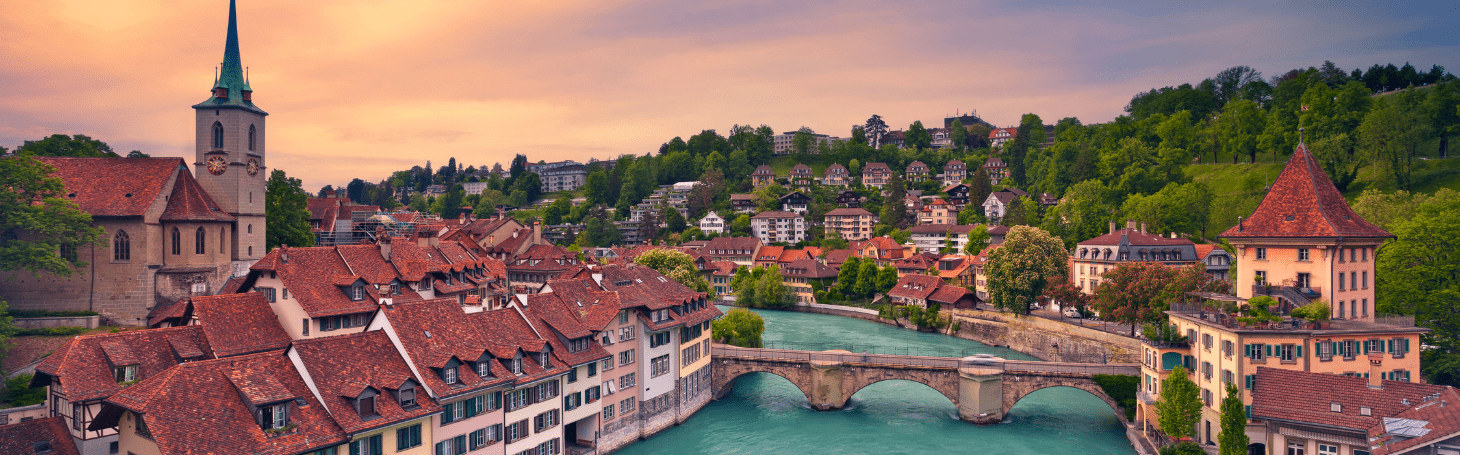
Train to Bern - connections, tickets and itinerary
From Bern Hauptbahnhof station, you can reach the UNESCO-listed Old Town in a few minutes on foot. Polish citizens enter Switzerland with a valid identity card or passport - no visa required. From Warsaw you will get to Bern with transfers in Berlin and Basel, and the journey takes about 12-14 hours. With PolishTrains, you can buy the international ticket to Bern without creating an account and receive it by e-mail and SMS.
Fast facts - Bern by train
-
Destination station: Bern Hauptbahnhof station, Bahnhofplatz 10a, 3011 Bern.
-
Currency: Swiss franc (CHF). Payment cards are widely accepted, but it is advisable to have cash for small purchases and markets.
-
Local transport: trams and buses BERNMOBIL. A single ticket is a few zlotys in conversion, a daily ticket a dozen or so. Check current prices before you go.
-
How much to go for: plan 2 days for the main attractions. If you want to add a trip to the surrounding area, plan 3-4 days.
-
Practical tip: the Lauben arcade stretches through the centre, shielding you from the rain for much of the walk. When planning departures from Wrocław, Warsaw, Katowice or Kraków, PolishTrains shows the route through Berlin and Basel before the final train to Bern.
When to go to Bern
The best choice is April–May or September, when the daytime temperature is 14–20°C, the crowds are moderate and Rosengarten, the Bear Park and the terraces above the Aare are easily accessible.
| Month | Daytime temperature | Weather | Tourist traffic |
| January | 2°C | Frosty, possible snow | Low |
| February | 4°C | Cold, some sunshine | Low |
| March | 9°C | Cool, first warmer days | Low |
| April | 14°C | Mild, variable | Moderate |
| May | 19°C | Warm, plenty of sunshine | Moderate |
| June | 23°C | Warm to hot | High |
| July | 25°C | Hot, afternoon thunderstorms | High |
| August | 24°C | Hot, afternoon thunderstorms | High |
| September | 20°C | Warm, stable | Moderate |
| October | 14°C | Cooler, golden autumn | Low |
| November | 7°C | Cool, foggy | Low |
| December | 3°C | Cold, possible snow | Low |
Spring (March–May)
-
Rosengarten opens in April, and the terrace offers a panoramic view of the Old Town and the peaks of the Alps.
-
In March it is 9°C, in May already 19°C, and the café terraces at the arcades open from mid-April.
-
The crowds are fewer than in summer and accommodation prices are lower.
Summer (June–August)
-
Daytime temperatures are 23–25°C. The people of Bern bathe in the river Aare, which has a clear, mountain character.
-
Tourist traffic is high and accommodation prices rise, especially in July and August.
-
Summer open-air festivals and concerts are held in parks and squares.
Autumn (September–November)
-
September is one of the best months to visit: the daytime temperature is 20°C, the crowds are smaller and accommodation prices drop after the summer holidays.
-
In October, the parks along the Aare and Rosengarten turn golden, making it a very good time for walks.
-
In November it is cooler, but the museums and cafés under the arcades operate as normal.
Winter (December–February)
-
It is 2–4°C during the day and snow appears regularly. In December, the Christmas market on Waisenhausplatz is in full swing.
-
The Einstein Museum and other museums are open throughout the winter.
-
Accommodation prices are among the lowest of the year, so it is easy to plan a winter city break. After arriving at Bern Hauptbahnhof, PolishTrains travellers can walk to the centre or check BERNMOBIL fares for several daily journeys.
Getting to Bern by train
You will arrive in Bern with transfers, usually via Berlin and Basel. The journey time depends on the connection you choose, and upon arrival you will disembark in the city centre.
From Wrocław
-
You travel 11–13 hours via Berlin Hauptbahnhof station and Basel SBB station.
-
In Basel you change trains to Bern.
-
You make both transfers within the same station.
From Warsaw
-
The journey takes 12–14 hours, usually via Berlin Hauptbahnhof station and Basel SBB station.
-
In Berlin you change to a connection to Basel, and in Basel to a train to Bern.
-
The last leg takes you directly to the city centre.
From Katowice
-
From Katowice you travel 12–14 hours via Wrocław, Berlin Hauptbahnhof station and Basel SBB station.
-
The first leg takes you to Wrocław and then you travel via Berlin and Basel to Bern.
-
You make each transfer at the same station.
From Kraków
-
The route from Kraków Główny station takes you via Katowice or Wrocław, and onwards via Berlin Hauptbahnhof station and Basel SBB station.
-
The journey takes 13–15 hours.
-
From Basel to Bern you take a domestic train.
For travellers from Gdańsk, Poznań, Łódź and other cities, the route runs via Warsaw, Wrocław or Katowice to Berlin, and on to Basel and Bern. Seat reservation is compulsory on the international leg. You can buy your ticket on PolishTrains without creating an account — you enter your e-mail address and phone number and the ticket is sent to your e-mail and by SMS. 30 minutes before departure you will receive an SMS reminder with a link to your ticket. The earlier you buy, the better the price and the greater the choice of seats, especially on international sections. With PKP Intercity tickets, refunds are possible up to 20 minutes before departure and exchanges up to 30 minutes before departure. See the refunds and exchanges policy page for details.
Local transport in Bern
You get around Bern on foot and by public transport. The cathedral, Clock Tower, arcades and the Bear's Den are all within walking distance of the centre.
Trams and buses - Bern has a dense public transport network operated by BERNMOBIL. A single ticket is a few zloty in conversion, a daily ticket a dozen or so. For several journeys a day, a day ticket will be more convenient. Check current prices before you go.
City bikes - Bern has a city bike system available seasonally. The riverside paths along the Aare will take you comfortably around the city.
Taxis - taxi ranks can be found at the train station. Prices in Switzerland are considerably higher than in Poland, so for short distances it is better to walk or take a tram.
Accommodation - hotels in the centre, around the train station and the Old Town, are most convenient for a city break. You can find lower-priced accommodation in the Länggasse and Breitenrain districts, from where you can reach the centre in a few minutes by tram.
Luggage - there are luggage storage facilities at Bern Hauptbahnhof station. They come in handy if you arrive before you check in or leave after you check out.
Where to stay overnight:
-
Centre / Old Town - the most convenient location for a city break, hotels near the station and the main attractions.
-
Länggasse and Breitenrain - quieter neighbourhoods with lower accommodation prices, tram to the centre in a few minutes.
What to see in Bern - highlights
Old Town (Altstadt)
UNESCO-listedold town. You can get around the main streets on foot in 2-3 hours. The Lauben Arcade stretches for several kilometres along the main streets, and underneath you will find shops, cafés and restaurants. Entrance is free.
Bern Cathedral (Berner Münster)
Gothic, built from 1421 onwards. There is a fee to enter the tower and it gives you a panoramic view of the rooftops of the Old Town, the river Aare and - in good visibility - the peaks of the Alps. A tour of the cathedral with tower climbing takes 45-60 minutes.
Einstein Museum (Historisches Museum Bern)
Albert Einstein lived in Bern from 1903 to 1905 and developed the special theory of relativity here. The exhibition on his life and work is interactive. There is an entrance fee. The tour takes 60-90 minutes.
The Bear Caves (Bärenpark)
A park on the river Aare with live bears, a symbol of Bern. The bears have a spacious enclosure with a slope going down to the river. Entrance is free of charge.
Bundeshaus (Swiss Parliament)
An impressive building on the escarpment above the Aare. Tours are free at designated times, so check the current schedule before visiting. The square in front of the parliament turns into a fountain in summer and an ice rink in winter.
Clock Tower (Zytglogge)
A medieval tower with a mechanical astronomical clock. A demonstration of the mechanism takes place every hour. Guided tours of the interior are charged and take about 60 minutes.
Rosengarten
Rose garden on a hill overlooking the Old Town and the Alps. Entrance is free of charge. The garden runs from April to October, and looks at its prettiest in May and June when the roses are in bloom.
Plan for day 1
See the Old Town and the Clock Tower in the morning, enter Bern Cathedral at noon, visit the Einstein Museum in the afternoon and walk to the Bear's Den and Rosengarten in the evening for sunset.
Plan for the weekend
Day 1: Arrange the same as the 1-day plan.
Day 2: See the Bundeshaus, walk along the Aare to the Matte district and, if you have enough time, take the train to Thun or Interlaken.
Eating and shopping in Bern
What to eat
Berner Platte - a traditional Bernese dish of various meats and cold cuts served with sauerkraut and beans. Portions are large and filling. You'll find the dish in the restaurants of the Old Town, especially along the main arcades.
Rösti - a Swiss classic of grated potatoes, fried until golden. It is served as an accompaniment to meat or as a stand-alone dish with cheese and egg. You can order it in most restaurants.
Fondue and raclette - dishes that taste best in autumn and winter. Restaurants at the Old Town arcade specialise in both versions of cheese. Fondue is served in a pot with melted cheese and pieces of bread, while raclette is put on top of potatoes.
Swiss chocolate - the chocolate shops on Kramgasse and Gerechtigkeitsgasse offer local and all-Swiss brands. This is one of the most practical souvenirs from Bern.
Where to eat:
-
The market in and around Bundesplatz - a market with local products: cheeses, cold cuts, vegetables and bread. It operates several times a week, so check the current schedule before visiting. It's a good option for a meal in an expensive city.
-
The Länggasse district - a quieter part of town with establishments for locals. The atmosphere is less touristy and prices are lower than in the Old Town. The proximity to the university translates into a large selection of cafés and bars.
Souvenirs
-
Bear figurines - the symbol of Bern, available in various sizes and versions.
-
Watches - a wide selection in shops on the main streets of the old town.
-
Chocolate - local and all-Swiss brands available in shops on Kramgasse and Gerechtigkeitsgasse.
-
Local jams and cheeses - available at the Bundesplatz market, easy to take home.
How much does Bern cost? Indicative costs
Bern is one of Europe's more expensive cities, and prices for accommodation and food are noticeably higher than in Poland and in many Western European countries. Amounts in PLN are indicative and depend on the season and the Swiss franc exchange rate.
| Category | Budget | Medium | Comfort |
| Accommodation (1 night) | 150–250 PLN | 350–550 PLN | 700–1200 PLN |
| Food (2 days) | 160–240 PLN | 300–440 PLN | 560–800 PLN |
| Local transport (2 days) | 30–50 PLN | 30–50 PLN | 100–160 PLN |
| Attractions (2 days) | 0–40 PLN | 80–140 PLN | 160–240 PLN |
| Total (2 days / 1 night) | 340–580 PLN | 760–1180 PLN | 1520–2400 PLN |
The budget option involves staying in a hostel or hotel outside the centre, eating in bars and at the market, and visiting mainly free attractions such as the Old Town, the Bear Park and Rosengarten.
The medium option includes a three-star hotel in or near the centre, restaurants at the arcades and 1–2 paid attractions per day, for example the Einstein Museum and the tower of Bern Cathedral.
The comfort option includes a four-star hotel in the Old Town, restaurants with traditional Bernese cuisine, taxis and all paid attractions.
Check current admission prices and the Swiss franc exchange rate before you go, as price lists change during the season.
Frequently asked questions
Check out where else you can go by train in Europe
Czech Republic
BrnoOstravaPragueOlomoucNetherlands
RotterdamAmsterdamFrance
LilleToulouseBordeauxNiceDijonLyonParisMarseilleParisAvignonSwitzerland
Château-d'OexLucerneSt. MoritzZurichLuganoBrocMontreuxInterlakenSankt GallenGenevaBernBellinzonaBaselAustria
InnsbruckVienna