

Poland
GdyniaLublinSzczecinPrzemyślGdańskPoznanSopotTorunŁódźKatowicePiwnicza-ZdrójChałupyKolobrzegOlsztynKrakowWrocławHelNowy TargKłodzkoJurataWładysławowoWalbrzychRzeszówKielceBialystokZakopaneWarsaw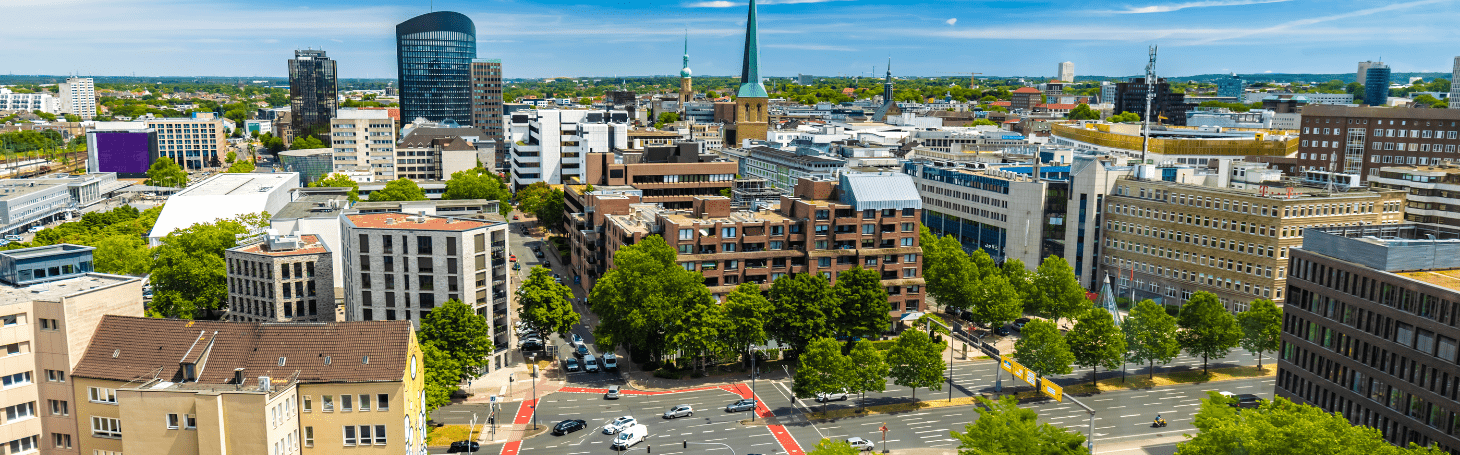
Train to Dortmund - connections, tickets and itinerary
A weekend of 2-3 days is enough to see Dortmunder U, Westfalenpark and the city centre. Dortmund combines the industrial heritage of the Ruhr district with green parks and the Borussia Dortmund stadium. All you need for the trip is a valid identity card.
Fast facts - Dortmund by train
-
Destination station: Dortmund Hauptbahnhof station, Königswall 15, 44137 Dortmund.
-
Best time to go: spring (April–May) and early autumn (September) – smaller crowds, daytime temperatures of 14–20°C, and accommodation prices lower than in summer.
-
Local transport: you get around the centre on foot or by public transport. A single ticket costs a few zloty and a day ticket a dozen or so.
-
Currency: in Germany you pay in euros (EUR).
-
Practical tip: Dortmund is a good base for exploring other cities in the Ruhr area – Essen, Bochum and Duisburg are all just a few minutes away by train.
When to go to Dortmund
Spring or early autumn is the best choice, as daytime temperatures are 14–20°C and accommodation prices are lower than in high season.
| Month | Daytime temperature | Weather | Tourist traffic |
| January | 3°C | Cold, possible snowfall | Low |
| February | 4°C | Cold, often cloudy | Low |
| March | 8°C | Cool, first warmer days | Low |
| April | 13°C | Mild, variable precipitation | Moderate |
| May | 18°C | Warm, plenty of sunshine | Moderate |
| June | 21°C | Warm, occasional thunderstorms | High |
| July | 23°C | Warmest month, sunny | High |
| August | 23°C | Warm, possible heatwaves | High |
| September | 19°C | Mild, days getting shorter | Moderate |
| October | 13°C | Cooler, golden autumn | Low |
| November | 7°C | Cool, frequent rain | Low |
| December | 4°C | Cold, Christmas markets | Low |
Spring (March–May)
-
In May, Westfalenpark is in full bloom and open to visitors – it's 18°C during the day, making it ideal for long walks.
-
The Mayday electronic music festival takes place at the end of April and beginning of May – check the dates before buying tickets, as hotels fill up quickly.
-
Accommodation prices are lower than at the summer peak.
Summer (June–August)
-
In July and August, daytime temperatures reach 23°C – a great time for strolling through the post-industrial parks and exploring outdoors.
-
The city hosts numerous outdoor events and trade fairs.
-
Tourist traffic is heavy on Borussia match weekends, so book your accommodation early.
Autumn (September–November)
-
In September, daytime temperatures are 19°C and accommodation prices are lower than in summer.
-
In January/February, the Jagd und Hund hunting fair takes place – if this doesn't interest you, check the dates before booking, as hotels can fill up.
-
In October, Westfalenpark looks particularly beautiful in the warm colours of autumn foliage.
Winter (December–February)
-
Christmas markets operate in the centre in December – it's around 4°C during the day, so dress warmly.
-
Accommodation prices are then the lowest of the year and tourist traffic remains low.
-
Museums and galleries operate normally – the Museum of Culture and Art and the Dortmunder U are excellent choices on colder days.
Getting to Dortmund by train
You will get to Dortmund from Poland with one change, usually in Berlin or Hannover.
From Poznań
-
From Poznań Główny station you travel about 7-8 hours with a change of trains in Berlin or Hannover.
-
You change trains once, usually at the same station.
-
Reserving a seat is compulsory on the foreign section.
-
Leaving in the morning, you arrive in Dortmund in the afternoon.
From Wrocław
-
You change trains in Berlin or Dresden, and the whole journey from Wrocław Główny station takes about 7-8 hours.
-
You change trains once on the route.
-
Reservation of a seat is compulsory on the foreign section.
-
You arrive at Dortmund Hauptbahnhof station in the city centre.
From Warsaw
-
On the route from Warsaw Central Station, you travel about 10-11 hours with one change of trains - usually in Berlin or Hannover.
-
You first arrive at Berlin Hauptbahnhof station and then change to an ICE or IC train to Dortmund.
-
You change trains once, usually at the same station.
-
Reserving a seat is compulsory on the foreign section.
-
You can leave in the morning and arrive in the evening. An overnight option is also available, so that you get off in the morning.
From Krakow
-
From Krakow you travel to Dortmund in about 11-12 hours with one or two changes - via Warsaw or Wroclaw and then Berlin.
-
Leaving in the morning, you arrive in Dortmund in the evening. An overnight option is also available, so that you disembark in the morning.
-
Reservation of a seat is compulsory on the foreign leg.
From Gdansk, Katowice and Lodz you will travel to Dortmund with a change in Warsaw or Wroclaw - the journey takes about 11-13 hours. You buy your tickets on PolishTrains without registration - your ticket goes to your email and SMS, and 30 minutes before departure you receive a reminder with a link to your ticket. Reserving a seat is compulsory on a foreign leg. The earlier you buy, the better the price and the greater the choice of seats. You can return your PKP Intercity ticket up to 20 minutes before departure or exchange it up to 30 minutes before departure - see our Return and Exchange Policy page for details.
Getting around Dortmund
You get around Dortmund mainly on foot and by public transport. The Dortmunder U, the Old Synagogue and the Museum of Culture and Art are all within a few minutes' walk of the station.
Public transport includes the U-Bahn metro, trams and buses. A single ticket costs a few zloty and a day ticket a dozen or so. For several journeys a day, a day ticket is the better choice. Tickets can be bought from vending machines at stops and stations.
Taxis and ride-hailing apps are available at the station. They come in handy in the evening or when you have heavy luggage. For short distances, the price difference compared with public transport is not large.
City bikes are available in Dortmund. On sunny days, this is a good option for exploring the parks and post-industrial areas that lie further from the city centre.
Hotels close to Dortmund Hauptbahnhof give good access to transport and the centre. A night in a three-star hotel costs roughly between a few dozen and over a hundred zloty per night, depending on the season and whether a Borussia match or trade fair is taking place.
Where to stay:
-
The area around Dortmund Hauptbahnhof – good access to transport and the centre, a convenient starting point for sightseeing.
-
Kreuzviertel district – a less touristy part of the city, popular with locals, with neighbourhood restaurants and a great atmosphere.
What to see in Dortmund - highlights
For a weekend, it is best to plan around Dortmunder U, Westfalenpark and the German Football Museum, then round out the itinerary with the city centre and Borussia Dortmund's stadium.
Dortmunder U
The former Union brewery converted into a cultural and arts centre. On the roof is a viewing terrace with a panoramic view of the city – entry to the terrace is free, while the galleries inside are ticketed. A visit takes 45–90 minutes. The distinctive letter 'U' at the top of the building is one of Dortmund's symbols.
Westfalenpark
One of the largest city parks in Germany, established on former industrial land. Inside stands the Florian TV tower with an observation deck overlooking the entire Ruhr area. Entry to the park is ticketed. A walk through the park takes 1.5–2 hours – it is worth allowing more time if you want to climb the tower.
German Football Museum (Deutsches Fußballmuseum)
An interactive exhibition on the history of football in Germany, from the earliest championships to the present day. There is an entrance fee. A visit takes 1.5–2 hours. Buy your ticket in advance during peak season, as the museum can be very busy on match weekends.
Museum of Culture and Art (Museum für Kunst und Kulturgeschichte)
Collections spanning the Middle Ages to the 20th century, including paintings, decorative arts and regional history. There is an entrance fee. A visit takes 1–2 hours.
Old Synagogue (Alte Synagoge)
One of the largest surviving synagogues in Germany, today a place of remembrance and education. Entry is free of charge. A visit takes 30–45 minutes.
Signal Iduna Park
Borussia Dortmund's stadium, one of the largest in Europe, with its legendary south stand. Stadium tours are available on non-match days – entry is ticketed. If you are visiting on a match weekend, check the schedule in advance, as tickets for matches and tours sell out quickly.
Plan for 1 day
Start the morning at Dortmunder U and the viewing terrace – from the top you can see the layout of the city and plan the rest of your walk more easily. Before noon, head to the German Football Museum, which is a few minutes' walk from the station. In the afternoon, stroll around the centre and visit the Old Synagogue. In the evening, head to the Kreuzviertel district, where you will find local restaurants and bars with far fewer tourists.
Plan for the weekend (2 days)
Day 1: Start the morning at Dortmunder U and the viewing terrace. Before noon, head to the German Football Museum. In the afternoon, stroll around the centre and visit the Old Synagogue. In the evening, go to the Kreuzviertel district.
Day 2: In the morning, head to Westfalenpark – walking through the park and climbing the Florian Tower will take 2–3 hours. In the afternoon, visit the Museum of Culture and Art. If you have time left, take the train to Essen or Bochum – you'll get there in just a few minutes and see a different side of the Ruhr area.
Eating and shopping in Dortmund
In Dortmund, you will taste local dishes originating from the region and shop close to the centre.
Pfefferpotthast - beef stew with pepper and capers, a dish that originates directly from Dortmund. You'll find it in traditional restaurants in the centre. It is served with bread or potatoes.
Dortmunder Export - a local beer style, lighter and less bitter than pilsner. It is worth trying it in one of the breweries or pubs in the centre. Dortmund has a long brewing tradition - in the 19th century it was one of the largest brewing centres in Europe.
Where to eat:
-
The Kreuzviertel district - local restaurants, cafes and bars. This is a less touristy part of the city, popular with locals. Here you'll find both German and international cuisine - from Vietnamese to Italian.
-
Wochenmarkt at Hansaplatz - fresh regional produce, cheeses, cold cuts and baked goods. The market operates several times a week, so check opening times before visiting.
Shopping before you return: the Thier-Galerie shopping centre is close to Dortmund Hauptbahnhof station. It is a convenient place to do some shopping just before your return train.
Souvenirs
- Borussia Dortmund goodies - buy them in the official shop next to the stadium and in the city centre. A yellow and black scarf or mug is a popular souvenir - not just for fans.
How much does Dortmund cost? Indicative costs
A weekend in Dortmund without a train ticket costs between PLN 210 and 360 in the budget version. On Borussia match weekends and during trade fairs, accommodation costs more.
| Category | Budget | Mid-range | Comfort |
| Accommodation (1 night) | PLN 80–120 | PLN 150–250 | PLN 300–500 |
| Food (per day) | PLN 60–90 | PLN 120–180 | PLN 200–300 |
| Local transport (per day) | PLN 5–10 | PLN 10–20 | PLN 40–80 |
| Attractions (per day) | PLN 0–20 | PLN 30–60 | PLN 60–120 |
| Total | PLN 210–360 | PLN 470–770 | PLN 900–1500 |
The amounts do not include the train ticket. The currency in Germany is the euro (EUR). Card payments are accepted almost everywhere, but cash comes in handy at markets and in small establishments.
Frequently asked questions
Check out where else you can go by train in Europe
Czech Republic
BrnoOstravaPragueOlomoucNetherlands
RotterdamAmsterdamFrance
LilleToulouseBordeauxNiceDijonLyonParisMarseilleParisAvignonSwitzerland
Château-d'OexLucerneSt. MoritzZurichLuganoBrocMontreuxInterlakenSankt GallenGenevaBernBellinzonaBaselAustria
InnsbruckVienna