




Poland
GdyniaLublinSzczecinPrzemyślGdańskPoznanSopotTorunŁódźKatowicePiwnicza-ZdrójChałupyKolobrzegOlsztynKrakowWrocławHelNowy TargKłodzkoJurataWładysławowoWalbrzychRzeszówKielceBialystokZakopaneWarsaw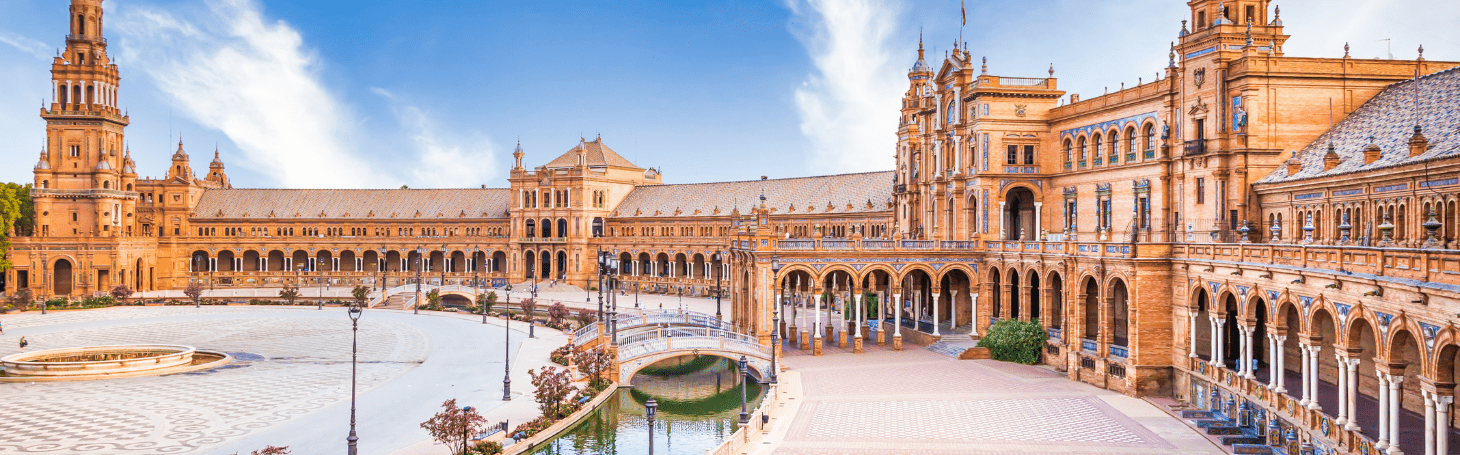
Train to Seville - connections, tickets and itinerary
Sevilla Santa Justa station on Avda. Kansas City has been in operation since 1992 and serves high-speed trains to the capital of Andalusia - one of Europe's most important flamenco cities. From Poland, you travel to Seville with transfers via Germany and France to Madrid, and then on to southern Spain. For this long journey, PolishTrains lets you book rail sections through Germany, France and Spain before planning your onward connections.
Fast facts - Seville by train
-
Distance to the centre: the historic centre, Barrio Santa Cruz, the cathedral and the Alcázar are about 1.5 km from the station - get there by tram in a few minutes or walk in about 20 minutes.
-
Documents: an identity card will suffice, as Spain is part of the Schengen area.
-
Best time to go: April-May and October. In spring the oranges bloom and the main festivals take place, and in October it is warmer than autumn in Poland and easier to visit without the heat.
-
How much to go for: a weekend (Friday evening - Sunday) is enough for the cathedral, the Alcázar and the Spanish Square. With 3 days you will also see the Triana and go to a flamenco performance.
-
Practical tip: buy your Alcázar and cathedral tickets in advance online - the queues at the ticket offices are long, especially in spring. With PolishTrains, you can purchase the complete route or selected sections without an account, receiving tickets by email and SMS for the journey.
When to go to Seville
The best choice is April-May or October - daytime temperatures are then 23-28°C and it is easier to sightsee without extreme heat.
| Month | Daytime temperature | Weather | Tourist traffic |
| January | 16°C | Cool, rainy | Low |
| February | 18°C | Cool, variable precipitation | Low |
| March | 18°C | Warmer, peak precipitation | Moderate |
| April | 23°C | Warm, sunny | High |
| May | 28°C | Hot, dry | High |
| June | 36°C | Hot, cloudless | Moderate |
| July | 36°C | Intense heat | Low |
| August | 37°C | Intense heat | Low |
| September | 33°C | Hot, dry | Moderate |
| October | 28°C | Warm, pleasant | Low |
| November | 19°C | Cooler, rainy | Low |
| December | 15°C | Cool, rainy | Low |
Spring (March to May)
-
It rains most often in March and the streets smell of orange blossom, so an umbrella comes in handy.
-
In April, Semana Santa and Feria de Abril take place - processions, flamenco, carriages and dancing attract crowds.
-
During both festivals, hotel prices rise 2-3 times, so accommodation is best booked several months in advance.
-
In May, the weather is more stable than in April and the crowds are sometimes smaller.
Summer (June-August)
-
Temperatures regularly exceed 40°C, so sightseeing between midday and late afternoon can be tiring.
-
Some restaurants and local bars close in August for the holidays.
-
Accommodation prices drop by 30-50% compared to spring.
Autumn (September-November)
-
It is still hot in September, with a marked improvement only coming towards the end of the month.
-
October is a very good time for a city break - daytime temperatures are 15-28°C, crowds are fewer and accommodation prices are lower than in spring.
-
In November, evenings are cooler and it rains more often, so it is worth taking a rain jacket.
Winter (December-February)
-
Daytime temperatures are 15-18°C and nighttime temperatures drop to 6°C, so a warmer jacket is useful.
-
In December, the Barrio Santa Cruz is lit up with illuminations and Christmas markets.
-
There are fewer cultural events in winter, but accommodation prices are among the lowest of the year. Using PolishTrains, check the Madrid–Seville section separately when your European itinerary requires a transfer before reaching Andalusia.
Getting to Seville by train
You will arrive in Seville with transfers via Germany, France and Spain, and finally disembark at Sevilla Santa Justa station close to the city centre.
From Madrid to Seville
-
From Madrid Puerta de Atocha station to Sevilla Santa Justa station, you travel about 2.5 hours by high-speed train.
-
The route takes you through Córdoba.
-
You'll find several connections throughout the day, so it's easy to match your departure time with your onward journey.
From Barcelona to Seville
-
From Barcelona Sants station to Sevilla Santa Justa station you take about 5.5 hours on a high-speed train.
-
On the way, you will pass through Córdoba or Madrid.
-
Depending on the day, you will either buy a direct fare or a variant with a change in Madrid.
From Warsaw to Seville
-
From Warsaw Central Station, you travel with a transfer via Berlin, Paris or Strasbourg and then via Madrid to Seville.
-
The entire journey takes an indicative 36-38 hours.
-
You can divide the route into two days with an overnight stop along the way, for example in Paris or Madrid.
-
Overnight connections are also available on the European section.
-
Booking a seat is compulsory on the foreign section.
You can buy tickets for the entire route or individual sections on PolishTrains without creating an account - you receive your ticket by email and SMS, and 30 minutes before departure an SMS reminder arrives with a link to your ticket. The earlier you buy, the greater the choice of seats. For PKP Intercity tickets, refunds are possible up to 20 minutes before departure and exchanges up to 30 minutes before departure - see the refund and exchange policy page for details.
Transport on site in Seville
From Sevilla Santa Justa station you can get to the historic centre by tram, taxi or on foot.
| Mode of transport | Time | Approximate cost |
| MetroCentro tram | A few minutes | A few euros |
| On foot | About 20 minutes | Free |
| Taxi / Uber | A few minutes | A few dozen euros |
The MetroCentro tram runs through the historic centre. You buy your tickets at the ticket machine at the stop, not on the tram.
TUSSAM buses cover the entire city - a single ticket costs a few euros. For several journeys a day, a daily ticket will be more convenient.
The Metro de Sevilla has its own tickets and is useful for longer journeys outside the centre.
The Cathedral, Alcázar, Plaza de España and the Metropol Parasol are all within a 2 km radius of the station. You get around the centre mainly on foot. Along the Guadalquivir River and to Plaza de España you can also get around comfortably by city bike - Seville has an extensive network of cycle routes.
Where to stay:
-
Barrio Santa Cruz - close to the main sights, with narrow streets and white stonework. Accommodation is most expensive here, but you save time on transfers.
-
Triana - local bars, ceramics and flamenco performances. Across the bridge from here you can reach the centre in a matter of minutes.
-
Alameda - a younger neighbourhood with lower prices than Santa Cruz. You'll find lots of bars and restaurants here, and you can walk to the Metropol Parasol in a few minutes.
What to see in Seville - highlights
Cathedral of the Blessed Virgin Mary (Catedral de Santa María de la Sede)
This is one of the largest Gothic cathedrals in the world, built in the 15th century on the site of a former mosque. Inside is the tomb of Christopher Columbus. The tour takes about an hour. There is an entrance fee - buy your ticket online in advance, as the queue at the ticket offices can stretch for several tens of minutes in spring.
La Giralda
You ascend to the top of the 104.5m high 12th century minaret via a ramp instead of stairs. Entry is included in the price of your cathedral ticket. From the top you will see the rooftops of Seville, the Guadalquivir River and the surrounding mountains. It takes about 30 minutes to climb the tower and descend.
Real Alcázar
In this complex of palaces and gardens you will see mudéjar style, azulejos, courtyards with fountains and peacocks walking through the gardens. The tour takes about 2 hours. There is an entrance fee. You will meet the fewest people here just after opening or in the late afternoon.
Plaza de España
This semi-elliptical square from 1929 is surrounded by 48 ceramic niches dedicated to the provinces of Spain. Each shows a different map, coat of arms and historical scene. Admission is free. It takes about 1.5 hours to walk around and see the details. You'll hit the prettiest light here before sunset.
Metropol Parasol (Las Setas)
This is a modern wooden structure in the Plaza de la Encarnación that resembles giant mushrooms. There is a rooftop terrace with panoramic views of the city. There is a fee to enter the terrace. The tour takes about an hour and you get the best view at sunset.
Barrio Santa Cruz
In the former Jewish quarter you walk between narrow streets, white houses and walls decorated with azulejos. Admission is free. The walk takes about two hours. In the evening, tapas bars open and you can hear flamenco music.
Archivo de Indias
In this archive you will see documents of the Spanish empire from the Americas - maps, lists of conquistadors and trade records. Admission is free. The building stands right next to the cathedral and the Alcázar, so it's easy to combine these places into one tour. The tour takes about an hour. The archive is closed on Mondays.
Plan for day 1
Morning: cathedral with Giralda - the tour takes 1.5 hours, and getting in at opening time helps you avoid the queues. Before noon: Real Alcázar - allow 2 hours for the tour. Afternoon: stroll around Barrio Santa Cruz with a tapas break - allocate 1.5-2 hours. Evening: Plaza de España at sunset, followed by a flamenco performance in Triana.
Plan for the weekend
Day 1: You can structure your first day in the same way as your day 1 plan.
Day 2: In the morning, climb the Metropol Parasol terrace, then cross the bridge to Triana - see the ceramics workshops, have lunch at the Mercado de Triana and walk along Calle Betis by the Guadalquivir River. In the evening, return to the Torre del Oro area and sit in one of the waterside bars.
Eating and shopping in Seville
What to eat
Salmorejo - a thick tomato cream served cold, with a hard-boiled egg and Serrano ham. You can find it in practically every tapas bar.
Espinacas con Garbanzos - spinach with chickpeas, a traditional Andalusian dish. A good choice if you are eating without meat.
Rabo de Toro - braised bull's tail, one of Seville's classic dishes. The meat falls apart after hours of slow cooking. Carrillada de Cerdo, or pork cheeks, is prepared in a similar style.
Serranito - a sandwich with grilled chicken, green pepper, tomato and Serrano ham. You'll often order it in bars as a quick and filling snack.
Churros with chocolate - a traditional breakfast or evening snack. Bar El Comercio has been in operation for over 100 years and is popular with locals.
Where to eat:
-
El Rinconcillo (Calle Gerona) - a bar that has been in operation since 1670. The barmen write their bills in chalk on the wooden bar. You'll order classics of Andalusian cuisine here, including salmorejo, jamón ibérico and croquetas.
-
Antigua Abacería de San Lorenzo (Calle Teodosio 53) - a small bar-shop popular with locals. You can order ham sliced at the bar, manchego cheeses and local wines.
Souvenirs
-
Ceramics from Triana - hand-painted azulejos and pottery have been made here since the 13th century. The shops Cerámica Santa Ana and Cerámicas Sevilla 1952 have workshops open to visitors.
-
Mercado de Triana - a market with local products such as olives, cheeses and cured meats. You can also buy jamón ibérico here.
-
Ribera del Duero wines and sherry from Jerez de la Frontera - you'll find them in wine shops in the centre and at the Mercado de Triana.
How much does Seville cost? Indicative costs
| Category | Budget | Mid-range | Comfort |
| Accommodation (1 night) | 130-160 PLN | 400-465 PLN | 840-1000 PLN |
| Food (3 meals) | 80-100 PLN | 250-300 PLN | 600-800 PLN |
| Local transport | 20-25 PLN | 40-50 PLN | 100-150 PLN |
| Attractions | 30-50 PLN | 60-80 PLN | 200-350 PLN |
| Total | 260-335 PLN | 750-895 PLN | 1740-2300 PLN |
The budget option includes accommodation in a hostel, tapas in bars and at the market, and visits to free attractions with one paid entry. The mid-range option includes a three-star hotel and a combination of restaurants and tapas bars. The comfort option includes a five-star hotel, high-end restaurants and attractions with a private guide.
During Semana Santa and Feria de Abril, accommodation prices increase 2-3 times. In July and August they drop by 30-50%, but temperatures in excess of 40°C make sightseeing difficult.
There is an entrance fee for the Cathedral with the Giralda and the Alcázar. Plaza de España, Barrio Santa Cruz and the Archivo de Indias are free to visit.
Frequently asked questions
Check out where else you can go by train in Europe
Czech Republic
BrnoOstravaPragueOlomoucNetherlands
RotterdamAmsterdamFrance
LilleToulouseBordeauxNiceDijonLyonParisMarseilleParisAvignonSwitzerland
Château-d'OexLucerneSt. MoritzZurichLuganoBrocMontreuxInterlakenSankt GallenGenevaBernBellinzonaBaselAustria
InnsbruckVienna