

Poland
GdyniaLublinSzczecinPrzemyślGdańskPoznanSopotTorunŁódźKatowicePiwnicza-ZdrójChałupyKolobrzegOlsztynKrakowWrocławHelNowy TargKłodzkoJurataWładysławowoWalbrzychRzeszówKielceBialystokZakopaneWarsaw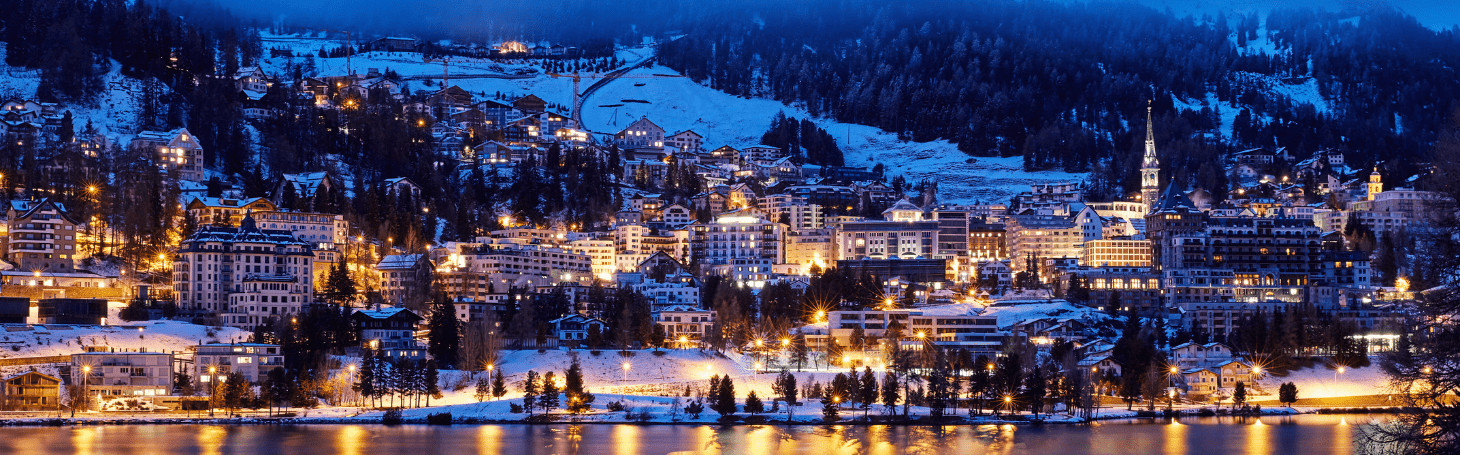
Train to St. Moritz - connections, tickets and itinerary
St. Moritz train station is located in the centre of the resort, at 1,800 metres above sea level. As soon as you step off the train, you immediately see the Alpine Engadine Valley. For planning this Alpine journey, PolishTrains helps you compare rail connections and arrange tickets before departure, including changes in Zürich and Chur.
Fast facts - St. Moritz by train
-
Documents: Switzerland is part of the Schengen area. A valid identity card is sufficient.
-
Currency: Swiss franc (CHF). Payment cards are accepted almost everywhere.
-
Best time to go: in winter, from December to March, you choose St Moritz for skiing and ice sports. In summer, from July to August, you go here for hiking and water sports on the lake.
-
How much to go for: a weekend (3-4 days) is enough for the main attractions and a day on the slopes or trail. A week allows you to add a ride on the Bernina Express or Glacier Express route.
-
Practical tip: St Moritz is a premium resort. Accommodation and restaurant prices are noticeably higher than in other Swiss towns. Book your accommodation in advance, especially during the ski season from January to March. Use PolishTrains to check routes through Zürich and Chur, matching the international connection with the RhB train to St. Moritz.
When to go to St. Moritz
The best choice is winter, from January to March, or summer, from July to August, when it is easiest to combine a stay with skiing, hiking and time at the lake.
| Month | Daytime temperature | Weather | Tourist traffic |
| January | -5 to 0°C | Sunny and frosty | High |
| February | -4 to 2°C | Sunny | High |
| March | -2 to 5°C | Sunny | Moderate |
| April | 2 to 9°C | Variable | Low |
| May | 6 to 14°C | Spring | Low |
| June | 10 to 18°C | Warm | Moderate |
| July | 13 to 22°C | Warm and sunny | High |
| August | 13 to 21°C | Warm | High |
| September | 9 to 17°C | Stable | Moderate |
| October | 4 to 11°C | Variable | Low |
| November | -1 to 5°C | Cloudy | Low |
| December | -4 to 1°C | Snowy | Moderate |
Winter (December to March)
-
In February, the White Turf horse race — one of the most spectacular sporting events in the Alps — takes place on the frozen lake.
-
The Cresta Run, the oldest natural ice track in the world dating back to 1884, is only open in winter. You can watch the runs from designated viewing points.
-
January and February are the peak ski season — tourist traffic is at its highest and accommodation prices are at their highest. In March there are fewer visitors, but snow conditions are still good.
Spring (April to May)
-
Tourist traffic is low and accommodation prices drop.
-
The slopes are already closed, but from May some hiking trails are accessible again.
-
During the transitional period, some restaurants and lifts are not operating, so check what is open before you go.
Summer (June–August)
-
Windsurfing and sailing competitions are held on Lake St. Moritz. July and August are the peak summer season.
-
The gondola lifts to Piz Nair and Piz Corvatsch also operate in summer. From these points you can set off on trails with panoramic views of the Rhaetian Alps.
-
Accommodation prices at the height of summer are comparable to the winter season.
Autumn (September–October)
-
In September there is less tourist traffic and the weather is stable, making it a good time for hiking.
-
Some lifts and restaurants are closed as the resort prepares for winter.
-
The larch trees in the Engadine turn golden and orange in autumn — one of the most beautiful sights in the Alps. With PolishTrains, buy without registration and receive the ticket by email and a departure link by SMS shortly before travel.
Getting to St. Moritz by train
You will travel from Poland to St. Moritz with transfers in Zurich and Chur. For the final leg, you take the RhB railway via the UNESCO-listed Albula route.
From Wrocław to St. Moritz
-
From Wrocław Główny station you travel 11–12 hours with changes in Zürich and Chur.
-
You first reach Zürich HB station, then change to a train to Chur and then to the RhB railway to St. Moritz.
-
The Chur–St. Moritz section takes 2 hours and passes through tunnels, viaducts and alpine panoramas.
From Warsaw to St. Moritz
-
From Warsaw Central station you travel 11–12 hours with two changes: at Zürich HB and at Chur.
-
In both Zürich and Chur you change trains at the same station.
-
From Chur to St. Moritz you take the RhB train via the Albula Pass.
From Kraków to St. Moritz
-
From Kraków Główny station you travel 12–13 hours. Depending on the day, you choose the route via Vienna or via Zurich and then Chur.
-
The Chur–St. Moritz section takes 2 hours by RhB train.
-
In St. Moritz, you alight at the station in the centre of the resort.
From Poznań, Gdańsk, Katowice and Łódź you can reach St. Moritz with changes in Zurich and Chur. Journey time is 11–14 hours depending on your starting city.
Seat reservations are compulsory on the international section. On RhB trains and on PKP Intercity and POLREGIO sections, skis and snowboards are treated as hand luggage. Carriage is free of charge if the equipment is stored in a bag.
Panoramic trains also run through St. Moritz on routes to Tirano and Zermatt. On both routes seat reservations are compulsory.
You can buy your ticket on PolishTrains without registration — it is sent to your email and by SMS. Shortly before departure you will receive an SMS with a link to your ticket. The earlier you buy, the greater the choice of seats. The rules for refunds and exchanges depend on the carrier; details can be found in the refund and exchange policy. On PKP Intercity routes, you can request a refund up to 20 minutes before departure and an exchange up to 30 minutes before departure.
Transport on site in St. Moritz
You get around St. Moritz on foot and by local transport. You can reach the main hotels, the lake, the Segantini Museum and Via Maistra from the station within a few minutes.
The ski slopes — Corviglia, Corvatsch and Diavolezza — can be reached by regional buses or ski buses running during the winter season. Check current timetables on site or in the local ticket app.
A single local transport journey costs just a few zlotys. If you plan several journeys a day, a day ticket will be more convenient.
Taxis are available at the train station, but prices in St. Moritz are noticeably higher than in other Swiss towns. If you are travelling to a hotel with heavy luggage, ask about a hotel transfer when you book.
During the summer season, some visitors use bicycles. Hire shops operate at the station and in the centre, and you can cycle to nearby villages such as Pontresina, Celerina and Silvaplana.
Where to stay:
-
Pontresina - a village near St. Moritz, popular with visitors looking for cheaper accommodation with good bus connections to the centre.
-
Celerina - a quiet village just next to St. Moritz, with lower accommodation prices and direct access to the Corviglia slopes.
-
Silvaplana - a village on Lake Silvaplana, close to the cable car to Piz Corvatsch, a good base for windsurfers and skiers.
-
St. Moritz centre - accommodation in the heart of the resort, close to Via Maistra and the lake, in the higher price range.
What to see in St. Moritz - main attractions
Segantini Museum
A museum dedicated to the painter Giovanni Segantini. Here you will find works by the artist from different periods of his career, including the monumental Alpine Triptych. The visit takes 45–60 minutes. Entry is charged.
Cresta Run
The oldest natural ice track in the world, built in 1884. It is only open in winter. Competitors slide headfirst on special sleds at speeds of over 100 km/h. You can watch the runs from designated points along the track, and admission for spectators is free.
Lake St. Moritz
In summer it hosts windsurfing and sailing competitions; in winter the surface freezes and becomes the White Turf horse racing track. A walk around the lake takes about an hour. The lakeside promenade is a great spot for a morning stroll or an evening unwind after a day on the slopes.
Piz Nair (3,057 m above sea level)
A peak accessible by gondola lift from the centre of St. Moritz. From the top you can enjoy a panoramic view of the Rhaetian Alps and the Engadine valley. In summer you can set off on hiking trails from here; in winter you have access to the Corviglia ski area. The gondola lift is charged.
Piz Corvatsch (3,303 m above sea level)
One of the highest ski resorts in Switzerland. You can reach the cable car at Silvaplana by bus from St. Moritz. The site operates in both winter and summer. From the viewing terrace you can see the glacier and peaks exceeding 4,000 metres above sea level.
Piz Bernina (4,049 m above sea level)
The highest peak in the Eastern Alps, visible from many points in the area. The ascent is for experienced mountaineers with a guide. If you do not climb at altitude, take the cable car up to Diavolezza, from where you can see Piz Bernina up close.
Julier Pass
A historic alpine pass connecting the Engadine valley with the rest of the Grisons (Graubünden). In summer it is a popular cycling route. You can reach the pass by bus from St. Moritz.
1-day plan
In the morning, take the gondola lift to Piz Nair and take in the panorama of the Rhaetian Alps and the Engadine valley. At midday, walk to Lake St. Moritz for a stroll along the promenade and lunch at one of the bistros. In the afternoon, visit the Segantini Museum. In the evening, choose a restaurant for dinner on Via Maistra.
Weekend plan (3–4 days)
You can arrange the first day in the same way as the 1-day plan — Piz Nair, the lake and the Segantini Museum.
Day 2: Dedicate to the Bernina Express from Chur to Tirano via St. Moritz and back. You travel through the Bernina Pass, viaducts and spiral tunnels. The round trip takes a full day.
Day 3: Depends on the season. In winter you can spend it on the slopes of Corviglia or Corvatsch; in summer on the trails around Pontresina or taking the cable car up to Diavolezza with views of Piz Bernina. In the evening you can opt for après-ski or dinner overlooking the lake.
Eating and shopping in St. Moritz
St. Moritz is a premium resort, so restaurant prices are noticeably higher than in other Swiss towns. Lunch at a bistro costs several dozen francs, while dinner at a hotel restaurant costs considerably more.
What to eat
Bündner Gerstensuppe - a thick barley soup from the Grisons, perfect after a day on the slopes.
Capuns - stuffed chard leaves with meat and cheese, baked in cream.
Maluns - a dish made from potatoes and flour, the Grisons version of rösti. It is hearty and often served with apple sauce.
Bündnerfleisch - dried beef, a regional speciality. You can find it in restaurants and shops as a souvenir.
Where to eat:
-
Bakeries and grocery shops at the station - they sell sandwiches and snacks at a fraction of the restaurant price.
-
Ski bars on the slopes - lunch can be cheaper here than in the centre.
-
Coop and Migros in the centre - self-catering significantly reduces food costs.
Souvenirs
-
Lindt or Läderach chocolate - a classic Swiss souvenir, easy to carry home.
-
Bündnerfleisch in vacuum packaging - a regional speciality available in shops along Via Maistra.
-
Miniature cow with bell - a popular souvenir from this alpine resort.
-
Swiss watches and merino wool products - available in boutiques along Via Maistra.
In the afternoon, the ski bars on the Corviglia and Corvatsch slopes buzz with activity. In the evening, the centre of St. Moritz has bars and restaurants with views over the lake.
How much does St. Moritz cost? Indicative costs
St. Moritz is one of the most expensive resorts in Europe. In the budget option you will usually stay in Pontresina, Celerina or Silvaplana, from where you can take a bus to the centre.
| Category | Budget | Mid-range | Comfort |
| Accommodation (1 night) | 250–350 PLN | 500–800 PLN | 1,200 PLN+ |
| Food (1 day) | 80–120 PLN | 150–250 PLN | 300–500 PLN |
| Local transport (1 day) | 15–25 PLN | 30–50 PLN | 80–150 PLN |
| Attractions (1 day) | 0–30 PLN | 50–100 PLN | 150–300 PLN |
| Total for 2 days | 440–700 PLN | 960–1,600 PLN | 2,260–3,100 PLN+ |
Amounts do not include a train ticket from Poland.
The budget option assumes accommodation in a hostel or guesthouse in Pontresina or Celerina, food from supermarkets and ski bars, and free attractions such as the lake and promenade. The Segantini Museum has an entry fee but fits within this budget.
The mid-range option includes a three-star hotel in St. Moritz, meals in mid-range restaurants, gondola lift access to Piz Nair and a day ticket for local transport.
The comfort option is a four- or five-star hotel or premium apartment, dining in hotel restaurants, a daily ski pass during the winter season and taxis.
The currency is the Swiss franc (CHF). The amounts in the table are in PLN and are indicative.
Frequently asked questions
Check out where else you can go by train in Europe
Czech Republic
BrnoOstravaPragueOlomoucNetherlands
RotterdamAmsterdamFrance
LilleToulouseBordeauxNiceDijonLyonParisMarseilleParisAvignonSwitzerland
Château-d'OexLucerneSt. MoritzZurichLuganoBrocMontreuxInterlakenSankt GallenGenevaBernBellinzonaBaselAustria
InnsbruckVienna