

Poland
GdyniaLublinSzczecinPrzemyślGdańskPoznanSopotTorunŁódźKatowicePiwnicza-ZdrójChałupyKolobrzegOlsztynKrakowWrocławHelNowy TargKłodzkoJurataWładysławowoWalbrzychRzeszówKielceBialystokZakopaneWarsaw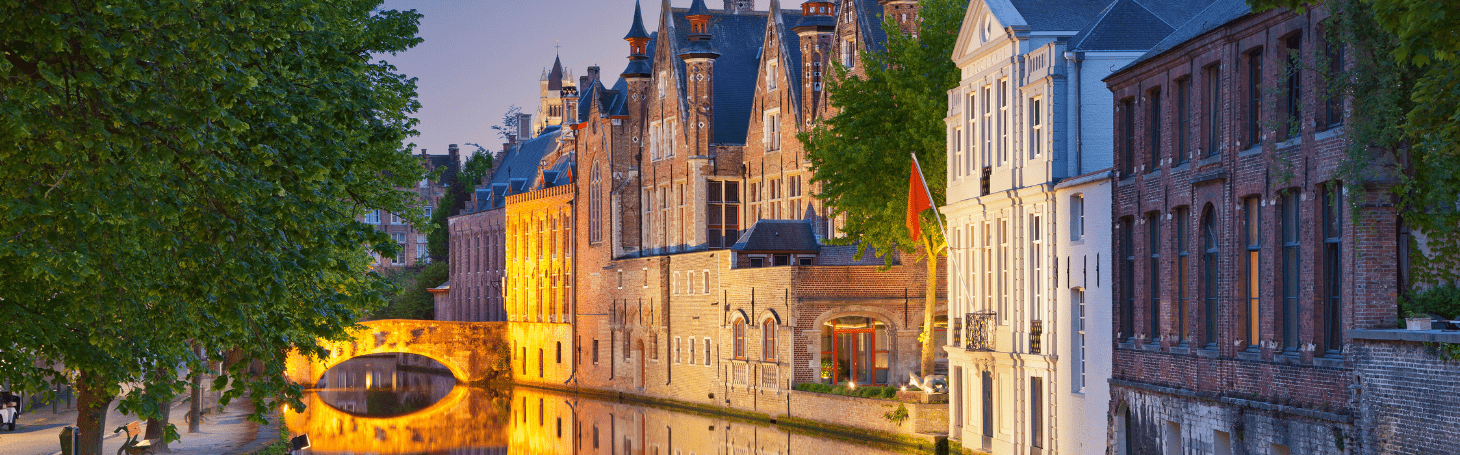
Train to Bruges - connections, tickets and itinerary
Station Brugge at Stationsplein 5 is a few minutes' walk from the UNESCO-listed Old Town. You'll enter Belgium with a valid identity card, and when you leave the station you step into the cobbled streets by the canals. PolishTrains lets you arrange the rail journey before exploring Bruges on foot, while remembering that a valid identity card is required to enter Belgium.
Fast facts - Bruges by train
-
Currency: Euro (EUR). Payment cards are accepted almost everywhere.
-
How much to go for: A weekend (2-3 days) is enough for the Old Town, Belfort, canals and Begijnhof. With 4-5 days you can add Ghent or Brussels.
-
Best time to go: Bruges is very popular in summer, so accommodation should be booked in advance, especially for weekends from June to August. When planning transfers through Brussels, PolishTrains helps you choose the connection and receive the ticket by e-mail and SMS before departure.
When to go to Bruges
It is best to choose April–May or September, when the daytime temperature is 13–19°C and tourist traffic is lower than in summer.
| Month | Daytime temperature | Weather | Tourist traffic |
| January | 5°C | Cool, possible precipitation | Low |
| February | 6°C | Cool, short days | Low |
| March | 9°C | Spring warming, variable conditions | Low |
| April | 13°C | Increasingly warm, less rain | Moderate |
| May | 17°C | Warm, lots of sunshine | Moderate |
| June | 20°C | Warm, long days | High |
| July | 22°C | Warmest, possible heat | High |
| August | 22°C | Warm, holiday season | High |
| September | 19°C | Warm, calmer | Moderate |
| October | 14°C | Cooler, frequent rain | Moderate |
| November | 9°C | Cool, foggy | Low |
| December | 6°C | Cold, Christmas market | Moderate |
Spring (March–May)
-
Daytime temperatures are 9–17°C, so it's pleasant walking along the canals and in the Old Town.
-
The gardens at Minnewater Park are in bloom from mid-April.
-
There are fewer tourists than in summer, so waits are shorter at the Belfort and for canal cruises.
Summer (June–August)
-
Daytime temperatures are 20–22°C and the long evenings are perfect for outdoor dining.
-
This is peak season, so there are the longest queues at the main attractions.
-
The Cactus Music Festival takes place in summer.
-
Book your accommodation early, as popular hotels in the centre sell out quickly.
Autumn (September–November)
-
September is one of the best months for a city break – it's 19°C by day and the crowds are much smaller than in the summer holidays.
-
It rains more often in October and the morning mists over the canals create a distinctive atmosphere.
-
With fewer tourists, it's easier to visit the museums and basilica.
Winter (December–February)
-
In December, the Christmas market on the Markt and Burg squares attracts many visitors, so book your accommodation early.
-
January and February are the quietest months of the year – museums are less crowded and hotel prices often drop.
-
Daytime temperatures are 5–6°C, so warm layers of clothing will come in handy. After arriving at Brugge station, PolishTrains notes that central attractions are walkable, while bicycles remain useful for neighbourhoods beyond the Old Town.
Getting to Bruges by train
You will arrive with one or two changes, usually via Brussels-Midi station in Brussels.
From Poznań
-
The journey takes 11–13 hours with transfers.
-
The route goes through Berlin and on to Brussels.
-
From Brussels-Midi station you change to the NMBS/SNCB train to Bruges, and the last leg takes about an hour.
-
You can leave in the morning and arrive in the evening.
From Wrocław
-
You travel 12–14 hours with changes via Berlin or Frankfurt and Brussels.
-
There are several connections a day from Wrocław to Berlin.
-
In Berlin or Frankfurt you change trains for the onward leg to Brussels.
-
From Brussels-Midi station you continue on a regional train to Bruges.
From Warsaw
-
You travel 14–16 hours with changes via Berlin, Cologne or Frankfurt to Brussels.
-
You can leave in the morning and arrive in the evening of the same day.
-
Alternatively, take an overnight train to Berlin and continue your journey in the morning.
-
In Berlin or Cologne you change trains at the same station.
From Kraków
-
You travel 15–17 hours with changes via Vienna or Warsaw and then through Germany to Brussels.
-
Via Vienna you continue on fast trains to western Europe.
-
Via Warsaw you can change to an overnight train to Berlin and continue in the morning.
-
The final stretch from Brussels to Bruges is covered by the NMBS/SNCB train.
Seat reservations are compulsory on the international section.
If you are travelling from Gdańsk, Łódź or Katowice, you will reach Bruges via Warsaw or Wrocław using the routes described above.
You can buy a ticket on PolishTrains without registration - enter the route, choose the connection and pay. The ticket is sent to your e-mail and by SMS. 30 minutes before departure you receive an SMS reminder with a link to your ticket, so you don't need to search your inbox. The earlier you buy, the better the price and the greater the choice of seats. You can return your PKP Intercity ticket up to 20 minutes before departure and exchange it up to 30 minutes before departure – see our returns and exchanges policy page for details.
Local transport in Bruges
You mainly get around Bruges city centre on foot, as the main attractions are within a 1–2 km radius of the station.
Bicycles - Bruges is one of the most bike-friendly cities in Belgium. Hire is available at the station and in the centre. A bike comes in handy when you want to reach neighbourhoods outside the Old Town or ride along the canals.
City buses - De Lijn's bus network serves the city and surrounding areas. A single ticket costs a few euros and a day ticket costs a little more. Buses are mainly useful for getting to outlying districts and suburbs.
Taxis - are available, but for short distances in the centre they are rarely used. They are useful if you are travelling with a lot of luggage.
Canal cruises - boarding points operate at several locations in the centre, including at Rozenhoedkaai. The cruise lasts about 30 minutes and is an attraction in its own right, not a means of transport.
Accommodation - hotels and apartments are concentrated in the centre of the Old Town and near the station. Book early in the summer season and during the Christmas market, as popular places fill up quickly.
Where to stay:
-
Old Town - the best location for tourists, close to all the main attractions; prices are higher in high season
-
Station area - convenient access, slightly lower prices than in the city centre
What to see in Bruges - highlights
Markt (Grand Market Square)
This is the heart of Bruges. Around the square stand Gothic townhouses with colourful facades, and on the ground floor there are restaurants and cafés. Entrance to the square is free. It's worth coming in the morning or in the evening when the townhouses are lit up.
Belfort Tower
The over-80-metre tower stands at the Markt. You climb 366 steps and at the top enjoy a panoramic view of the Old Town rooftops, canals and surrounding fields. There is an entrance fee. The visit takes 45–60 minutes. Queues are shorter in the morning.
Burg District
This is the oldest part of the city, a few minutes' walk from the Markt. Here you will find two of Bruges' most important landmarks:
-
Heilig Bloed Basiliek (Basilica of the Holy Blood) - the lower Romanesque chapel from the 12th century is free to enter. The upper Gothic-style chapel has an entrance fee. The basilica holds a reliquary which, according to tradition, contains a drop of Christ's blood.
-
Stadhuis (Town Hall) - one of the oldest town halls in Belgium, with a Gothic hall and wooden vaulted ceiling. There is an entrance fee. The visit takes about 30 minutes.
Minnewater (Lake of Love)
A peaceful park with a lake lies to the south of the centre. A walk around the park takes 20–30 minutes. Entrance is free. Trees blossom here in spring and swans are among the most photographed subjects in Bruges.
Canal Cruises
Boarding points operate at several locations in the centre, including at Rozenhoedkaai, one of the most photographed spots in the city. The cruise lasts about 30 minutes and there is an entrance fee. In high season it is advisable to arrive before noon.
Bruges Beer Experience (Beer Museum)
The museum is located on the Markt, in the former post office building. The interactive exhibition tells the history of Belgian brewing and ends with a tasting. There is an entrance fee. The visit takes about an hour.
Begijnhof (Beguinage)
The complex of white 17th-century houses surrounded by trees is a UNESCO-listed site. Entrance to the courtyard is free. It is one of the most peaceful places in the centre.
One-day plan
Start the morning by climbing the Belfort tower, as queues are shortest before noon. Then walk to the Markt and on to the Burg district, where you'll see the Basilica of the Holy Blood and the Town Hall. In the afternoon, take a canal cruise from the boarding point at Rozenhoedkaai. In the evening, have dinner in one of the side streets, where prices are lower than on the Markt itself.
Weekend plan (2 days)
You can arrange the first day the same way as the one-day plan. On the second day, start with a walk around Minnewater and a visit to the Begijnhof. Then walk through the centre to the chocolate shops and pop into the Bruges Beer Experience. In the evening, head out for a tasting of Belgian beers in one of the pubs along the canals. If you have a third day, take the train to Ghent - the journey takes about 25 minutes.
Eating and shopping in Bruges
What to eat
Belgian frites (frieten) - served with mayonnaise rather than ketchup. You'll find a frituur all over the centre and a portion costs a few euros. Frites are eaten standing up, straight from a paper cone.
Belgian beer - there are many pubs in the centre with a wide selection of Belgian beers. Trappist beers such as Westvleteren and Chimay, as well as local ales, are well worth trying. The Bruges Beer Experience at the Markt combines brewing history with tastings.
Belgian chocolate - there are many chocolatiers in the centre, especially around the Markt and in the streets leading to the Burg. Pralines are a classic souvenir from Bruges. Prices are higher than in supermarkets, but you are buying a handmade product, often prepared on the premises.
Belgian waffles - there are two main types: the Brussels waffle, lighter and rectangular, and the Liège waffle, sweeter and made with pearl sugar in the dough. Stalls in the centre sell waffles for a few euros.
Where to eat:
-
Restaurants on the Markt - you'll pay more here, as this is the most touristy part of town
-
Side streets and the Sint-Anna district - places with lower prices, east of the centre; try stoofvlees, the Flemish beef stew braised in beer, and moules-frites
Souvenirs
-
Bruges lace - a historic souvenir of the city; shops selling handmade lace operate near the Burg and in the centre; prices are higher than for mass-produced souvenirs, but you are buying an authentic product with centuries of tradition
-
Saturday market on the Markt - local produce, cheeses, cured meats and flowers; a great opportunity to pick up something to eat for a picnic by the Minnewater
How much does Bruges cost? Indicative costs
For 2 days in Bruges, it is worth preparing a budget to match the standard of accommodation, the number of attractions and how you plan to eat out.
| Category | Budget | Mid-range | Comfortable |
| Accommodation (1 night) | 150–200 PLN | 350–500 PLN | 600–900 PLN |
| Food (per day) | 80–120 PLN | 150–220 PLN | 250–350 PLN |
| Local transport | 0–20 PLN | 20–40 PLN | 40–80 PLN |
| Attractions | 30–60 PLN | 60–120 PLN | 120–200 PLN |
| Total (2 days) | 340–520 PLN | 730–1100 PLN | 1260–1880 PLN |
The amounts in PLN are approximate conversions at the current euro exchange rate. Prices vary depending on the season.
Prices in Bruges are higher than in Polish cities, especially in peak season.
Free attractions: walking along the canals and through the Old Town, Minnewater, Begijnhof, Markt square, the lower chapel of the Basilica of the Holy Blood and entry to the main nave of selected churches.
Frequently asked questions
Check out where else you can go by train in Europe
Czech Republic
BrnoOstravaPragueOlomoucNetherlands
RotterdamAmsterdamFrance
LilleToulouseBordeauxNiceDijonLyonParisMarseilleParisAvignonSwitzerland
Château-d'OexLucerneSt. MoritzZurichLuganoBrocMontreuxInterlakenSankt GallenGenevaBernBellinzonaBaselAustria
InnsbruckVienna