



Poland
GdyniaLublinSzczecinPrzemyślGdańskPoznanSopotTorunŁódźKatowicePiwnicza-ZdrójChałupyKolobrzegOlsztynKrakowWrocławHelNowy TargKłodzkoJurataWładysławowoWalbrzychRzeszówKielceBialystokZakopaneWarsaw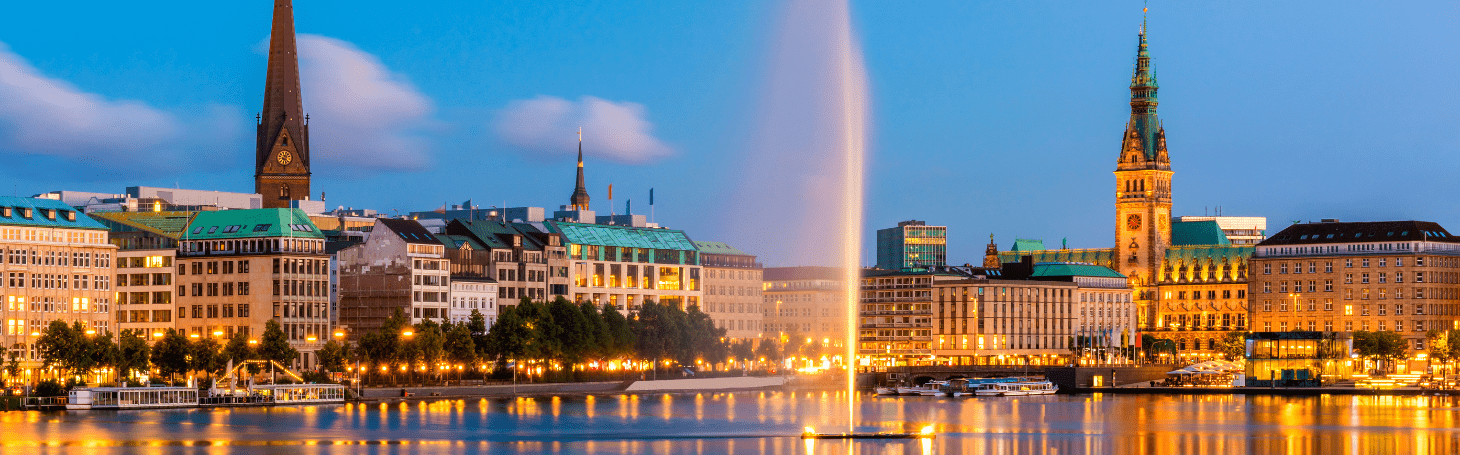
Train to Hamburg - connections, tickets and itinerary
From Poznań you travel 5.5–6 hours to Hamburg with one change. Hamburg is Germany's second largest city and the country's largest port. A weekend is enough to see the City Hall, the Speicherstadt and the quays on the Elbe. For a weekend in Hamburg, PolishTrains lets you compare connections from Poznań and arrange the required seat reservation before departure.
Fast facts - Hamburg by train
-
Destination station: Hamburg Hauptbahnhof, Steintordamm 1, 20099 Hamburg
-
Documents: identity card is sufficient - Germany is in the Schengen area
-
Currency: euro (EUR); card payments are common, but cash comes in handy in smaller establishments
-
Local transport: you travel around the city by metro (U-Bahn) and light rail (S-Bahn)
-
Interesting fact: Hamburg has more bridges than Venice, so plan a walk along the canals on your first day PolishTrains sends the Hamburg ticket by e-mail and SMS, with a link arriving shortly before departure.
When to go to Hamburg
Spring or early autumn is the best choice - daytime temperatures are 15–20°C, crowds are smaller than in summer and accommodation prices are lower.
| Month | Daytime temperature | Weather | Tourist traffic |
| January | approx. 3°C | Cold, rainy, short days | Low |
| February | approx. 4°C | Cold, possible snow | Low |
| March | approx. 8°C | Cool, variable, longer days | Low |
| April | approx. 12°C | Mild, increasingly sunny | Moderate |
| May | approx. 17°C | Warm, green, little rain | Moderate |
| June | approx. 20°C | Warm, long days | High |
| July | approx. 22°C | Warmest, possibly hot | High |
| August | approx. 22°C | Warm, occasional thunderstorms | High |
| September | approx. 18°C | Pleasant, increasingly short | Moderate |
| October | approx. 13°C | Cooler, rainy | Moderate |
| November | approx. 7°C | Cold, rainy, foggy | Low |
| December | approx. 5°C | Cold, Christmas markets | Moderate |
Spring (March–May)
-
From April, the Planten un Blomen gardens – one of the largest city parks in the centre of Hamburg – are in bloom.
-
In May, Hamburg Harbour Birthday, a multi-day harbour festival with a parade of ships, takes place.
-
Accommodation prices are lower than in peak summer and the weather is good for day-long walks.
Summer (June–August)
-
The days are the longest of the year – the sun sets after 9 pm, so you can stroll along the Alster in the evening.
-
Tourist traffic is at its highest of the year and accommodation prices rise, so it is worth booking your hotel early.
-
Harbour and canal cruises run on a full schedule, and waterfront summer terraces are open.
Autumn (September–November)
-
In September, the daytime temperature is still above 15°C and there are fewer people at the attractions than in summer.
-
It rains more often from October onwards, so it is also worth planning visits to museums such as the Kunsthalle and Miniatur Wunderland.
-
Accommodation prices drop after the summer season and it is easier to find a room in the centre.
Winter (December–February)
-
In December, a Christmas market with mulled wine and local delicacies operates at the Town Hall.
-
Museums and galleries become the main attraction of the season, and the Kunsthalle and Elbphilharmonie are easier to enter without queues.
-
The days are short, but the evening illuminations of the harbour and Speicherstadt give the city a special atmosphere. After arriving at Hamburg Hauptbahnhof, use local U-Bahn or S-Bahn information separately from the PolishTrains rail ticket when planning journeys beyond the centre.
Getting to Hamburg by train
You will get to Hamburg with one change, usually in Berlin.
From Poznań
-
5.5-6 hours with a transfer in Berlin or Hannover.
-
The transfer takes place at the same station.
-
A morning departure allows you to reach Hamburg in the afternoon.
From Wrocław
-
You travel 7-7.5 hours via Berlin.
-
You change trains once, often at Berlin Hauptbahnhof station.
-
You arrive in Hamburg the same day in the afternoon or evening.
From Warsaw
-
9-9.5 hours with one change of trains in Berlin.
-
You first take a PKP Intercity train to Berlin and then a Deutsche Bahn train to Hamburg.
-
Leaving early in the morning allows you to arrive in the evening.
From Krakow
-
10-10.5 hours with one change in Berlin or Warsaw.
-
The route passes through one of the major railway junctions, so you only change trains once.
-
You leave Krakow in the morning and get off in Hamburg in the evening.
You also travel from Gdansk, Katowice and Lodz with one change in Warsaw or Berlin. Reservation of a seat is compulsory for the foreign leg. On PolishTrains, you buy your ticket without registration - you enter the route, choose the connection and pay. You receive your ticket by e-mail and SMS. 30 minutes before departure you receive an SMS with a link to your ticket. The earlier you buy, the better the price and the greater the choice of seats. You can return your PKP Intercity ticket up to 20 minutes before departure and exchange it up to 30 minutes before departure. See our returns and exchanges policy page for details.
On-site transport in Hamburg
For a city break in Hamburg, you get around on foot and by public transport. You can walk to the City Hall, the Jungfernstieg and the Old Town from the train station in a few minutes.
Hamburg has an extensive underground (U-Bahn) and light rail (S-Bahn) network. By metro or S-Bahn you will reach the harbour districts, Altona and Blankenese in a few minutes. The stations are at the main station.
A single ticket for public transport is a few zlotys and a daily ticket a dozen zlotys. If you make several journeys a day, a day ticket will be more convenient - buy it from the ticket machine at the station or from the local ticket app.
There are taxi ranks and ride-hailing apps at the station. Hamburg also has the StadtRAD city bike system - you'll find stations near the station and throughout the city centre. You can explore the canals and the Alster promenade by bike, especially in spring and summer.
You can get to HafenCity and Speicherstadt by metro or walk along the canals.
Where to stay overnight:
-
The centre (Altstadt/Neustadt) - the most convenient base, close to the Town Hall, Jungfernstieg and main station
-
HafenCity - modern harbour quarter, good for architecture lovers and close to Speicherstadt
-
Schanzenviertel - alternative neighbourhood with local atmosphere, cafés and lower accommodation prices
What to see in Hamburg - highlights
City Hall (Hamburger Rathaus)
The Neo-Renaissance building from 1897 has an impressive inner courtyard. Entrance to the courtyard is free, so it is worth a look even without a ticket. Guided tours of the interior are chargeable and take 30-45 minutes. The Town Hall stands on the Rathausmarkt, a few minutes' walk from the train station.
St. Michael's Church (Hauptkirche St. Michaelis)
The tower is 132 metres high - you climb the 453 steps or take the lift. From the top you will see a panoramic view of the harbour, the Elbe and the entire city. There is a fee to enter the tower and the tour takes 45-60 minutes.
Granary Quarter (Speicherstadt) and HafenCity
The complex of red brick warehouses on the canals was listed by UNESCO in 2015. A walk through the district is free and takes 1-2 hours. There are museums inside, including Miniatur Wunderland, which is the largest railway model in the world. HafenCity is a modern extension of the Speicherstadt with the Elbphilharmonie as the architectural dominant feature.
Port and Landungsbrücken
During a harbour cruise you will see Hamburg from the water. Cruises have a fee, last about an hour and start from the harbour at Landungsbrücken. At the quay you will also find stalls selling Fischbrötchen - fish sandwiches that are a symbol of Hamburg's harbour cuisine.
Kunsthalle Hamburg
One of Germany's largest art galleries brings together a collection from the Middle Ages to contemporary art. There is an entrance fee and the tour takes 2-3 hours. The building stands next to the main station, so you can also have a look here before your return train.
Alster Park and promenade
A free walk along the Alster Lake takes you through the greenery overlooking the water and the city skyline. The promenade itself is 1.5 km long. It is worth coming here in the evening after a day of sightseeing. In spring and summer, there are canoe and boat rentals on the Alster.
Plan for day 1
Morning: Town Hall and Old Town - stroll through the Rathausmarkt, Town Hall courtyard and Altstadt streets. Midday: Granary Quarter and HafenCity - walk along the canals and Elbphilharmonie from the outside. Afternoon: St Michael's Church tower - panorama of the city and harbour. Evening: walk along the promenade on the Alster and dinner in the Jungfernstieg area.
Plan for the weekend (2-3 days)
Day 1: you can arrange the first day in the same way as the plan for day 1.
Day 2: Kunsthalle Hamburg in the morning, Altona at noon and the fish market on Sunday, and a harbour cruise from Landungsbrücken in the afternoon.
Day 3: excursion to Blankenese with villas on the Elbe and a sandy beach, or a visit to Hagenbecks Tierpark - one of the oldest zoos in Europe.
Eating and shopping in Hamburg
What to eat
Fischbrötchen - a sandwich with fish, herring, salmon or prawns - is a classic Hamburg harbour snack. You'll eat it at the stalls at Landungsbrücken and at the fish market in Altona. Such a snack costs between a few and a dozen zloty.
Labskaus - a traditional seaman's dish of salted beef, beetroot and potatoes, served with a fried egg and pickled cucumber. It looks unusual, but is well worth trying. You can find it in traditional restaurants in the centre and by the harbour.
The fish market (Fischmarkt) in the Altona district takes place on Sunday mornings. You can buy fresh fish and seafood here and admission is free. It's worth coming early, as the market starts at dawn and finishes before noon.
Where to dine
The Schanzenviertel district brings together local cafés, restaurants and bars, so it's a less touristy alternative to the city centre. You'll eat cuisine from all over the world here, from Vietnamese to Italian, and prices are lower than at the harbour. In the evening, the neighbourhood clearly comes alive.
Souvenirs
-
Products with a harbour and anchor motif - classic Hamburg souvenirs available in shops in the centre and at the quayside
-
Local craft beer - a good choice for a travel gift
-
Ceramics from workshops in the Speicherstadt - an original souvenir from the UNESCO landmark district
Europa Passage is a shopping centre next to the station, good for shopping before returning. Mönckebergstraße, the main shopping street, connects the station with the Town Hall.
How much does Hamburg cost? Indicative costs
Hamburg is more expensive than Polish cities, but cheaper than London or Paris. Amounts in the table are for one day's stay including accommodation.
| Category | Budget | Mid-range | Comfortable |
| Accommodation | 100–150 PLN | 250–350 PLN | 500–700 PLN |
| Food | 60–80 PLN | 120–160 PLN | 200–280 PLN |
| Local transport | 15–20 PLN | 15–20 PLN | 50–70 PLN |
| Attractions | 0–30 PLN | 50–80 PLN | 80–120 PLN |
| Total | 175–280 PLN | 435–610 PLN | 830–1170 PLN |
-
Budget: hostel or basic-standard hotel, eating mainly on the go, a day ticket for public transport and free attractions or one paid one.
-
Mid-range: three-star hotel, lunches and dinners in restaurants, day ticket, 2–3 paid attractions and a harbour cruise.
-
Comfortable: four-star or designer hotel, harbour restaurants and dinners with a view, taxis and a full programme of attractions including the Kunsthalle and Elbphilharmonie.
Frequently asked questions
Check out where else you can go by train in Europe
Czech Republic
BrnoOstravaPragueOlomoucNetherlands
RotterdamAmsterdamFrance
LilleToulouseBordeauxNiceDijonLyonParisMarseilleParisAvignonSwitzerland
Château-d'OexLucerneSt. MoritzZurichLuganoBrocMontreuxInterlakenSankt GallenGenevaBernBellinzonaBaselAustria
InnsbruckVienna