




Poland
GdyniaLublinSzczecinPrzemyślGdańskPoznanSopotTorunŁódźKatowicePiwnicza-ZdrójChałupyKolobrzegOlsztynKrakowWrocławHelNowy TargKłodzkoJurataWładysławowoWalbrzychRzeszówKielceBialystokZakopaneWarsaw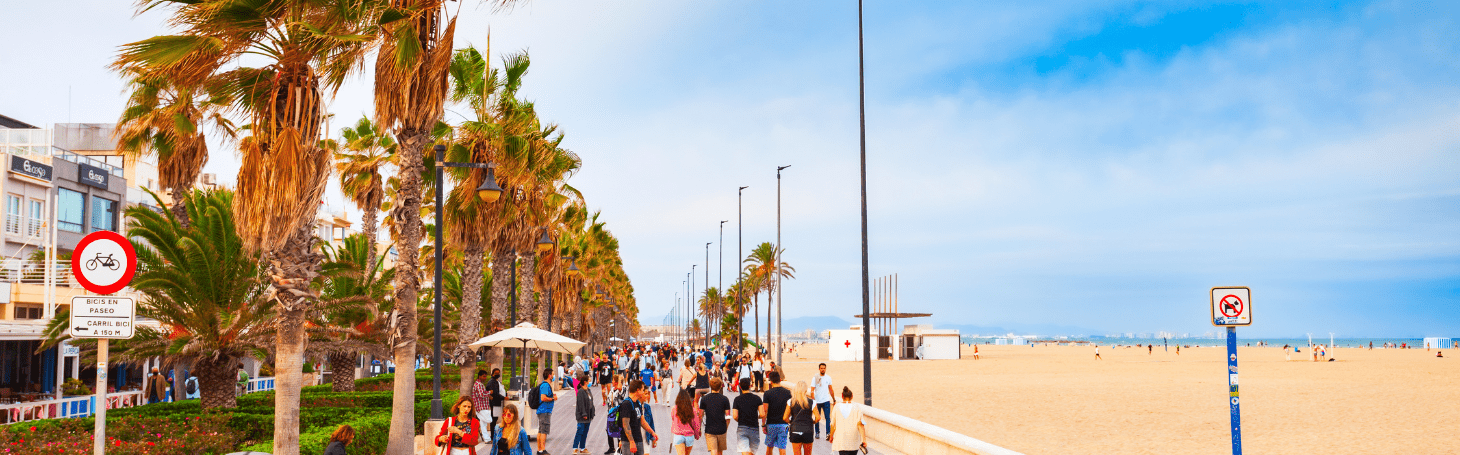
Train to Valencia - connections, tickets and itinerary
After leaving Valencia Joaquín Sorolla station, you will reach the centre in a dozen minutes. The easiest way to get from Poland is to fly to Madrid or Barcelona, and then take a fast train on the Spanish section - from Madrid it takes about 2 hours, from Barcelona about 3.5 hours. PolishTrains lets you arrange the Spanish train segment after flying to Madrid or Barcelona, with Valencia Joaquín Sorolla as your destination station.
Fast facts - Valencia by train
-
Destination station: Valencia Joaquín Sorolla, 46007 Valencia - station serving long-distance trains.
-
Documents: Spain is part of the Schengen area - an identity card is sufficient. Make sure the document is valid for the entire journey.
-
Currency: Euro (EUR). Recalculate your budget before you go - Poland is not in the Eurozone.
-
How much to go for: a weekend (Friday evening - Sunday) is enough for the main attractions. If you want to see Ciudad de las Artes y las Ciencias, Malvarrosa beach and El Carmen district without rushing, plan 3-4 days.
-
Best time to go: April-May and September - daytime temperatures are 22-28°C, fewer crowds than in summer and lower accommodation prices.
-
Practical tip: Las Fallas, the spectacular fire festival, takes place in March. Book accommodation and tickets several months in advance, as prices and occupancy increase dramatically. Using PolishTrains, you can purchase the Spanish ticket without an account and receive it by email and SMS, including a departure reminder.
When to go to Valencia
The best choice is April, May or September - the daytime temperature is then 22-28°C and the crowds are less than in the middle of summer.
| Month | Daytime temperature | Weather | Tourist traffic |
| January | 16°C | Cool, damp, occasional rain | Low |
| February | 17°C | Cool, more and more sunshine | Low |
| March | 19°C | Pleasant, Las Fallas - crowds in the city | Large |
| April | 22°C | Warm, sunny, gardens in bloom | Moderate |
| May | 26°C | Warm, beaches start their season | Moderate |
| June | 30°C | Hot, full beach season | Large |
| July | 32°C | Hot, peak tourist season | Large |
| August | 31°C | Hot, La Tomatina at the end of the month | Large |
| September | 28°C | Warm, sea water still warm | Moderate |
| October | 23°C | Pleasant, increase in rainfall | Moderate |
| November | 18°C | Cooler, rainy days | Low |
| December | 16°C | Cool, Christmas decorations | Low |
Spring (March to May)
-
In mid-March, Las Fallas takes place - a fire festival lasting several days with giant sculptures burned in the streets. Accommodation prices can even double during this period.
-
April is the best time for gardens and city parks - plants are in bloom and the temperature allows for day-long walks without the heat.
-
In May, the beaches start their season, although the sea water is still cool. Accommodation prices are still lower than in summer.
Summer (June-August)
-
From June, Malvarrosa beach is in full swing - lifeguards, beach bars and the promenade are full of people.
-
In July and August, the temperature exceeds 30°C. Check the current opening hours of restaurants and attractions before visiting.
-
At the end of August, La Tomatina, the biggest tomato battle in the world, takes place in Buñol, 30 km from Valencia.
Autumn (September-October)
-
In September, the beaches are still warm and the crowds are noticeably fewer than at the height of summer. Accommodation prices drop.
-
October brings more rain, but temperatures of 23°C still allow for comfortable sightseeing on foot.
Winter (November to January)
-
From November to January, Valencia is at its quietest - few tourists and the lowest accommodation prices of the year.
-
In December, the centre is decorated with Christmas decorations, with a Christmas tree and Christmas market in the Plaza del Ayuntamiento. Before booking through PolishTrains, check the carrier’s refund and exchange conditions, since the stated deadlines apply specifically to PKP Intercity tickets.
Getting to Valencia by train
You will get to Valencia if you combine a flight to Spain with a train on the domestic section. The most common choice is to arrive in Madrid or Barcelona and then take the train to Valencia Joaquín Sorolla station.
From Madrid to Valencia
-
From Madrid to Valencia you take a fast train for around 2 hours.
-
Trains leave from Madrid Atocha station.
-
You will find several connections a day on this route.
-
From Madrid-Barajas Airport you will take the suburban train or metro to Madrid Atocha station.
From Barcelona to Valencia
-
From Barcelona to Valencia you take a long-distance or regional train for around 3.5 hours.
-
Trains leave from Barcelona Sants station.
-
You will find several connections a day on this route.
-
From Barcelona-El Prat airport to Barcelona Sants station, you will reach Barcelona Sants station by suburban train in a dozen minutes.
You can buy your ticket for the Spanish section on PolishTrains without creating an account - all you need is your e-mail address and phone number. You receive your ticket by email and SMS, and 30 minutes before departure an SMS reminder arrives with a link to your ticket. The earlier you buy your ticket, the better the price and the greater the choice of seats. Seat reservations are compulsory on the international section. The total journey time depends on the flight connection and the length of the changeover.
For PKP Intercity tickets, you can make a refund up to 20 minutes before departure and an exchange up to 30 minutes before departure. For other carriers, check the rules for refunds and exchanges.
Transport on site in Valencia
You get around the centre of Valencia on foot and by public transport. Metrovalencia operates the metro and trams, and EMT buses complete the access throughout the city.
A single ticket costs a few zloty and a day ticket costs a dozen zloty. For several journeys a day, a day ticket will be more convenient - you buy once and don't have to punch your ticket at each entrance.
Taxis and rides ordered through the app are available in Valencia. A ride from the train station to the centre costs a few tens of zloty, so it's a good choice if you have a lot of luggage or a late arrival.
You get around the historic centre on foot. The main attractions of Ciutat Vella - the cathedral, Lonja de la Seda and Mercado Central - are all within 1-2 km of each other. During your city break, you don't need to use transport at every turn.
You can reach Malvarrosa beach by tram from the centre in a few minutes. Ciudad de las Artes y las Ciencias lies to the south of the centre - you can get there by public transport in a few minutes.
Where to stay overnight:
-
Ciutat Vella - by the cathedral and Lonja de la Seda, close to the main attractions but more expensive.
-
El Carmen - an artistic district with street art, bars and restaurants. Prices are moderate.
-
Malvarrosa - by the beach, further from the historic centre but with sea views and access to fish restaurants.
What to see in Valencia - main attractions
Ciudad de las Artes y las Ciencias
A futuristic complex designed by Santiago Calatrava. Inside you'll find the Oceanogràfic, the science museum Museu de les Ciències Príncep Felipe and the IMAX cinema L'Hemisfèric. The exterior tour itself is free and takes 3-5 hours. With entrances to individual attractions , plan for 6-8 hours. Come in the morning or towards the evening to avoid the biggest crowds and heat.
Metropolitan Cathedral (Catedral-Basílica)
The 13th-century cathedral combines Romanesque, Gothic and Baroque styles. According to tradition, the Holy Grail is kept in the cathedral. Entrance to the cathedral is free, while the Miguelete observation tower has a fee. The tour takes 1-1.5 hours. It is worth climbing the tower in the morning, before it gets hot.
Lonja de la Seda (Silk Exchange)
A 15th-century building listed by UNESCO. The Gothic trading hall with its massive spiral columns is one of the best-preserved secular Gothic works in Europe. There is an entrance fee. The tour takes 45-60 minutes. Come in the evening - the lighting gives the interior a unique character.
Viveros Gardens
A large urban park next to the former royal gardens. In spring, especially in April and May, it is at its greenest here and the shade of the trees offers a respite from the hustle and bustle of the city. The tour takes 1.5-2 hours.
Malvarrosa beach
A wide sandy beach with a promenade and fish restaurants. The bathing season runs from May to September. It is noticeably less crowded in the morning than in the afternoon. You can get there by tram from the centre in a few minutes.
Museum of Fine Arts (Museo de Bellas Artes)
The collection of Spanish and Valencian paintings includes works by Goya, Velázquez and painters of the Valencian school. The tour takes 1.5-2 hours. Check the current opening days and times before visiting.
Plan for Day 1
Morning: Mercado Central - snacks and coffee for breakfast, then walk around Ciutat Vella, i.e. the cathedral and Lonja de la Seda. Lunch: paella at a restaurant off the main tourist promenade. Afternoon: Ciudad de las Artes y las Ciencias - exterior tour and one museum inside. Evening: tram to Malvarrosa beach - dinner overlooking the sea.
Plan for the weekend (Friday evening - Sunday)
Day 1: Arrival, stroll through the illuminated Ciutat Vella and dinner in the El Carmen district.
Day 2: Ciutat Vella, i.e. the cathedral, the Lonja and the Mercado Central, then the Viveros Gardens and the Ciudad de las Artes y las Ciencias.
Day 3: Museum of Fine Arts in the morning, souvenir shopping around the Mercado Central and return.
Eating and shopping in Valencia
What to eat
Paella Valenciana - an authenticValencian version made with chicken, green beans and white beans on bomba rice. This is not the seafood paella that tourist restaurants often serve. Look for it in the side streets of Ciutat Vella or by the beach.
Arroz a Banda - rice cooked in fish broth, served with grilled fish. This is a popular dish at fish restaurants along Malvarrosa beach.
Horchata de chufa with fartons - a sweet drink made from chufa tubers served with oblong buns sprinkled with icing sugar. This is a traditional breakfast or afternoon snack. Horchatería Santa Catalina in the Plaza de Santa Catalina is one of the most famous establishments of its kind.
Where to eat:
-
Mercado Central - a huge market hall in an Art Nouveau building. Here you'll find stalls selling fruit, vegetables, meat and fish, while bars inside the hall serve tapas, jamón ibérico and fresh juices. It's a good choice for lunch.
-
El Carmen district - bars and restaurants, and streets lined with street art. In the evenings, the district clearly comes alive. Prices are moderate.
-
Restaurants by Malvarrosa beach - you'll pay more than in the centre, but you get a sea view and a wide selection of fish dishes. La Pepica is a well-known beachside restaurant that has been in operation for more than a century.
Souvenirs
-
Valencian ceramics - plates, jugs and figurines are traditional Valencian souvenirs.
-
Bomba rice - for paella, worth bringing home.
-
Traditional fan - abanico, a distinctive regional product.
-
Regional wines - olive oil, smoked paprika (pimentón) and wines cost less than in Poland.
Large shops are closed on Sunday, so plan your shopping for Saturday.
How much does Valencia cost? Indicative costs
| Category | Budget | Medium | Comfort |
| Accommodation (1 night) | 150-200 PLN | 250-350 PLN | 400-600 PLN |
| Food (daily) | 80-120 PLN | 150-200 PLN | 250-350 PLN |
| Local transport (daily) | 15-20 PLN | 20-30 PLN | 30-50 PLN |
| Attractions (daily) | 40-50 PLN | 80-100 PLN | 150-200 PLN |
| Total (weekend, 2 nights) | 570-780 PLN | 1000-1360 PLN | 1660-2400 PLN |
The budget variant assumes a hostel or budget hotel, food in market halls and bars, public transport with a day ticket and one paid entrance per day. The medium variant includes a three-star hotel, mid-range restaurants and a few paid attractions. The comfort option includes a four-star hotel in the centre, beachfront restaurants with wine and taxis to supplement public transport.
Amounts are approximate and given in PLN. To the cost of your stay, add your air ticket and train ticket for the Spanish section.
In March, during Las Fallas, accommodation prices rise sharply, so book several months in advance. In the low season, i.e. January, February and November, accommodation prices are noticeably lower and the city is quieter.
Frequently asked questions
Check out where else you can go by train in Europe
Czech Republic
BrnoOstravaPragueOlomoucNetherlands
RotterdamAmsterdamFrance
LilleToulouseBordeauxNiceDijonLyonParisMarseilleParisAvignonSwitzerland
Château-d'OexLucerneSt. MoritzZurichLuganoBrocMontreuxInterlakenSankt GallenGenevaBernBellinzonaBaselAustria
InnsbruckVienna