


Poland
GdyniaLublinSzczecinPrzemyślGdańskPoznanSopotTorunŁódźKatowicePiwnicza-ZdrójChałupyKolobrzegOlsztynKrakowWrocławHelNowy TargKłodzkoJurataWładysławowoWalbrzychRzeszówKielceBialystokZakopaneWarsaw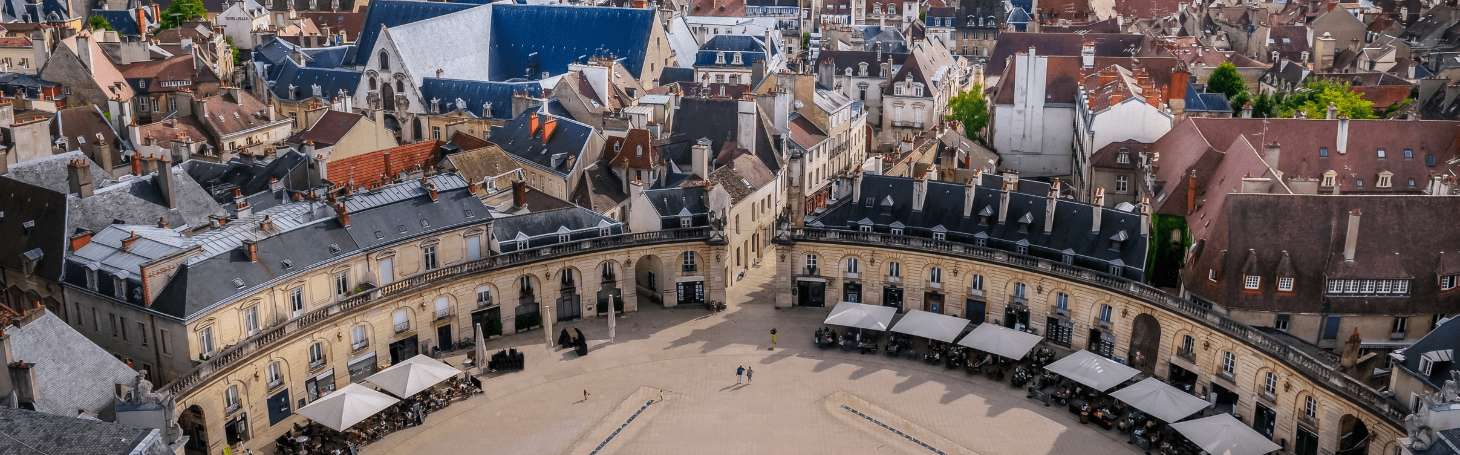
Train to Dijon - connections, tickets and itinerary
The Gare de Dijon-Ville train station is located in the city centre - you can walk to the Palace of the Dukes of Burgundy in just a few minutes. France is a member of the Schengen area, so all you need is a valid identity card. You can get to Dijon from Poland with one change - usually in Paris or Strasbourg - and the journey takes 8-11 hours, depending on your starting city. PolishTrains lets travellers compare connections via Paris or Strasbourg and receive the Dijon ticket electronically before the journey.
Fast facts - Dijon by train
-
Currency: euro. Dijon is the capital of Burgundy, a region famous for its wine and mustard.
-
Local transport: tram and bus; a single ticket is a few zloty, a daily ticket a dozen.
-
How much to go for: 2-3 days are enough for the main attractions.
-
Practical tip: Dijon is a student town with a lively gastronomic scene. During the International Gastronomic Fair in autumn, accommodation prices rise, so book in advance. On PolishTrains, travellers can book without registration and receive the ticket by e-mail and SMS, useful when changing stations in Paris.
When to go to Dijon
The best choice is April–May or September–October, when daytime temperatures are 14–20°C and tourist traffic remains moderate.
| Month | Daytime temperature | Weather | Tourist traffic |
| January | 4°C | Cold, possible snowfall | Low |
| February | 6°C | Cold, frequent frost | Low |
| March | 10°C | Cool, first warmer days | Low |
| April | 14°C | Mild, variable precipitation | Moderate |
| May | 18°C | Warm, plenty of sunshine | Moderate |
| June | 22°C | Warm to hot | High |
| July | 26°C | Hot, dry | High |
| August | 25°C | Hot, afternoon thunderstorms | High |
| September | 20°C | Warm, stable weather | Moderate |
| October | 15°C | Mild, shorter days | Moderate |
| November | 8°C | Cool, frequent rain | Low |
| December | 5°C | Cold, possible frost | Low |
Spring (March–May)
-
In the Dijon area, the vineyards are in bloom and you can stroll in the Jardin de l'Arquebuse without the summer heat.
-
Daytime temperatures are 10–18°C, crowds are smaller than in summer and accommodation prices are lower than in high season.
-
In May, local markets and open-air festivals in the heart of Burgundy get under way.
Summer (June–August)
-
Daytime temperatures reach 22–26°C and the long evenings are perfect for outdoor dinners at Place de la Libération.
-
During peak season accommodation prices rise and more people visit the Museum of Fine Arts.
-
In summer there are outdoor music and cultural festivals, including Estivade.
Autumn (September–November)
-
The Burgundy grape harvest continues through September and October, with the Côte de Nuits and Côte de Beaune vineyards opening to visitors.
-
The International Gastronomic Fair in Dijon takes place in November and is one of the region's biggest culinary events.
-
Daytime temperatures are 8–20°C and the parks and wine trails take on their autumn colours.
Winter (December–February)
-
Daytime temperatures are 4–6°C and accommodation prices are then among the lowest of the year.
-
In December, Christmas markets open in the centre of Dijon with stalls selling pain d'épices, mulled wine and local cheeses.
-
In winter you can visit museums and galleries without queues, including the Museum of Fine Arts. PolishTrains recommends buying earlier when possible, since seat choice and fares are generally more favourable for the international part of the itinerary.
Getting to Dijon by train
You can get to Dijon from Poland with one change - usually in Paris or Strasbourg - and alight at Gare de Dijon-Ville station.
From Wrocław
-
The journey time is 9-10 hours, with a change in Strasbourg or Paris.
-
You take the train to Strasbourg via Strasbourg and then continue to Dijon by train.
-
For the option via Paris, you change from Paris Est station to Paris Gare de Lyon station and continue to Dijon.
From Katowice
-
The journey takes 9-10 hours.
-
You change trains in either Strasbourg or Paris, and both options end at Gare de Dijon-Ville station.
-
Through Strasbourg the change is sometimes shorter.
From Warsaw
-
From Warsaw you travel 9-10 hours, with a change in Paris.
-
First you go to Paris, then from Paris Gare de Lyon station to Dijon.
-
In Paris, you change from Paris Est station to Paris Gare de Lyon station - take the metro.
-
You can leave in the morning and arrive in the evening of the same day.
From Krakow
-
The journey takes 10-11 hours.
-
You go via Vienna or Paris, depending on the connection you choose.
-
With the option via Paris, you go to Paris, change station to Paris Gare de Lyon and continue to Dijon.
From Poznan, Gdansk and Lodz you travel to Dijon with a change of train station in Warsaw or Wroclaw and then continue via Paris or Strasbourg. Seat reservations are compulsory for the foreign leg. On PolishTrains you will buy your ticket without registration - you will receive it by e-mail and SMS. 30 minutes before departure, you'll get an SMS reminder with a link to your ticket, so you're not looking for it in your inbox. The earlier you buy, the greater the choice of seats and the better the price. On PKP Intercity you can return your ticket up to 20 minutes before departure and exchange it up to 30 minutes before departure. See the refund and exchange policy page for details.
Transport on site in Dijon
You will mainly get around Dijon on foot, and for further distances you will use the tram, bus or city bike.
The main attractions are within 1-2 km of the station, so you will get around the centre on foot.
Around Dijon, you'll travel by tram and bus. For several trips a day, a day ticket will be more convenient. Check the current routes and timetables at the stops.
You can use the Vélodi city bikes. The centre is flat, so you can also cycle to further points, for example to the Well of Moses on the site of the former Carthusian monastery.
Taxis and VTCs can be found at the train station. They are useful with luggage or in the evening after dinner.
You'll find hotels and flats within a few hundred metres of the Gare de Dijon-Ville station.
What to see in Dijon - highlights
The main attractions in Dijon are centred around the old town, with the Well of Moses on the western outskirts of the city being a further highlight.
Palace of the Dukes of Burgundy (Palais des Ducs de Bourgogne)
A 15th-century palace in the heart of the city, today the town hall and home of the Museum of Fine Arts. From the Tour Philippe le Bon tower, 45 metres high, you view the panorama of the old town and the surrounding vineyards. There is a fee to enter the tower and the tour takes 30-45 minutes. It's worth arriving in the morning before the queues build up.
Museum of Fine Arts (Musée des Beaux-Arts)
One of the largest and oldest museums in France, it is housed in the wings of the Dukes' Palace. The collection includes works from antiquity to contemporary art, including tombs of the Dukes of Burgundy. Entry to the permanent collection is free. Plan on 1.5-2 hours for the tour.
The Well of Moses (Puits de Moïse)
Gothic sculpture from 1395-1406 by Claus Sluter, on the site of the former Carthusian monastery of the Chartreuse de Champmol. Six monumental figures of prophets surround the base of a former crucifix. The tour takes 30 minutes and there is an entrance fee. The monastery lies on the western outskirts of the city - get there by tram or bicycle.
Saint-Bénigne Cathedral
Romanesque-Gothic cathedral with a crypt dating back to the 10th century. The crypt is one of the best-preserved Romanesque architectural features in Burgundy. The tour takes 30-45 minutes and entry is free.
Notre-Dame Church (Église Notre-Dame de Dijon)
A Gothic church from the 13th century with the famous owl, or chouette de Dijon, built into the corner of the outer wall. According to local tradition, touching the owl with the left hand brings good luck. The façade, with its three rows of false gargoyles, is one of Dijon's most recognisable sights.
Maison Millière
One of the oldest surviving bourgeois houses in Dijon, on Rue de la Chouette. The wooden half-timbered structure dating from the 15th century now houses a restaurant and gift shop.
Saint-Michel Church (Église Saint-Michel de Dijon)
The 16th century Renaissance façade stands out against the backdrop of Burgundian ecclesiastical architecture. The interior combines Gothic and Renaissance elements.
Arquebuse Garden (Jardin de l'Arquebuse)
Botanical garden next to the Natural History Museum with a collection of more than 3,500 plant species. Admission is free. It's a good place to relax between sightseeing - you'll find benches in the shade of the trees and alleyways among the flower beds.
Plan for day 1
Start the morning with the Palace of the Dukes of Burgundy and the Museum of Fine Arts, which is worth 2-2.5 hours. At noon, walk through the old town along the Rue de la Liberté to the Notre-Dame church and touch an owl for luck. Have lunch at one of the bistros on Place de la Libération. Spend the afternoon at the Well of Moses - get there by tram and take a 30-minute tour. In the evening, sit down for dinner in the gastronomic quarter around Rue Berbisey.
Plan for the weekend (2 days)
Day 1: Arrange the same as the 1-day plan.
Day 2: In the morning, visit Saint-Bénigne Cathedral with its crypt, which is worth spending 30-45 minutes on, followed by the Arquebuse Garden and the Natural History Museum. Set aside an afternoon for a trip to the surrounding vineyards of the Côte de Nuits or Côte de Beaune - reachable by train or bus in 30-40 minutes. The grape harvest in September and October is the best time for such a trip, but the wineries welcome visitors all year round.
Eating and shopping in Dijon
In Dijon, it's worth buying mustard, trying Burgundian cuisine and checking out the Halles market.
Dijon is the mustard capital of the world. You can buy dozens of varieties - from classic Dijon mustard to versions with blackcurrant or truffles - at the Maille shops in Rue de la Liberté and Fallot in the old town. A jar of mustard is one of the best souvenirs from Burgundy.
Burgundian cuisine is based on local produce and wine. Three dishes you'll find in most restaurants on the Place de la Libération:
-
Bœuf bourguignon - beef braised in Burgundy red wine with carrots, onions and mushrooms
-
Escargots de Bourgogne - Burgundy-style snails baked with garlic butter and parsley
-
Pain d'épices - Dijon gingerbread with honey and mixed spices, baked according to recipes dating back to the 14th century
The Halles de Dijon market, or Les Halles, is a covered market designed by Gustave Eiffel's studio. It is open several times a week - buy Burgundy cheeses, cured meats, fresh fruit and baked goods here. It will work well for breakfast or a quick lunch between sightseeing.
Burgundy wine is a separate chapter. The Côte de Nuits and Côte de Beaune region produces some of the most expensive wines in the world, but you'll also buy bottles at affordable prices in the wine bars in the centre of Dijon. During the International Gastronomic Fair, tastings take place on the fairground.
The gastronomic quarter around Rue Berbisey and Rue Monge brings together local restaurants and bars with Burgundian menus. There are fewer tourists here than around the Palais and prices are lower.
Lunch in a bistro costs a few tens of zlotys. Dinner in a restaurant with a regional menu and a glass of Burgundy wine costs more. The Halles market is a good option if you want to eat well and spend less.
Souvenirs
-
Pain d'épices - Dijon gingerbread in decorative tins
-
Burgundy wine - bottles from the Côte de Nuits or Côte de Beaune region
-
Ceramics - with vine motifs, available in shops on the Rue de la Liberté and around the old town
-
Mustard - dozens of varieties in the Maille and Fallot shops
How much does Dijon cost? Indicative costs
For 2 days and 1 night it is advisable to budget depending on the standard of accommodation, food and number of paid attractions.
| Category | Budget | Medium | Comfort |
| Accommodation (1 night) | 150–200 PLN | 250–350 PLN | 450–600 PLN |
| Food (1 day) | 80–120 PLN | 150–200 PLN | 300–400 PLN |
| Local transport (1 day) | 10–20 PLN | 20–30 PLN | 40–60 PLN |
| Attractions (1 day) | 0–30 PLN | 30–60 PLN | 80–120 PLN |
| Total (2 days / 1 night) | 240–370 PLN | 450–640 PLN | 870–1,180 PLN |
The budget option assumes a hostel or basic-standard hotel, food at the Halles market and bistros, getting around on foot with an occasional single ticket, and free attractions such as the Museum of Fine Arts and the Arquebuse Garden.
The medium option includes a three-star hotel, restaurants with a regional menu, a day ticket for public transport, and entry to the Tour Philippe le Bon tower and the Well of Moses.
The comfort option includes a four-star or boutique hotel, Burgundy wine dinners, taxi or VTC, and wine tastings and all paid attractions.
Museum of Fine Arts – the permanent collection is free. Arquebuse Garden – admission is free. Tour Philippe le Bon tower – entry is chargeable.
Frequently asked questions
Check out where else you can go by train in Europe
Czech Republic
BrnoOstravaPragueOlomoucNetherlands
RotterdamAmsterdamFrance
LilleToulouseBordeauxNiceDijonLyonParisMarseilleParisAvignonSwitzerland
Château-d'OexLucerneSt. MoritzZurichLuganoBrocMontreuxInterlakenSankt GallenGenevaBernBellinzonaBaselAustria
InnsbruckVienna