

Poland
GdyniaLublinSzczecinPrzemyślGdańskPoznanSopotTorunŁódźKatowicePiwnicza-ZdrójChałupyKolobrzegOlsztynKrakowWrocławHelNowy TargKłodzkoJurataWładysławowoWalbrzychRzeszówKielceBialystokZakopaneWarsaw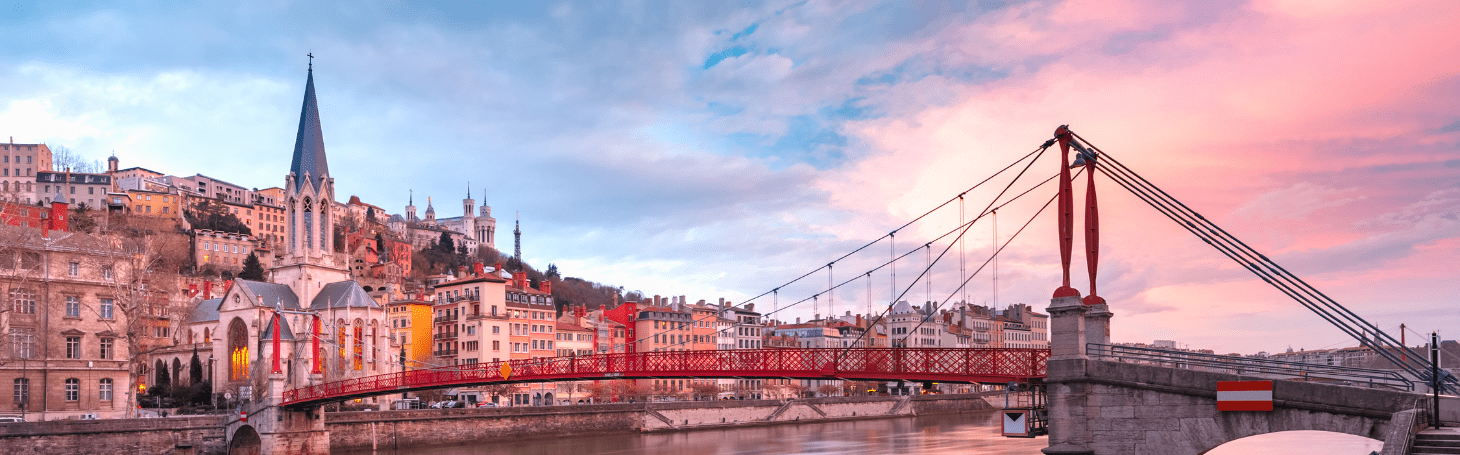
Train to Lyon - connections, tickets and itinerary
Lyon-Part-Dieu station on Place Charles Béraudier is the main station of the agglomeration. After leaving the station, you can reach the Old Town in a matter of minutes by metro or tram. From Poland, you will reach Lyon with one or two changes, usually via Paris or Strasbourg, in about 10–14 hours. For current route options and international tickets, PolishTrains helps you compare journeys through Paris or Strasbourg before planning your Lyon itinerary.
Fast facts - Lyon by train
-
Documents: valid identity card – France is a Schengen country, passport not required
-
Currency: euro (EUR) – payment by card accepted almost everywhere, cash is useful at markets and small establishments
-
Best time for a city break: April–May and September–October – daytime temperatures are 15–22°C and crowds are smaller than in summer
-
Public transport: a single ticket costs a few zlotys and a day ticket a dozen or so zlotys; for several journeys a day it is better to buy a day ticket
-
How long to stay: a weekend (Friday evening – Sunday) is enough for Vieux-Lyon, Fourvière and Presqu'île; for Croix-Rousse and Confluence, plan 3–4 days
-
Practical tip: book a table at a traditional bouchon lyonnais in advance, especially at weekends When planning a long journey, PolishTrains lets you purchase tickets without an account, with delivery by email and SMS for convenient access.
When to go to Lyon
It is best to choose spring or early autumn, when daytime temperatures are 15–22°C and tourist traffic is lower than at the peak of summer.
| Month | Daytime temperature | Weather | Tourist traffic |
| January | 5°C | Rainy, possible snow | Low |
| February | 7°C | Cool, variable | Low |
| March | 12°C | Variable, getting warmer | Low |
| April | 16°C | Mild, sunny | Moderate |
| May | 20°C | Warm, sunny | Moderate |
| June | 25°C | Warm, dry | High |
| July | 28°C | Hot, sunny | High |
| August | 27°C | Hot, afternoon thunderstorms | High |
| September | 22°C | Warm, sunny | Moderate |
| October | 17°C | Mild, variable | Moderate |
| November | 10°C | Cool, rainy | Low |
| December | 6°C | Cold, cloudy | Moderate |
Spring (March–May)
-
In March it is around 12°C during the day and 20°C in May – a light jacket is usually sufficient
-
Parc de la Tête d'Or, Lyon's largest city park, is full of greenery and flowers from April – admission is free
-
Accommodation prices are lower than in summer and queues to attractions are shorter
Summer (June–August)
-
It is 25–30°C during the day – bring a hat and water when exploring the Fourvière hill
-
Nuits de Fourvière, a theatre and music festival in an ancient amphitheatre, runs from June to August
-
Accommodation prices are higher and it is harder to get a table without a reservation at popular bouchons
Autumn (September–October)
-
September and October are a great time to visit the bouchons, as the menu features plenty of fresh produce from local farms
-
In autumn, daytime temperatures are 10–22°C, making it pleasant to walk around Croix-Rousse and Presqu'île
-
Outside long weekends, tourist traffic is lower than in summer
Winter (December–February)
-
Daytime temperatures are 3–8°C – a warm jacket is needed, but severe frosts are rare
-
At the beginning of December, the Fête des Lumières – the grand illuminations of the entire city – takes place; book accommodation several weeks in advance
-
Outside the festival, tourist traffic is low and accommodation prices are among the lowest of the year After arriving at Lyon-Part-Dieu, PolishTrains suggests checking the local day-ticket option if your sightseeing plans include several journeys.
Getting to Lyon by train
From Poland, you will travel to Lyon with one or two changes, usually via Paris or Strasbourg.
From Kraków to Lyon
-
The journey to Lyon takes approximately 11–13 hours with a change in Vienna or Strasbourg.
-
The route via Vienna continues through Switzerland, usually via Zurich or Basel, and from there to Lyon.
-
An alternative route goes via Paris and involves fewer changes along the way.
From Wrocław to Lyon
-
The route from Wrocław goes via Frankfurt or Strasbourg and the journey takes around 11–13 hours.
-
From Strasbourg to Lyon you travel by TGV with no further changes along the way.
-
Regular trains depart from Wrocław towards Germany, so the first leg can easily be combined with the rest of your journey.
From Warsaw to Lyon
-
From Warsaw to Lyon the journey takes around 12–14 hours with a change in Paris or Strasbourg.
-
On the route via Paris, you change between Paris Gare de l'Est or Paris Gare de Lyon, depending on your chosen connection.
-
You can leave in the morning and arrive in Lyon the same evening, or plan an overnight stay in Paris.
From Poznań to Lyon
-
From Poznań, the journey takes approximately 12–14 hours via Berlin and Frankfurt or via Paris.
-
In Berlin or Frankfurt you change to connections heading further west into Europe.
-
The route via Paris takes longer, but a longer layover gives you time to head into the city centre.
Seat reservation is compulsory on the international leg. You can buy your ticket on PolishTrains without creating an account – all you need is an email address and a phone number. Your ticket is sent by email and SMS, and 30 minutes before departure an SMS reminder arrives with a link to your ticket. The earlier you buy, the greater the choice of seats. The rules for refunds and exchanges depend on the carrier and the type of ticket. With PKP Intercity, you can get a refund up to 20 minutes before departure and an exchange up to 30 minutes before departure; see the refund and exchange rules for details.
Local transport in Lyon
You can get around Lyon by metro, trams and buses, and between the most important districts you can often walk as well. There is a metro stop at Lyon-Part-Dieu station, so you can reach Vieux-Lyon and Presqu'île within minutes.
For several journeys a day, it is better to buy a day ticket. Tickets can be bought from vending machines at metro stations.
Vieux-Lyon and Presqu'île can be explored on foot – the main attractions are within a 2 km radius. The Fourvière hill is reached by funicular, whose station is at Saint-Jean station in Vieux-Lyon. The funicular ride is included in your public transport ticket.
You can also hire a Vélo'v city bike – stations are located at the main points around the city. The Presqu'île and the banks of the Rhône and Saône are well suited to cycling.
The Confluence district lies to the south of the centre – get there by tram in a few minutes from Presqu'île.
If you arrive late or with heavy luggage, taxis are available at Lyon-Part-Dieu station. Ride-hailing apps also operate in the city.
Where to stay:
-
Vieux-Lyon – historic centre, close to the main attractions, intimate atmosphere
-
Presqu'île – heart of the city, good access to transport, restaurants and shops
-
Croix-Rousse – quiet hilltop neighbourhood, local atmosphere, a good choice for a longer stay
What to see in Lyon - highlights
You can see the most important sights in Lyon in two days, and explore the city centre and Old Town on foot.
Vieux-Lyon (Old Town)
One of the largest surviving Renaissance urban complexes in Europe, listed as a UNESCO World Heritage Site. You can walk through the narrow streets, 16th-century townhouses and fountain-filled courtyards in 2–3 hours. Entry to the streets and courtyards is free.
Traboules
A network of passages through townhouses and inner courtyards, unique to Lyon. Some of the traboules in Vieux-Lyon and on the Croix-Rousse are open to visitors – look for brass plaques at the gates. You can pick up a map with the marked passages at the tourist office on Place Bellecour. With the map you can walk the main traboules in about an hour.
Basilica of Notre-Dame de Fourvière
It stands at the top of the Fourvière hill and can be seen from many points across the city. Entrance is free. The terrace in front of the basilica offers a panoramic view of Lyon and, in clear weather, you can also see the Alps. Taking the funicular from Vieux-Lyon, visiting the basilica and climbing to the terrace takes around an hour.
Saint-Jean-Baptiste Cathedral
A Gothic cathedral in the heart of Vieux-Lyon with a 14th-century astronomical clock that shows the dates of religious holidays. Entrance is free. A visit takes 30–45 minutes.
Croix-Rousse district
The historic silk weavers' quarter, located on a hill above the Presqu'île. Here you will find cafés, murals on the walls of the townhouses and local shops. On Saturday mornings, the Boulevard de la Croix-Rousse hosts one of Lyon's best markets – where you can buy cheeses, charcuterie, fruit and vegetables from the region.
Confluence district
A revitalised post-industrial district on the southern tip of the peninsula, where the Rhône meets the Saône. The modern architecture here contrasts sharply with the Renaissance Vieux-Lyon. The Musée des Confluences, a museum of science and civilisation housed in a crystal-like building, charges an admission fee. Allow 2–3 hours to visit the museum.
Plan for 1 day
Morning: Vieux-Lyon – walk through the streets of the Old Town, the traboules and Saint-Jean-Baptiste Cathedral (2–3 hours). Midday: funicular to the Fourvière hill, the basilica and the panorama of the city (1–1.5 hours). Afternoon: Presqu'île – Place Bellecour, the shopping streets and the Saône waterfront (1.5–2 hours). Evening: dinner at a bouchon lyonnais in Vieux-Lyon or on the Presqu'île.
Weekend plan
Day 1: Vieux-Lyon – stroll through the streets of the Old Town, the traboules and Saint-Jean-Baptiste Cathedral, then funicular to the Fourvière hill, basilica and panorama of the city; in the afternoon the Presqu'île and dinner at a bouchon lyonnais.
Day 2: Head to Croix-Rousse in the morning – if it is a Saturday, you will find the market on the Boulevard de la Croix-Rousse. In the afternoon, take the tram to Confluence for the Musée des Confluences. In the evening, return to the Presqu'île for dinner. If you want to add another destination outside the city, you can reach Geneva by train from Lyon in under two hours.
Eating and shopping in Lyon
Lyon is famous for its bouchons lyonnais – traditional restaurants serving Lyonnaise cuisine in intimate surroundings. Food is one of the main reasons to visit.
What to order in a bouchon:
-
Quenelles – fish dumplings, usually made with pike, in a creamy sauce
-
Andouillette – offal sausage with a distinctive, robust flavour
-
Salade lyonnaise – salad with bacon, croutons and a poached egg
-
Tablier de sapeur – breaded tripe, served with tartare sauce
-
Cervelle de canut – white cheese spread with herbs, served as a starter
You will find bouchons mainly in Vieux-Lyon and on the Presqu'île. At weekends, book a table in advance as popular establishments fill up quickly.
Les Halles de Lyon Paul Bocuse – a covered market next to Part-Dieu station, open every morning. Here you will find local cheeses, charcuterie, sweets and wine. It is a great place for breakfast or lunch, as many stalls have seating.
Pralines roses – pink caramelised almonds, a Lyonnaise speciality. You can buy them at patisseries all over the city. They also often make their way into tarte aux pralines.
Shopping: the Presqu'île is the main shopping area – boutiques, department stores and local shops. The Saturday morning market on Croix-Rousse is a good place for fresh produce and local crafts.
Wine: Lyon sits between the Beaujolais vineyards to the north and the Côtes du Rhône to the south. You can order local wine in bouchons, and the pot lyonnais – a 46 cl carafe – is the traditional way to serve it.
Souvenirs
-
Pralines roses – pink caramelised almonds, available at patisseries throughout the city
-
Wine from the region – Beaujolais or Côtes du Rhône, available in wine shops and at markets
-
Silk products – a nod to the tradition of the Croix-Rousse weavers, available in local shops
How much does Lyon cost? Indicative costs
A weekend in Lyon can be done on a budget from 450 PLN if you choose budget accommodation and stick to free attractions.
| Category | Budget | Mid-range | Comfortable |
| Accommodation (1 night) | from 150 PLN | from 300 PLN | from 500 PLN |
| Food (per day) | from 60 PLN | from 120 PLN | from 200 PLN |
| Local transport (per day) | from 15 PLN | from 15 PLN | from 50 PLN |
| Attractions (per day) | from 0 PLN | from 30 PLN | from 60 PLN |
| Total | from 450 PLN | from 930 PLN | from 1,620 PLN |
Budget: hostel or budget hotel, eating at bars and bakeries, mainly free attractions such as Vieux-Lyon, Fourvière and the traboules. Mid-range: three-star hotel in the centre, lunch or dinner at a bouchon, plus the Musée des Confluences and other museums. Comfortable: four-star hotel or apartment on the Presqu'île, restaurants with reservations, taxi or Vélo'v and paid attractions.
The currency in France is the euro (EUR). Payment by card is accepted almost everywhere, and cash comes in handy at markets and small bouchons. Accommodation prices rise during the Fête des Lumières and at the height of summer, so book early.
Frequently asked questions
Check out where else you can go by train in Europe
Czech Republic
BrnoOstravaPragueOlomoucNetherlands
RotterdamAmsterdamFrance
LilleToulouseBordeauxNiceDijonLyonParisMarseilleParisAvignonSwitzerland
Château-d'OexLucerneSt. MoritzZurichLuganoBrocMontreuxInterlakenSankt GallenGenevaBernBellinzonaBaselAustria
InnsbruckVienna