



Poland
GdyniaLublinSzczecinPrzemyślGdańskPoznanSopotTorunŁódźKatowicePiwnicza-ZdrójChałupyKolobrzegOlsztynKrakowWrocławHelNowy TargKłodzkoJurataWładysławowoWalbrzychRzeszówKielceBialystokZakopaneWarsaw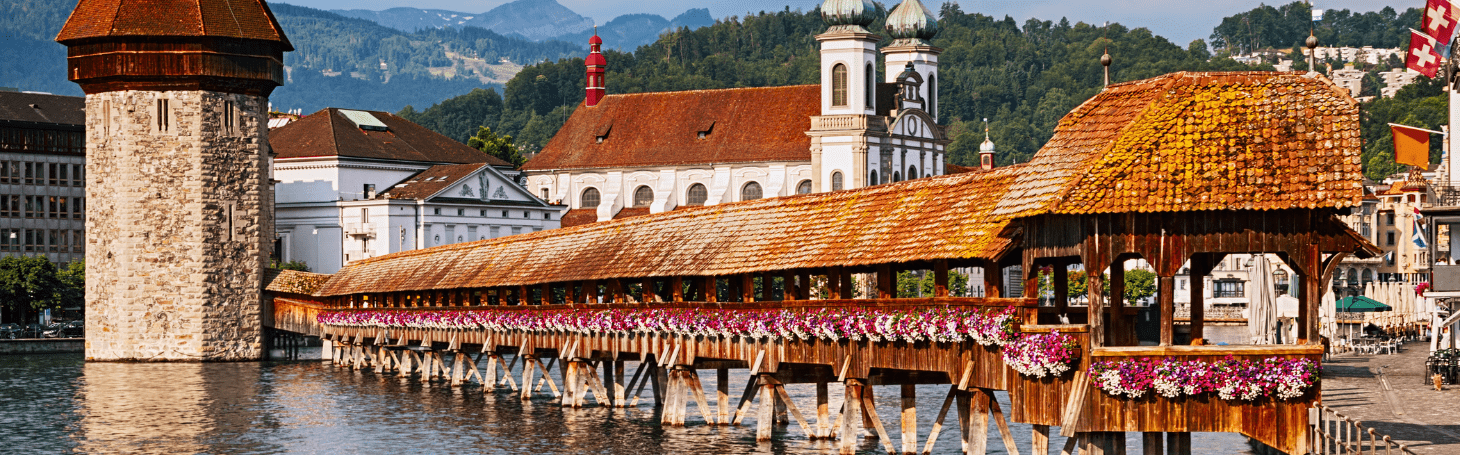
Train to Lucerne - connections, tickets and itinerary
From Luzern Bahnhof station at Zentralstrasse 1, you will reach the Chapel Bridge and the old town in just a few minutes. Switzerland is part of the Schengen area, so all you need for your trip is a valid identity card or passport. From Poland to Lucerne you travel with transfers - from Wrocław about 10 hours, from Warsaw about 14-15 hours.. PolishTrains lets you compare available routes to Lucerne and select a transfer itinerary suited to your departure city.
Fast facts - Lucerne by train
-
Currency: in Switzerland you pay in Swiss francs (CHF), not euros.
-
Local transport: you get around the centre on foot, while further districts are served by VBL buses and trolleybuses and lake ships.
-
Best time to go on a city break: preferably May, June or September, when the daytime temperature is 15-22°C and less crowded than in peak summer.
-
How much to go for: a weekend (2 nights) is enough for the main attractions of the centre. If you want to ascend Pilatus, plan a separate day for this trip.
-
Where to stay overnight: The Old Town gives you the closest access to the attractions, while the lake area provides a quieter area and nice views.
-
Practical tip: you'll see most of the attractions in the centre, such as the Chapel Bridge, the Museggmauer walls and the Jesuit Church, free of charge. The Transport Museum, cruises and the ascent to Pilatus are chargeable. When planning a walking-focused stay, PolishTrains helps you arrange the rail journey so arrival at Luzern Bahnhof fits your itinerary.
When to go to Lucerne
For a city break, it is best to choose May, June or September, when the daytime temperature is 15-22°C and tourist traffic remains lower than in peak summer.
| Month | Daytime temperature | Weather | Tourist traffic |
| January | 1°C | Frosty, possible snow | Low |
| February | 7°C | Cool, variable conditions | Low |
| March | 10°C | Spring warming, Fasnacht | Moderate |
| April | 14°C | Mild, flowering gardens | Moderate |
| May | 15°C | Warm, long days | Moderate |
| June | 19°C | Warm, sunny | Moderate |
| July | 22°C | Warmest, sunny | High |
| August | 22°C | Warm, afternoon thunderstorms | High |
| September | 17°C | Mild, stable weather | Moderate |
| October | 11°C | Cooler, autumn colours | Low |
| November | 6°C | Cool, short days | Low |
| December | 3°C | Cold, Christmas markets | Moderate |
Spring (March–May)
-
Fasnacht – colourful street parades with music and lanterns – takes place in March. It is more crowded during this period and accommodation is worth booking in advance.
-
In April, the Richard Wagner Museum opens, the gardens are in bloom and at 14°C it is comfortable to stroll through the old town.
-
In May, the Lucerne Festival Pulse takes place and the day lasts about 15 hours, so you have plenty of time to explore.
Summer (June–August)
-
At the end of June, the Lucerne City Festival takes place – a free city event on the lake with concerts and food stalls.
-
July and August sees the Lucerne Festival in Summer, a classical music festival held since 1938. During this time, temperatures reach 22°C, but accommodation prices are the highest of the year.
-
August sees regular afternoon thunderstorms, so it is advisable to carry a rain jacket.
Autumn (September–October)
-
September sees the World Band Festival with many free open-air concerts by orchestras from around the world.
-
September is one of the best months for a city break - the daytime temperature is 17°C, the weather tends to be stable and there is less tourist traffic than in summer.
-
In October, autumn colours appear at Lake Lucerne and the temperature drops to 11°C.
Winter (November–February)
-
The Museggmauer walls are closed from November to March, so plan to climb the towers at another time.
-
From December to February, the daytime temperature is -4 to 7°C and the day lasts about 8.5 hours. In December, the Christmas markets are well worth a visit.
-
From October to March, on Fridays, there is a Fondue & Raclette cruise on the lake – dinner on a ship overlooking the illuminated mountains. For the international section, PolishTrains allows you to book the required ticket while checking the transfer itinerary before departure.
Getting to Lucerne by train
You will travel from Poland to Lucerne with one or two changes, usually via major stations in Germany and Switzerland.
From Wrocław to Lucerne
-
You travel about 10 hours with one or two changes.
-
Most often you change trains at Berlin Hauptbahnhof station or Frankfurt am Main station and then at Basel SBB station.
-
Departing in the morning allows you to reach Lucerne in the evening of the same day.
From Krakow to Lucerne
-
You travel from Krakow to Lucerne in about 13-14 hours with changes via the Czech Republic or Germany.
-
Depending on the connection you choose, you change trains at major hub stations, with the last change falling at Basel SBB station.
-
The exact route depends on the day and time of departure.
From Warsaw to Lucerne
-
From Warsaw to Lucerne you travel approximately 14-15 hours with changes.
-
Most often, the route goes via Berlin Hauptbahnhof station or Frankfurt am Main station and then via Basel SBB station.
-
You can either leave in the morning and arrive in the evening, or choose to arrive in Berlin at night and continue your route in the morning.
From Poznan, Gdansk, Katowice and Lodz you will also travel to Lucerne with transfers via Berlin or other major hubs in Germany and Switzerland. Seat reservations are compulsory for the international section. The earlier you buy your ticket, the greater the choice of seats and the better the price. On PolishTrains you buy your ticket without registration - it goes to your e-mail and SMS. 30 minutes before departure you get an SMS reminder with a link to your ticket. Rules for refunds and exchanges depend on the carrier; for PKP Intercity tickets, refunds are possible up to 20 minutes before departure, and exchanges up to 30 minutes before departure. Details can be found on the page describing the rules for refunds and exchanges.
Local transport in Lucerne
You get around the centre of Lucerne mainly on foot. The main attractions lie close to each other, so walking is enough for most of your sightseeing plan.
Lucerne does not have a metro. Public transport consists of VBL buses and trolleybuses, which connect the centre with further districts and surrounding towns. A single ticket costs the equivalent of a few Swiss francs. For several journeys per day, a day ticket will be more convenient. The fine for travelling without a ticket is substantial, so it is worth always carrying your ticket with you.
The lake boats are part of the public transport system and connect Lucerne with towns around Lake Lucerne. For a trip to Pilatus, you can sail to Alpnachstad, from where the cogwheel railway to the summit departs.
For longer stays or multiple journeys, it is worth checking out the Swiss Travel Pass, which covers public transport, trains and some mountain railways throughout Switzerland.
Where to stay:
-
Old Town (Altstadt) - the tourist centre – you can walk to the main attractions, but accommodation prices are higher.
-
By the lake - it is quieter and more scenic, and you can walk to the main attractions in a few minutes.
What to see in Lucerne - highlights
Kapellbrücke (Chapel Bridge)
The oldest wooden bridge of its kind in Europe, built in 1360. Inside, paintings from the 17th century depicting the history of the city and Lucerne's patron saints have been preserved. Next to the bridge stands the Water Tower (Wasserturm) from around 1300 – one of the oldest buildings in the city. The tour takes 30-45 minutes and admission is free. It is easier to take photos in the morning without the crowds.
Museggmauer
Medieval fortification walls from the 14th–15th century, 870 metres long with nine towers. Four towers are open to visitors from April to November. The clock on the Zytturm tower from 1535 strikes one minute ahead of all other clocks in the city. From the Männliturm tower you will see a panorama of the city, the lake and the Alps. The tour takes 45-90 minutes and admission is free.
Mount Pilatus (2,128 m)
From the summit you will see 73 Alpine peaks. You ascend on the world's steepest cogwheel railway with an incline of 48%, and the ride takes about 40 minutes. The cogwheel railway mainly operates from May to November. There is an entrance fee. The excursion takes 4-6 hours including travel from Lucerne. Tickets are worth buying online, and it is best to head to the summit in the morning or towards evening.
Museum of Transport (Verkehrshaus der Schweiz)
One of the largest museums in Switzerland, dedicated to rail, air and space transport. Inside you will also find the Swiss Chocolate Adventure and a planetarium. The tour takes 3-8 hours, depending on your interests. There is an entrance fee, and Swiss Travel Pass or Swiss Museum Pass holders receive a 50% discount. The museum is outside the centre and you can get there by bus in a few minutes. It is open daily.
Spreuerbrücke (Mill Bridge)
A wooden bridge from 1408 with 45 surviving "Dance of Death" paintings from the 16th–17th centuries. It is less crowded than the Kapellbrücke, and equally atmospheric. The tour takes 20-30 minutes and admission is free.
Jesuit Church (Jesuitenkirche)
The oldest and largest Baroque church in Switzerland, built between 1666 and 1677. The interior is distinguished by frescoes and stucco work. The tour takes 30-45 minutes and admission is free.
Lake Lucerne
A catamaran cruise takes about an hour and offers views of Pilatus, Rigi and Bürgenstock. There is an entrance fee. From October to March, on Fridays, there is a Fondue & Raclette cruise – dinner on board with a traditional Swiss menu.
Plan for 1 day
Start the morning with the Kapellbrücke and Spreuerbrücke – both bridges are close to each other over the Reuss River. Before noon, plan a walk around the old town with a visit to the Jesuit Church. In the afternoon, climb the Museggmauer walls and lookout towers. In the evening, stroll along the Reuss quay with views of the illuminated bridges. Pilatus and the Transport Museum require a separate day.
Plan for the weekend
Day 1: Old town, both bridges, the Jesuit Church and the Museggmauer walls. In the evening, dinner by the lake or a walk along the quay.
Day 2: excursion to Pilatus (4-6 hours including travel) or the Transport Museum (3-8 hours). If you choose Pilatus, there will still be time for a lake cruise on your return.
Eating and shopping in Lucerne
What to eat
Fondue and raclette are classics of Swiss cuisine. Fondue involves dipping bread in melted cheese, while raclette is cheese scraped straight from the wheel onto a plate with potatoes and gherkins. You can try these dishes in restaurants in the old town or during the Fondue & Raclette cruise on the lake.
Rösti are crispy potato pancakes, popular for breakfast and lunch. Wirtshaus Galliker is a well-known address for local cuisine with traditionally served rösti.
Alplermagronen is alpine pasta with potatoes and cheese, served with apple compote. Luzerner Käsekuchen is a savoury cheesecake and a regional speciality. You can find both dishes at the Rathaus Brauerei next to the town hall.
The Old Swiss House has been in operation since 1931 and is famous for its antique décor from the 17th century. The menu features, among other dishes, sirloin in green pepper sauce and pike with ratatouille.
Where to eat:
-
Kornmarkt - a square with traditional restaurants next to the town hall dating from 1602–1606.
-
Reuss quay (Rathausquai) - restaurants overlooking the Chapel Bridge.
Souvenirs
-
Swiss chocolate - a classic souvenir available in many shops in the centre.
-
Miniature Kapellbrücke models - a popular souvenir inspired by the city's symbol.
-
Traditional Alpine cowbells - a characteristic souvenir of the region.
Most shops are open from 9:00 to 18:00 and have shorter hours on Sundays or remain closed.
Food costs: Switzerland is one of the most expensive countries in Europe for dining out, with budget meals at a café or bar and restaurant dinners priced well above what you would pay in Poland. Switzerland is one of the most expensive countries in Europe in terms of gastronomy.
How much does Lucerne cost? Indicative costs
Lucerne is noticeably more expensive than Poland, especially in terms of food and accommodation. You will see many of the centre's main attractions free of charge, so the biggest expenses usually relate to accommodation and mountain tours.
| Category | Budget | Mid-range | Comfort |
| Accommodation (1 night) | 100-150 zł | 300-500 zł | 500-900 zł+ |
| Food (per day) | 120-180 zł | 240-360 zł | 450 zł+ |
| Local transport | 20-30 zł | 40-60 zł | 60-80 zł |
| Attractions | 0 zł | 80-150 zł | 200-350 zł |
| Total | 240-360 zł | 660-1070 zł | 1210-1780 zł+ |
In the budget option, you visit free attractions such as bridges, walls and churches, and eat at cheaper cafés. The mid-range option includes entry to the Transport Museum or a lake cruise and meals in traditional restaurants. The comfort option means a four- or five-star hotel, Pilatus, fine dining and lake boats.
Switzerland is noticeably more expensive than Poland, especially in terms of food and accommodation. You will see many of the centre's main attractions for free, so the biggest expenses tend to be for accommodation and mountain tours.
Frequently asked questions
Check out where else you can go by train in Europe
Czech Republic
BrnoOstravaPragueOlomoucNetherlands
RotterdamAmsterdamFrance
LilleToulouseBordeauxNiceDijonLyonParisMarseilleParisAvignonSwitzerland
Château-d'OexLucerneSt. MoritzZurichLuganoBrocMontreuxInterlakenSankt GallenGenevaBernBellinzonaBaselAustria
InnsbruckVienna