




Emergency stopping of a train - rules, regulations and consequences | PolishTrains
Published
An emergency stop of a train is a situation that requires a quick reaction and precise action from both the driver and all railway staff. Knowledge of the applicable rules, regulations and the potential consequences of such an incident is essential to ensure passenger safety and maintain the smooth operation of rail traffic. Find out the most important information on emergency stopping of a train.
At a glance
At a glance
- Emergency stopping of a train is only lawful when there is a genuine and immediate risk to life or health
- The emergency brake interrupts the air brake system and applies the brakes on all carriages automatically
- Any passenger or crew member may activate the emergency brake in a life-threatening situation
- Unjustified use can result in a 900 PLN carrier surcharge, a fine of up to 5,000 PLN, or criminal liability
- After activation, passengers must remain in place and inform the conductor of the reason for the stop
- Appeals against carrier penalties can be submitted to the Rail Passenger Ombudsman at pasazer.gov.pl
What is an emergency stop of a train and in what situations can it be used?
Emergency stopping of a train is the immediate interruption of the running of a train when there is a risk to the life, health of persons on board or to the safety of rail traffic. It is an action taken in exceptional cases where further running could lead to serious consequences such as an accident or collision.
An emergency stop is used, inter alia, in situations such as:
- the appearance of an obstacle on the track,
- sudden danger to passengers or staff (e.g. technical failure, fire, fainting of a person on board),
- inappropriate behaviour of persons on the platform or in the train,
- warning signals from the dispatcher or other railway services indicating a danger.
By responding quickly and appropriately to such situations, the risk of accidents can be significantly reduced and travel safety increased.
How does the emergency brake on a train work and who can use it?
The emergency brake is a mechanism designed to stop a train immediately in an emergency situation. Activating it interrupts the air circulation in the brake system, which in turn leads to the automatic application of the brakes on all wagons - irrespective of the driver's reaction. This brings the train to a stop as quickly as possible, minimising the risk of an accident.
The emergency brake can be used by
- any passenger who notices a life or health threatening situation,
- members of the train crew if the driver does not react in time.
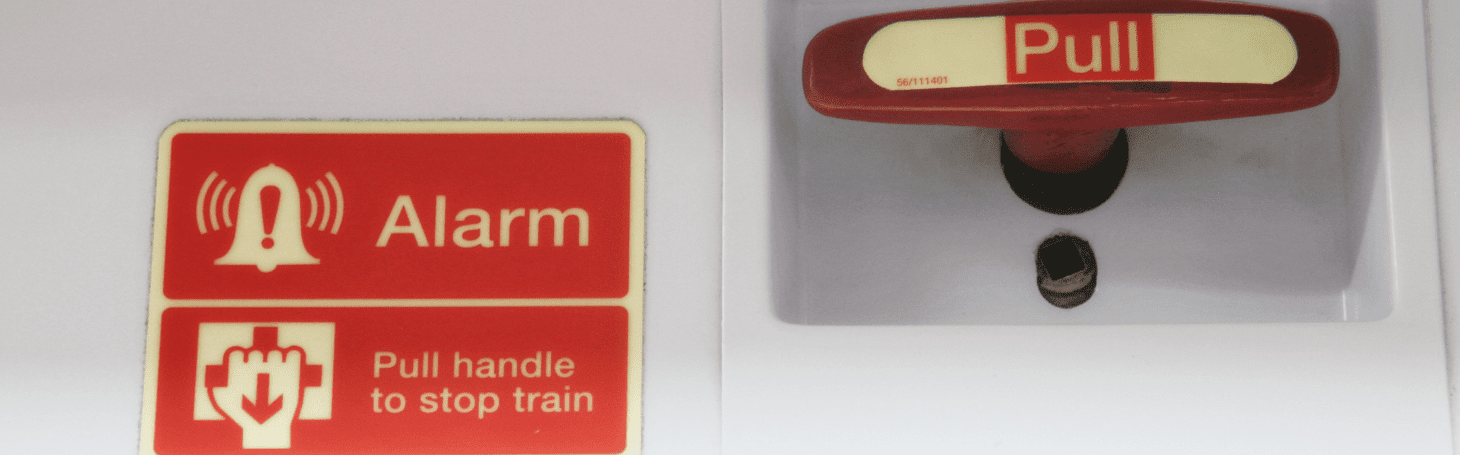
Special levers or buttons are located in the passenger carriages. Their use not only stops the trainset, but also triggers an emergency signal and informs the relevant services of the breakdown or danger.
When can the emergency brake be used?
Although every passenger has access to the brake, it must not be applied without reason. Unjustified stopping of a train can lead to:
- serious delays and disruption to traffic,
- safety risks (e.g. sudden braking can be dangerous for standing passengers),
- legal or financial liability of the person who used it without justification.
The emergency brake can only be applied without consequences if there is a real and immediate danger to passengers, crew or persons near the tracks.
Examples of situations where use is justified:
- Emergency health problems: fainting, attack of illness, serious injury to a passenger or crew member.
- Fire or smoke in the carriage.
- An obstacle on the tracks (e.g. vehicle, animal, piece of infrastructure) that could cause a derailment or collision.
- Aggressive or dangerous behaviour of passengers that endangers other people.
- Other emergency situations that require an immediate stop of the train set to avoid danger.
The emergency brake on a train is a life-saving tool, but should only be used when justified. In emergency situations it is a fully justified action and has no legal consequences. However, activating it inappropriately or unnecessarily can be a serious offence.
Stopping a train without reason - what are the consequences for the passenger?
Unjustified stopping of a train, especially by using the emergency brake without any real danger, is taken very seriously by the railway services and the law. A passenger who causes such an action risks both financial and legal consequences. In practice, an unjustified stop can lead to delays, disruption of the timetable, and increased costs for the operator, which are often passed on to the perpetrator of the incident. In addition, a passenger who interrupts a train for no reason can be fined or penalised and, in extreme cases, if their action causes serious consequences they may face criminal liability. It is therefore worth remembering that the emergency brake is an emergency measure and should only be used in situations of real danger.
Penalty for stopping a train without justification - what does the legislation say and what is the practice?
Stopping a train without justification, including the unlawful use of the emergency brake, is treated as an offence or a criminal offence under several acts:
- Article 160 of the Penal CodeConcerning the Introduction of a Danger of a Catastrophe in Land Traffic. If the stopping of a train without justification causes danger to the life or health of many persons or substantial damage to property, this may be treated as a criminal offence punishable by imprisonment for up to 3 years.
- Regulations for the**Carriage of Passengers, Goods and Animals in Rail Transport.**The regulations of individual rail operators often contain provisions on the prohibition of unjustified use of the emergency brake and on financial penalties or other sanctions against passengers who violate these rules.
- Article 97 § 1 of the Code of Offences speaks of interfering with official activities or with the activities of public utilities. Stopping a train without justification may be classified as interfering with the activities of a railway establishment, which is an offence. This offence is punishable by a fine of up to PLN 5,000.
The legal consequences of an unjustified train stop can range from fines and penalties to criminal liability for more serious consequences. In addition, rail operators can claim compensation for losses incurred and offenders can be excluded from further services. All of this is aimed at ensuring the safety and fluidity of rail traffic.
This may interest you 👇
Rolling stock failure - what does it mean and how long can it last?
Your train did not arrive on time and all you heard was the message rolling stock failure? If you bought a ticket on PolishTrains, you can check the refund and exchange rules on the help page. We explain what this message means, how long it may take to fix the fault and what to do step by step. You can check the current service status and any timetable changes following a rolling stock failure in the PolishTrains search engine by entering the train number and travel date. This mysterious term refers to an unexpected train fault that can lead to delays or disruptions in rail traffic. What exactly is meant by this term, what consequences does such a breakdown entail and how long does it take to rectify it - you will find this information below!

PKP service time and technical interruption - how long does it last and what is worth knowing?
Buying a ticket on the PKP website you may come across the message "PKP technical break". You can check the current sales status in the PolishTrains search engine, where you can buy a ticket without creating an account. When the PKP Intercity system is unavailable, it is useful to know which tickets you can still buy and when you can ask the conductor for a ticket. Direct trains to Germany, the Czech Republic, Austria, Hungary, Slovakia and Lithuania are displayed immediately in the PolishTrains (polishtrains.eu) search engine, just like domestic connections. For many travellers, this can seriously derail their plans, so it's worth knowing what this is about and when such a break is scheduled.First and foremost, it's important to stress that this is not a breakdown, but a regular, scheduled PKP service time.