




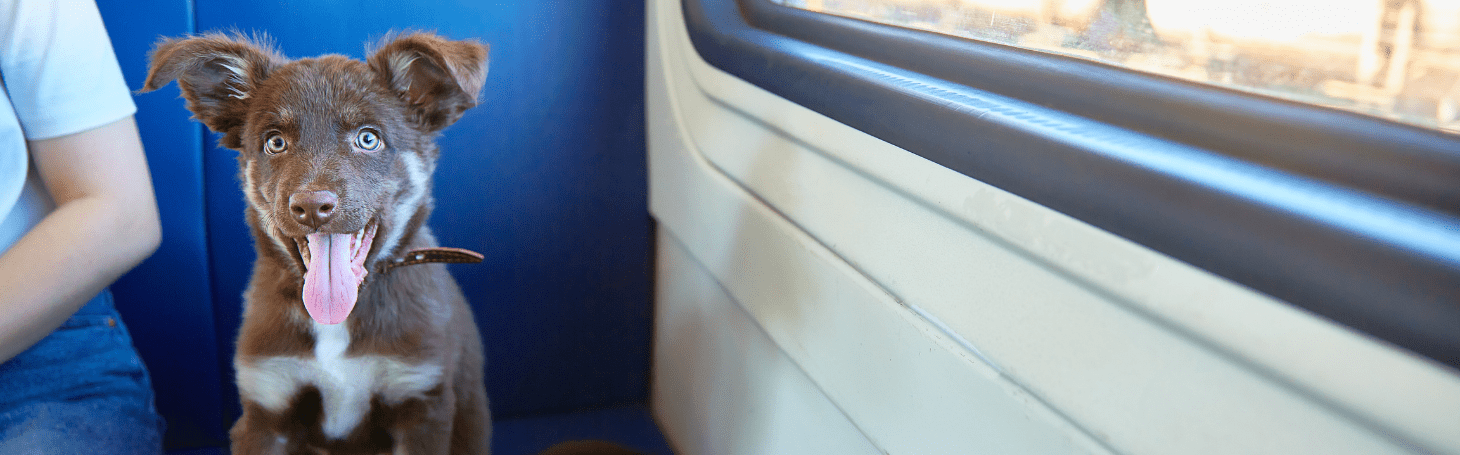
Dog on the train - how do you transport a dog on a train? | PolishTrains
Published
Would you like to take your pet on the train? You will find detailed rules for transporting animals, including the required documents and permitted accessories, in the PolishTrains guide to travelling with luggage and animals. Before travelling, also check which documents to bring and when a ticket is required for a dog. Many travellers take their dog on a seaside holiday, and you can check the timetable and ticket for your chosen route in the PolishTrains search engine. Are you planning a trip together to the mountains or the seaside, or perhaps to visit family in another city? You can transport your dog comfortably on PKP Intercity and on the trains of most regional carriers. Read on to find out how much it costs for a dog ticket on a train, what transporting your pet is like on PKP and what you need to bear in mind if you are facing a long train journey with your dog.
At a glance
-
Dog in a carrier: travels free of charge – you keep the carrier on your lap or in the luggage area; a muzzle is not required
-
Dog outside a carrier: a ticket is required – the dog must be on a lead and wearing a muzzle
-
Documents: bring proof of a current rabies vaccination and a vaccination certificate on every journey; when travelling abroad, an animal passport is also required
-
Assistance dog and guide dog: travel free of charge on PKP Intercity – the rules for assistance dogs and guide dogs differ in terms of the accessories that are mandatory
-
Buying a ticket for a dog: you can add the ticket when booking your seat on PolishTrains or with the help of the Customer Service Office ### At a glance
- PKP Intercity allows dogs, cats, rabbits, rodents, birds and fish in appropriate carriers
- Pets in a closed carrier travel free of charge on PKP Intercity trains
- Dogs outside a carrier must be on a lead and wear a muzzle
- Every dog must have a current rabies vaccination certificate regardless of how it travels
- Guide and assistance dogs travel free on PKP Intercity; the handler must carry confirming documents
- A pet passport and microchip documentation are required for crossing the Polish border with a dog
Can a dog be transported on a train?
A dog on the train is an increasingly common sight, with many travellers choosing to share journeys with their pet on both short and long journeys. It is worth remembering, however, that carriers allow the carriage of animals under certain restrictions.
The most popular Polish long-distance carrier, PKP Intercity, allows not only dogs but also other pets such as cats, pet rabbits, rodents, canaries, fish or turtles, provided they are placed in an appropriate carrier. If you want to reduce your animal’s stress during changes, you can check direct connections on your chosen route in the PolishTrains search engine. A pet is understood to be a pet that stays at home with you and is your companion. However, you will not transport farm animals such as cattle, sheep or poultry on the train.
What regulations govern transporting a dog on a train?
How to transport a dog on a train is regulated by the general regulations of the Railway Transport Office (UTK) and the regulations of the individual carriers.
Carriage of animals on PKP - the most important UTK guidelines:
-
each passenger may transport one animal under his/her care,
-
small dogs and other pets which travel in a carrier,
-
may be transported free of charge,
-
a possible charge is levied in the PKP for transport of a dog if it is not placed in a carrier,
-
a dog that is not in a carrier must be on a leash and muzzled,
-
every dog, regardless of the mode of transport, must have a current vaccination against rabies, and you must take the vaccination certificate with you on the journey
-
there is a 95% discount for guide dogs, however, many carriers offer free travel for these animals.
The rules may be different with other carriers, so before travelling check the current information in the PolishTrains guide to transporting luggage and animals. Other rules may apply on international trains and for journeys already abroad. Always check with the carrier before travelling to find out what is available for your dog - the rules can be very similar, but can also vary greatly. Some countries also have additional restrictions on travelling with your pet.
In addition to a vaccination certificate, you will also need to obtain a passport for your dog to enable it to cross the Polish border.
How much does a dog ticket cost on the PKP?
-
Dog in a carrier: travels free of charge – you keep the carrier on your lap or in the luggage area; a muzzle is not required
-
Dog outside a carrier: a ticket is required – the dog must be on a lead and wearing a muzzle
-
Documents: take up-to-date rabies vaccination and vaccination records on every journey; when travelling abroad, an animal passport is also required
-
Assistance dog and guide dog: travel free of charge on PKP Intercity – the rules for assistance dogs and guide dogs differ in terms of the accessories that are mandatory
-
Buying a ticket for a dog: you can add the ticket when booking your seat on PolishTrains or with the help of Customer Service You do not always have to have a separate ticket for your dog, the PKP allows you to carry your pet free of charge if it has been placed in a carrier such as a cage, container or basket. You must hold the carrier containing your dog or cat on the train on your lap or place it in the space provided for free luggage - above or below your seat in the compartment or in another designated area. Importantly, the cage or other container must not be on tables, seats, lounging areas or sleeping beds. The animal must also have limited access to its surroundings and must not protrude from outside the carrier so that it does not impede the journey of fellow passengers.
If your dog is too large or you simply do not want to transport it in a special carrier, you can bring it on board the train on a lead and with a muzzle. If you want to reduce your animal’s stress during changes, you can check direct connections on your chosen route in the PolishTrains search engine. Before travelling, check the current information on the carrier’s website or in the PolishTrains guide to travelling with luggage and animals. You will then need to purchase a PKP dog ticket - the charge is a flat rate of PLN 15.20 regardless of the length of the route you are travelling on. You will conveniently purchase your dog ticket when booking your seat.
If you have not bought a ticket for your dog beforehand, you can also do so from the conductor; on PKP Intercity, this involves an additional charge of 20 PLN. On the other hand, failure to purchase a ticket or inappropriately transporting your pet may result in a fine and, in special cases, the need to leave the train at the nearest station.
Assistance dog and guide dog on board a train
On PKP Intercity, you will transport your guide dog, assistance dog and dog trained as an assistance dog free of charge. However, specific rules must be observed:
-
assistance dog - should have a waistcoat or harness marked 'assistance dog' and a certificate confirming its role, importantly it does not need to be muzzled or led on a lead,
-
guide dog - should have a muzzle and be kept on a lead, and its owner must bring the appropriate documents confirming the legitimacy of travelling with a guide dog. The rules may be different with other carriers, so before travelling check the current information in the PolishTrains guide to transporting luggage and animals.
How do I report the carriage of my dog when I buy a ticket?
Not sure how to buy an Intercity or other carrier's dog ticket? You can buy it on PolishTrains without registering, and the ticket will be sent by email and SMS. You can buy domestic tickets on PolishTrains up to 30 days before travelling.
If you need help, contact the PolishTrains Customer Service Office: telephone 703 402 010, email kontakt@PolishTrains.pl, every day 7:00-23:00. You will find the details on the PolishTrains contact page. Get in touch with the Customer Service Desk at PolishTrains. You can do this by email**(contact@polishtrains.eu)** or by telephone (hotline: +(48) 12 345 16 61). PolishTrains employees will help you purchase your ticket and answer your questions about your journey.
You do not need to buy a ticket if your pet is in a carrier, in this situation you only need to buy a ticket for yourself and your pet will not leave its cage for the entire journey. If you are travelling in a compartment carriage, you only need to ask permission from the other passengers (this does not apply to assistance and guide dogs). If a person objects to travelling in a compartment with your pet, you must go to the conductor who will assign another seat for you. This rule does not apply to compartmentless carriages, where you do not need to get permission from other travellers to travel with your dog.
When purchasing your ticket, we also recommend that you reserve a seat under the window, so that your dog can lie quietly on the floor, without disturbing others, and even less stressed by people passing over him, which can happen when he is in the aisle.
Importantly, your dog is not allowed:
-
in the catering carriage (except for assistance and guide dogs),
-
on seating areas,
-
on a bed in a sleeping car,
-
on the reclining seats in a BC carriage.
In a sleeper or lie-flat carriage, as a general rule, you may only transport your dog if you have purchased all the seats in the compartment, but you must adhere to the rule that your dog may not be on beds or other passenger seats. If he is not travelling in a carrier, sit him directly on the floor or spread a blanket over him.
Rules for transporting dogs of different breeds and sizes
Do you have a German Shepherd or Labrador retriever and wonder whether your dog can travel on the train if it is large in size? We have good news - you can also transport such a pet on the train! Carriers allow dogs of all sizes to be transported on condition that they do not disturb or endanger other passengers.
As you will not be transporting your dog in a carrier, you must keep him on a leash and muzzled throughout the journey to ensure the comfort of others and to avoid exposing you and your pet to unpleasantness. Also remember to prepare your pooch for such a journey. If this is his first journey and new situations make him anxious or stressed, be sure to contact your vet beforehand. When travelling with a dog to Karpacz, it is worth checking the timetable in the PolishTrains search engine and choosing a date outside the busiest period.
Dog on a train without a muzzle - does a dog have to be muzzled on a train?
Do you have a small dog and are wondering whether your dog must be muzzled on the train and whether there are any exceptions to this rule? We are already in a hurry to answer! If your pet is travelling in a carrier, there is no need to muzzle him. In a situation where you are alone in the carriage and your dog is not in a carrier, you can remove its muzzle - until other passengers are seated. However, you should be prepared to quickly put it on your pet at the request of other travellers or the conductor. A dog on a train without a muzzle can be a danger to others, especially if it has not been on public transport before and is stressed.
Travelling with your dog - practical advice for owners
Do you want your journey to pass pleasantly and stress-free and your dog to feel really comfortable on the train? Take along his favourite toy (necessarily one that doesn't make a sound) or a blanket - this will make him feel more secure and comfortable. If it's his first train journey, it's worth consulting your vet. He or she will choose the right anti-stress product to make the journey easier and give your pet more peace of mind.
Planning a long train journey with your dog? Consider travelling with a change of train! Many hours in a compartment can be too tiring for your dog - eventually there will come a point when he needs a walk and a toilet. A short change break will allow him to stretch his paws and take care of his needs. Or perhaps your train has a longer stop at one of the stations? Check if you can actually make it in time for a brisk walk. Your pet is not allowed to do his business on the platform or within the station, and with a possible delay the stop may be shortened. If you're not familiar with the area, it's best not to take any chances - your pooch may become stressed and you may not make it back in time.
Remember that, as a guardian, you are responsible for cleaning up after your pet if he or she has a mishap. Therefore, stock up on poop bags, liners, a paper towel or wet wipes in advance to help you deal with the problem quickly.
When travelling with a dog to Karpacz, it is worth checking the timetable in the PolishTrains search engine and choosing a date outside the busiest period. Looking for ideas for a trip? Take a peek at the inspiration from PolishTrains! Check out what is worth visiting in Szklarska Poręba, Łeba or Wrocław.
Marcin Lis, member of the PolishTrains team. A travel enthusiast who regularly travels by train across Poland and Europe. Analyst and marketer studying travellers’ needs and behaviour since 2017.