



Sopot - attractions and places to see at the Polish seaside
Published
Can you fall in love with a city from the first step? You can buy train tickets on PolishTrains without creating an account – the ticket is sent by e-mail and SMS, and you can reach Sopot from many major cities. The route runs from Sopot Centrum station via Muzeum Sopotu, Skwer Kuracyjny and the pier to Krzywy Domek and Monciak, returning to the starting point. Sopot is one of Poland’s spa resorts that is easiest to reach by train – you can check connections from many cities in the PolishTrains search engine. In Sopot - definitely yes! Just step out of the train station and let yourself be swept away by the unique atmosphere of this seaside city. Regardless of the season, Sopot always has something to offer - from relaxing on the beach, through the history of the German resort to atmospheric walks on the longest wooden pier in Europe. Find out how to get to Sopot from the biggest cities. Hop on the train to Sopot!
Table of contents
- 1. THE BEST ATTRACTIONS IN SOPOT - WHAT TO SEE AND VISIT?
- 1.1 What is worth seeing in Sopot? Obligatory points on the city map
- 1.2 Attractions in Sopot - from the pier to lesser-known places
- 2.WHAT TO VISIT IN SOPOT? A GUIDE FOR EVERY TOURIST
- 2.1 The Sopot Museum
- 2.2 Pump room for saline waters
- 2.3 Cure Square
- 2.4 Sopot pier
- 2.5. Beach in Sopot
- 2.6 Sopot Castle
- 2.7 Crooked House
- 2.8 Bohaterów Monte Cassino Street - Monciak Street
- 2.9 St George's Church
- 3. HOW TO GET TO SOPOT?
- 3.1 Low-cost train to Sopot
- 3.2 What should you know before you travel?
- More travel inspiration
1. THE BEST ATTRACTIONS IN SOPOT - WHAT TO SEE AND VISIT?
Sopot is one of the most beautiful seaside resorts in Poland, offering both well-known and less obvious attractions. If you're wondering what to see in Sopot, you can't miss the Sopot pier - the longest wooden pier in Europe. A walk on it is the perfect opportunity to admire the Bay of Gdansk. Right next to it is the Kuracyjny Square, full of cafes and elegant buildings, as well as the Lighthouse, from where you can enjoy a beautiful panorama of the city.
1.2 Attractions in Sopot - from the pier to lesser-known places
Sopot's attractions are not only the famous pier. Its lesser-known corners are also worth discovering, such as the Sopot Museum, which is housed in a beautiful historic villa where you can learn about the history of the city and its development as a resort. Another place worth a visit is the Pijalnia Wód Solankowych, where you can taste the healthful water from the St Adalbert's Spring. While strolling around the city, look out for unique architecture - on Haffnera Street you will find charming wooden villas from the turn of the 19th and 20th centuries. If you are looking for an icon of Sopot, visit the Forest Opera, where concerts and cultural events are organised in a natural setting.
2.WHAT TO VISIT IN SOPOT? A GUIDE FOR EVERY TOURIST
We start from the railway station📍SopotCentrum, which for many years was one of the key transport hubs of the region. Already in 1909 Sopot had direct railway connections to Berlin, Bydgoszcz, Königsberg, St. Petersburg, Poznan, Szczecin, Toruń and Warsaw. In the interwar period, when Sopot belonged to the Free City of Gdańsk, trains ran here even every ten minutes during rush hour! PKP tickets for routes to Sopot are usually cheaper outside the peak holiday season, and you can check current prices for your chosen day in the PolishTrains search engine. It is here that tourists from all over Poland get off in high season to discover the charms of the seaside resort. After leaving the station, we head to a place that will allow us to explore the history of Sopot. We go to 📍Museum ofSopot ⤵️
🕚15 min 🚶1.2 km
2.1 The Sopot Museum
The museum is housed in an elegant villa from the early 20th century, which was a former summer residence. Did you know that for centuries Sopot functioned as a small fishing settlement before it became a spa? Its development as a resort began in 1823, when Dr Jean Georg Haffner established the first sea bathing resort here. Over the years the town, then bearing the German name Zoppot, grew in popularity and became a favourite holiday destination for the aristocracy and elite. In the Sopot Museum you will find old photographs, furniture and memorabilia that will take you back in time to the heyday of the resort. This is the perfect place for history and architecture lovers and anyone who wants to better understand the unique atmosphere of the city. From the museum we go to recuperate in the 📍PijalniaWód Solankowych ⤵️.
🕚10 min 🚶750 m
2.2 Pump room for saline waters
The Pump Room of Saline Waters is located in the Spa House, one of the most important buildings in Sopot. It is a beautiful building combining a sanatorium and cultural function, so it is worth stopping for a moment to admire its interiors. The first Spa House in Sopot was built in 1824, serving a spa function. The current building refers to the modernist style from 1910. In the pump room, you can taste the therapeutic brine that comes from the St Adalbert's Spring, located 800 metres underground. The mineral-rich water has positive effects on the digestive and respiratory systems. Leaving the building, we stand at our next attraction: we are at the📍 Curaçao Square ⤵️.
🕚1 min 🚶100 m
2.3 Cure Square
This is the heart of touristic Sopot, full of cafes, restaurants and street artists. As far back as the 19th century, patients gathered here, enjoying the sea air and looking for company. In the summer, concerts and cultural events are held here, giving the place a unique atmosphere. Near the square is the historic lighthouse, which originally served as the boiler room chimney of the Balneological Plant. Today, it is open to the public as a vantage point from which you can admire the panorama of the city and the Bay of Gdańsk. From here you can see our next attraction and it is the famous📍 Sopot pier ⤵️.
🕚1 min 🚶100 m
2.4 Sopot pier
An icon of the city and the longest wooden pier in Europe - its walking part is as long as 511.5 metres. Strolling along the pier, you can admire views of the Bay of Gdansk and feel the refreshing sea breeze. Thanks to its overhanging construction, the pier acts as a natural inhaler - the air in the area contains a lot of iodine, so it is a therapy for the respiratory tract. There is a marina at the end of the pier. There is also a restaurant where you can enjoy both local food and the view of the open sea. In the summer season, from the pier you can take a cruise around the bay or to the nearby Hel peninsula. Head back inland for a stroll along one of the most popular beaches on the Baltic Sea. Heading:📍 Beach at Sopocie⤵️
🕚11 min 🚶850 m
2.5. Beach in Sopot
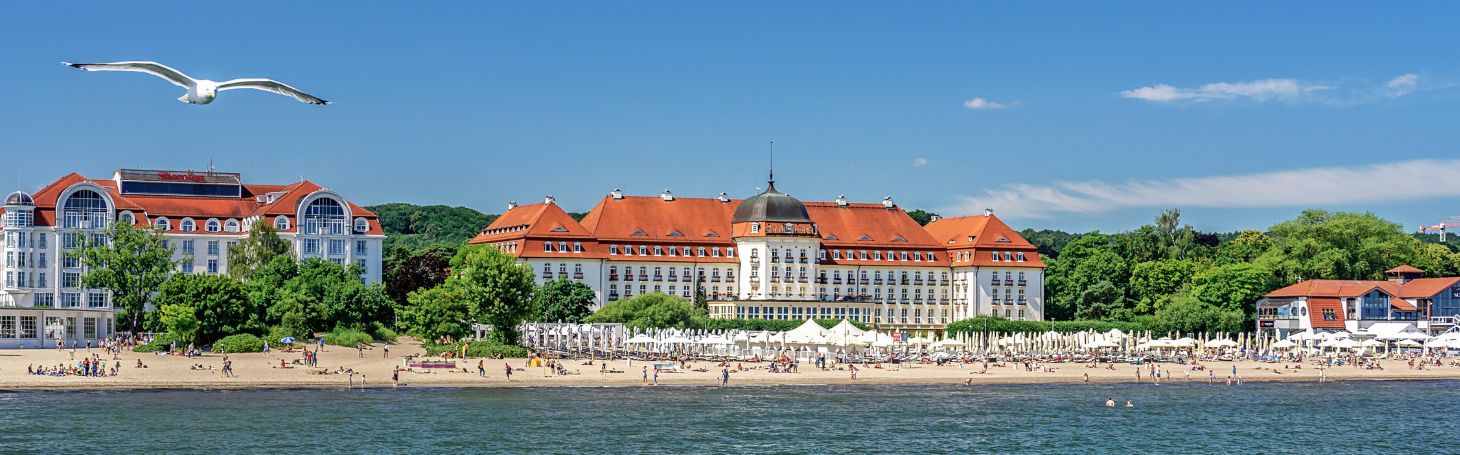
This wide, sandy beach is the perfect place to relax. The sand here is soft and clean, the water is warm thanks to the shallow Gulf of Gdansk and the view of the sea and the pier is unforgettable. Sopot's beach is 4.5 km long and connects to the beaches of Gdańsk and Gdynia, creating one of the longest sandy coastlines in Poland. Next to the beach is the Grand Hotel, now known as the Sofitel Grand Sopot, one of the most luxurious hotels in Poland. Guests of the hotel have included Charles de Gaulle, Fidel Castro, Marlene Dietrich, Greta Garbo and Shakira. Interestingly, in 1939, during the September campaign, Adolf Hitler stayed at the Grand Hotel in Sopot while awaiting the surrender of Warsaw. From the beach, it's just a few steps away from the next attraction: 📍 Grodzisko ⤵️
🕚4 min 🚶300 m
2.6 Sopot Castle
This is one of the oldest monuments of Sopot, where you can see the remains of a defensive settlement from over a thousand years ago. In the open-air museum you will see reconstructions of ancient huts, palisades and ramparts. All of the above were reconstructed exactly in the places where their authentic elements were discovered. Fragments of pottery, tools, weapons and ornaments were also found here during the excavations and can now be seen in the museum exhibition. The open-air museum as a branch of the Archaeological Museum in Gdańsk is a great place for an outdoor history lesson. The facility also organises educational lessons, demonstrations of blacksmithing, pottery and old everyday life, so you can feel like you are in a medieval settlement. From the medieval settlement we return to the modern buildings - we go to see📍 The Crooked House ⤵️
🕚 14 min 🚶1 km
2.7 Crooked House
Before reaching the cottage, walk along Haffner Street, where you can admire the resort's unique wooden architecture. Sopot is famous for its beautiful villas with verandas, which were built at the turn of the 20th century. Many of them served as summer residences for the rich inhabitants of Gdansk and Berlin. The characteristic wooden ornaments, openwork balconies and glazed verandas give these buildings a unique charm. Passing more villas, we come to the main attraction. The Crooked House is one of the most characteristic buildings in Poland. Its wavy façade gives the impression as if the building came from a fairy tale. And there is nothing strange about that, as its design was inspired by the illustrations of Jan Marcin Szancer and Per Dahlberg, famous for their fairy-tale drawings. The Crooked House has become a symbol of modern Sopot and is eagerly photographed by tourists. It even took first place on the list of the 50 strangest buildings in the world, published by the Village of Joy portal. The house stands at our next attraction:📍Bohaterów Monte Cassino Street, or the famous Monciaku⤵️.
🕚 1 min 🚶20 m
2.8 Bohaterów Monte Cassino Street - Monciak Street
Monciak, or Bohaterów Monte Cassino Street, is a representative street in Sopot. Along the promenade there are numerous cafes, restaurants and bars, which also make it the centre of the city's nightlife. During the season, Monciak is, along with Droga Królewska in Gdańsk and Skweru Kościuszki in Gdynia, one of the most crowded places in the Tricity. On Monciak there is a statue of Parasolnik - a figure of Sopot urban folklore. The Parasolnik was professionally involved in umbrella repair, hence his nickname. His extravagant clothing and openness made him a cult figure in the 1960s and 1970s. The sculpture shows the Umbrella Man dressed as... a tiled cooker, which adds to its unique, slightly humorous character. On Bohaterów Monte Cassino Street stands our last attraction:📍 S t. Jerzego⤵️ Church.
🕚 1 min 🚶20 m
2.9 St George's Church
It is a neo-Gothic church from 1901, distinguished by its richly decorated brick façade and tall, slender tower. There is a story connected with the latter. The funds for the temple were donated by Kaiser Wilhelm II, who ordered that the church tower be visible from ships on the Bay of Gdansk. This was to emphasise the importance of the building in the landscape of Sopot. Even if you are not a fan of sacred architecture, it is worth a look inside to admire the craftsmanship and harmony of the neo-Gothic decorations. From here, after a day full of attractions, we return to the train station📍SopotCentrum.
3. HOW TO GET TO SOPOT?
You can reach Sopot directly from several major Polish cities. Sopot Centrum station is right in the centre, so after arriving you can walk to Monciak and the pier in a few minutes.
-
Warsaw - Sopot: about 3 hours, direct connection
-
Kraków - Sopot: about 5.5 hours, direct connection or one change
-
Wrocław - Sopot: about 5 hours
-
Katowice - Sopot: about 5 hours
-
Poznań - Sopot: about 3.5 hours
-
Gdańsk - Sopot: a few minutes by SKM or a regional train
You can buy tickets for all routes to Sopot on PolishTrains without creating an account – the ticket is sent by e-mail and SMS. Sopot is a city well connected to the rest of the country. You can get to Sopot in just a few minutes from Gdańsk and Gdynia, as well as directly from larger cities such as Warsaw, Kraków, Wrocław, Katowice or Poznań. The Warsaw-Sopot and Krakow-Sopot routes are particularly popular. The Pendolino from Warsaw reaches here in about 3 hours and from Krakow in just over 5 hours.
3.1 Low-cost train to Sopot
If you are looking for cheap tickets, book in advance, especially during the tourist season. Sopot, like the whole of the Tricity, is a popular holiday destination. Ticket prices to Sopot can vary depending on the departure date and the starting city. On our website PolishTrains.eu you can easily compare prices and find the best offer. It is worth remembering that faster connections are slightly more expensive, but will give you more time to explore the city. There are many trains to Sopot from all over the country - you are sure to find the perfect connection!
3.2 What should you know before you travel?
Before you set off for Sopot, it is a good idea to check the timetable and any train changes. If you buy your ticket through our service, you will receive it by e-mail or SMS, so you don't have to print out the document. In modern long-distance trains you will find comfortable seats, Wi-Fi, electric sockets and dining cars. The station in Sopot is a modern facility in the very centre of the city. After exiting the train, it only takes a few minutes of walking to find yourself on the famous Monciak, or Bohaterów Monte Cassino Street, leading straight to the pier. Travelling by train is not only comfortable, but also saves time!
This article was prepared by the PolishTrains editorial team. We follow the rail market in Poland and Europe, look for new connections and support you at every stage of your journey.