




Attractions in Zamość - the best places to visit
Published
This city, founded by Jan Zamoyski in the 16th century, is a perfect example of a fortress city. You can also pay for your ticket quickly with BLIK, without logging in to your bank and without downloading an additional app. You can buy train tickets to Zamościa on PolishTrains without creating an account, and you will receive the ticket by email and SMS. A walk through the UNESCO-listed Old Town is a real journey back in time, where every corner tells of the founder's former glory and vision. Check out with us the most interesting places in Zamość and find out how to get to Zamość by train from cities such as Warsaw, Krakow or Lublin..
Table of contents
- 1. HIGHLIGHTS OF ZAMOSC, WHAT IS WORTH SEEING?
- 1.1 Historical monuments of Zamość worth visiting - map
- 1.2. ZAMOŚĆ IN ONE DAY - THE MOST IMPORTANT PLACES TO VISIT
- 2. ZAMOŚĆ - WHAT TO SEE IN ONE DAY?
- 2.1 Zamosc Fortress
- 2.2 Zamosc Synagogue - Multimedia Museum of the History of the Jews of Zamosc and the Surrounding Area
- 2.3 Armenian townhouses
- 2.4 Rynek Wielki in Zamość
- 2.5. Zamoyski Palace
- 2.6. Museum of Fortifications and Weapons Arsenal Branch of the Zamojskie Museum
- 2.7 Parish of the Resurrection and St Thomas the Apostle
- 2.8 West footbridge
- 2.9 Lviv Old Gate
- 3. HOW TO GET TO ZAMOSC?
- 3.1 Low-cost train to Zamosc
- 3.2 Useful information before travelling
- More travel inspiration
1. HIGHLIGHTS OF ZAMOSC, WHAT IS WORTH SEEING?
Zamosc is a city full of attractions that will delight history lovers. At the top of the list of "Zamość monuments" is the Rynek Wielki with its picturesque Armenian town houses and the magnificent town hall with its characteristic staircase. The Cathedral of the Resurrection and St Thomas the Apostle are also worth a visit. Walking around Zamość you will feel the magical atmosphere of the streets of the old town, listed on the UNESCO list. You can buy your ticket on PolishTrains without creating an account – it is sent by email and SMS. The ticket you buy is also saved in the PolishTrains mobile app, so you can show it to the conductor without printing a paper copy. 30 minutes before departure, you receive an SMS reminder with a link to the ticket. The earlier you buy, the better the price and the greater the choice of seats. If you are interested in the attractions of Zamość and its surroundings, take a look at the nearby Zwierzyniec with its picturesque Roztoczanski National Park.
1.2. ZAMOŚĆ IN ONE DAY - THE MOST IMPORTANT PLACES TO VISIT
Zamosc hides countless architectural treasures, fortunately all conveniently located in the very centre of the city. The Old Town is a real maze of charming streets with colourful townhouses and a beautiful market square. Another must-see for history lovers is the Zamość Fortress. Its walls hide the secrets of the past and a walk through the bastions allows you to feel the atmosphere of the old times. Not to forget the Synagogue, which completes the picture of a multicultural city.
2. ZAMOŚĆ - WHAT TO SEE IN ONE DAY?
We start our journey by getting off at the station📍Zamość**- Old Town**. This is a small but charming railway station located in the heart of the historical part of the city. From the station you can easily reach the main tourist attractions of Zamość. Not far away, just a 10-minute walk, is the first attraction on our route 📍TwierdzaZamość ⤵️
🕚 10 min 🚶700 m
2.1 Zamosc Fortress
Zamość Fortress is a pearl of Renaissance bastion fortification, built on the initiative of the town founder Jan Zamoyski. Its walls, bastions and ramparts will take you back to the times when the whole town was one big fortress. It was supposed to protect Zamość from the invasions of enemies and to secure a strategically important trade route. On a guided tour of Bastion VII you will discover mysterious underground corridors, shooting galleries and casemates, where supplies were stored and where the crew took shelter. Walking along the historic walls, you will feel like a former defender of the city and learn about the strategies that made Zamość one of the most powerful fortresses in Central Europe! The fortress was so well designed that it was captured only once in its history - by the Austrian army in 1809, but only because the garrison did not have enough soldiers to defend itself. At this point it is worth mentioning the person of Joanna Zubrova, who became famous as a defender of the Fortress and an excellent gunner. She was the first woman selected to be decorated with the Order of Virtuti Militari. From a military climate we turn to a religious one - we go to the nearby📍Synagoguein Zamościu⤵️.
🕚 5 min 🚶350 m
2.2 Zamosc Synagogue - Multimedia Museum of the History of the Jews of Zamosc and the Surrounding Area
The Renaissance synagogue in Zamość is a unique monument and a testimony to the multicultural history of the city. Jews settled here as early as in the 16th century, enjoying numerous privileges. Jan Zamoyski invited especially Sephardic Jews, coming from southern Europe, counting on their contribution to the development of trade and diplomacy. That is enough of a historical introduction, but as far as the building itself is concerned - your attention will certainly be drawn to its Renaissance attic and rich stuccowork in the characteristic Zamość style. Interestingly, the synagogue was erected in a slight depression in the ground, which made it possible to create a magnificent building without violating the regulations that prohibited erecting Jewish buildings higher than churches. Unfortunately, the Germans devastated the synagogue during World War II, converting it into a workshop and stables. After the war, the building served as a warehouse and library. Now it houses the "Synagogue" Centre with the Multimedia Museum of Jewish History - a must-see to show the multicultural past of Zamość. From the synagogue we head to the edge of the market square to see the📍Armenian Townhouses ⤵️
🕚 2 min 🚶130 m
2.3 Armenian townhouses
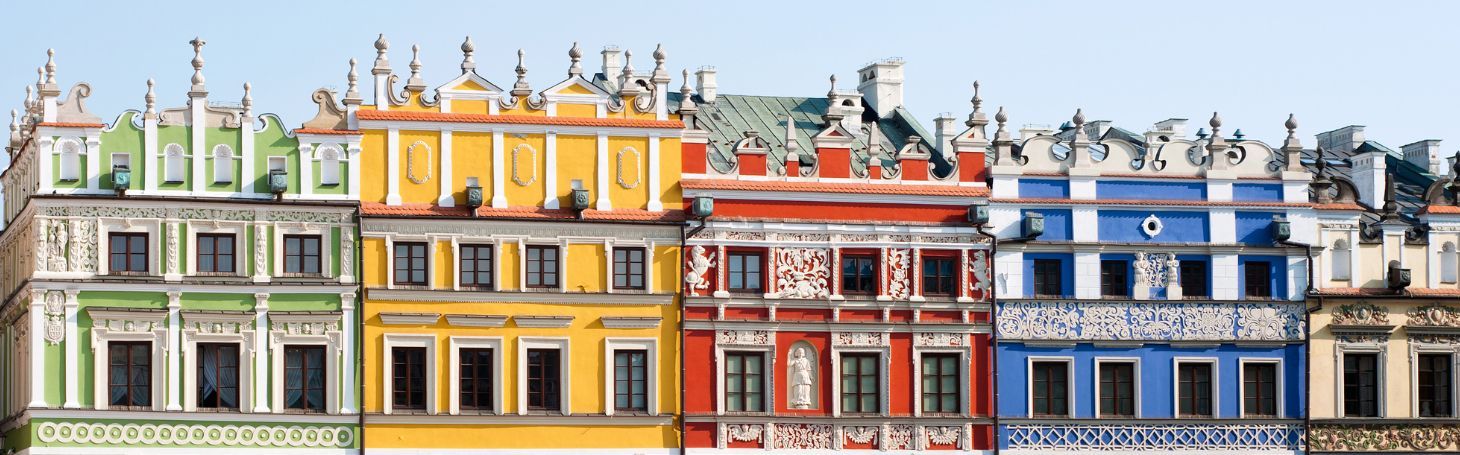
This part of Zamość, where the Tenements are located, was granted by Jan Zamojski to the Armenians. In the 17th century, Armenians contributed significantly to the development of Zamość thanks to their flair for trade. And their tenements, which were houses and headquarters of workshops and shops, are to this day a real feast for the eyes! The colourful facades resemble gingerbread houses, each hiding a different story. The green Wilczkowska Tenement House shows bas-reliefs with John the Baptist, while the red Tenement House Under the Angel shows the Archangel Gabriel. The blue Under Marriage Tenement depicts a quarrelling couple, reminding us of human weaknesses, and the yellow Under Madonna Tenement depicts the Madonna and Child trampling a dragon: a symbol of the triumph of good over evil. Today, most of them house the Zamojskie Museum, which brings the history of the city and the Armenian community closer. Now we turn sideways to see our next attraction📍TheGrandMarketin Zamościu⤵️
🕚 1 min 🚶85 m
2.4 Rynek Wielki in Zamość
The Rynek Wielki in Zamość is the heart of the city with an area of 100 x 100 metres, which from the first moments impresses with its symmetry. Each side of the market is a carefully planned space which was to combine commercial, administrative and representative functions. The central point is the Town Hall with its monumental staircase and clock tower - a meeting place and a symbol of Zamość. Interestingly, the Town Hall is not located in the central part of the square as it usually is. Thanks to this, it does not compete with the most important building in the city, which was supposed to be Jan Zamoyski's palace. Walking around the square you can feel the spirit of "Padua of the North" - as Zamość was called due to Jan Zamoyski's fascination with Padua, where he studied. No wonder that the Italian architect Bernardo Morando designed Zamość as an ideal city - harmonious, functional and in line with the humanist ideas of the time. Staying on the theme of the Zamoyski-Morando duo, we go to see📍PalaceZamoyskich⤵️
🕚 4 min 🚶270 m
2.5. Zamoyski Palace
The Zamoyski Palace is the former residence of the town's founder Jan Zamoyski and his family. It was the first building erected after the foundation of Zamość, designed by the architect Bernardo Morando. Originally it had a rectangular form with two storeys, a tower with a terrace and a 2-wing staircase from the side of the Rynek Wielki. The palace burnt down in 1658, but was rebuilt in Baroque style. In the 18th century it underwent another reconstruction in the late Baroque style. In 1821, the palace was sold to the state and converted into a military hospital, which unfortunately irrevocably changed its appearance. The building now houses a court. As a consolation for disappointed tourists, there is a monument to Jan Zamoyski on horseback in front of the palace, unveiled on the occasion of the 400th anniversary of his death. It is worth taking this opportunity to present the extraordinary figure of Jan Zamoyski - a great politician, hetman, chancellor and visionary. He founded the Zamojska Academy, one of the first universities in Poland. Zamoyski was also an excellent military commander, successful in battles against Moscow and the Tartars. He managed a vast landed estate, called the "Zamojski State", which at the end of his life included 6 towns and 149 villages covering an area of 3830 km². From the palace we head to 📍Museumof Fortifications and Weapons Arsenal ⤵️
🕚 5 min 🚶400 m
2.6. Museum of Fortifications and Weapons Arsenal Branch of the Zamojskie Museum
The Zamość Arsenal is one of the most important defensive and historical buildings in Zamość. Built in the 17th century as a storehouse for weapons and ammunition, over the centuries it has served various functions, including a detention centre and even... a school! Today, the Arsenal is home to the Museum of Fortifications and Weapons, where, among other things, you will learn even more facts about Zamość and its fortifications during a multimedia show. If you're a fan of the general theme of military and weapons, you've come to the right place. At the museum you can trace the development of the art of war from the 16th to the mid-20th century. As a short break from Zamość Fortress topics, we head off to see Zamość Cathedral and📍Parishof the Resurrection ⤵️.
🕚 6 min 🚶400 m
2.7 Parish of the Resurrection and St Thomas the Apostle
The cathedral is one of the most important points on the Lublin Renaissance Route, ideal for visiting Zamość and the surrounding area. Called a pearl of Renaissance architecture, it was built at the end of the 16th century on the initiative of none other than Jan Zamoyski, according to a design by the well-known architect Bernardo Morando. The church is an example of the so-called Lublin Renaissance, a unique architectural trend combining Gothic with elements of the Italian and Dutch Renaissance. Interestingly, the dimensions of the cathedral are 15 times smaller than those of Zamość at that time, which was supposed to emphasise its symbolic significance for the city. In the Zamoyski Chapel, also known as the Ordynacka Chapel, there is a tombstone of Jan Zamoyski made of black marble, and in the crypt under the cathedral his ashes rest. After numerous historical attractions, it's time to relax in nature - we set off to📍Viewingbridgezachodnią⤵️
🕚 9 min 🚶650m
2.8 West footbridge
As the name suggests, the footbridge offers a view - over the southern foreground of the Zamość Fortress and its remains. Its construction refers to the former fortifications. Thanks to its location in a secluded place, the footbridge is an ideal place for a short break during a walk and for admiring the panorama of the city at the same time. It is also the perfect place to take exceptional photographs. With the western and eastern footbridges , you can go beyond the walls of the old town and walk around them. Returning towards the train station we pass the last point on our route📍TheLviv Old Gate ⤵️
🕚 7 min 🚶450 m
2.9 Lviv Old Gate
The Old Lviv Gate is a monument that is part of the former city fortifications. Built at the end of the 16th century, it was the main entrance to the city from the direction of Lviv. The mighty vaulted cradle, numerous shooting holes and thick walls remind us of Zamość's strategic role as a fortress city. The façade, with a bas-relief of St. Thomas the Apostle and the Zamoyskis' coat of arms, gives the whole gate a noble, representative character. During the Russian partition Walerian Łukasiński, a national hero, founder of the Patriotic Society and participant of the November Uprising, was imprisoned here. This is where we end our walk through historic Zamość and from under the Lwowska Gate we return to the train station📍Zamość**- Old Town**.
3. HOW TO GET TO ZAMOSC?
We recommend the train as a means of transport! Travelling by train bypasses the stress and expense of parking in the city centre. The train station in Zamość is located close to the Old Town, so you can quickly reach the most important attractions. You can get to Zamość directly from such cities in Poland as Kraków, Lublin or Warsaw. A direct InterCity train from Warsaw to Zamość takes just over four hours, while from Krakow you will get here in half the time.
3.1 Low-cost train to Zamosc
Compare prices for tickets to Zamość on PolishTrains.eu and buy well in advance - it's the easiest way to find cheap deals. Remember that prices vary according to season, availability and city of departure. It's worth hunting for promotions such as "Super Promo", "Weekend Ticket" or special discounts for young people, students and seniors. Zamość is very popular during the summer season, so booking in advance will help you avoid higher prices and missing seats. Consider travelling during the off-peak season - it's an extra way to save money and have a smoother journey.
3.2 Useful information before travelling
Before you set off on your journey to Zamość, remember to take your ticket and check any changes to the timetable. When you book through our service, you will receive your ticket conveniently - either by email or SMS - plus we will remind you of your departure 30 minutes before your scheduled time. InterCity trains on the route to Zamość offer many amenities, such as Wi-Fi, electric sockets and dining cars. There are specially adapted seats for people with special needs. If you need help, our helpline is open every day until 23:00 and is ready to answer any questions.