





What does the place "corridor" mean on the train? | PolishTrains
Published
Are you about to buy travel tickets and don't know what a corridor seat on a train means? On PolishTrains, when buying a ticket, you can indicate your seat preference – aisle, window or middle – before confirming the purchase. In many PKP Intercity open-plan carriages, aisle seats have numbers ending in 3, 4, 7 and 8, while in compartment carriages they are often seats 1 and 2. You can check the PKP Intercity timetable for the next few days in the PolishTrains search engine before selecting a specific seat. We explain what it means and what you can expect from such a seat, depending on the type of carriage.
At a glance
The rules for ticket refunds and changes depend on the fare – you can find the details on the PolishTrains ticket refunds and exchanges page.
Deutsche Bahn
Deutsche Bahn operates connections in Germany and many international routes. Ticket refund and change conditions depend on the fare, so check the current rules on the PolishTrains ticket refunds and exchanges page.
RegioJet
RegioJet operates connections between Poland, the Czech Republic, Slovakia and Austria. ### At a glance
- A 'corridor' seat is the aisle seat — the one closest to the central walkway of the carriage
- In open-plan PKP Intercity carriages, corridor seats have seat number endings 3, 4, 7, and 8
- Compartment carriages use a different numbering system where endings 1 and 2 indicate the aisle side
- Seat numbering varies between operators such as PKP Intercity, RegioJet, Deutsche Bahn, and Italo
- Corridor seats are recommended for passengers who travel with children or need to get up frequently
- First-class carriages may include single-seat rows where each seat is both at the window and the corridor Ticket change conditions depend on the fare – check them on the PolishTrains ticket refunds and exchanges page before purchasing.
What does the place "corridor" mean on the train?
In the simplest terms, a 'corridor' seat means the seat closest to the aisle, which is the corridor. You may encounter two more types of seats. "Window" means the seat right next to the window, i.e. furthest from the aisle. The "middle" seat is in the middle, meaning you will probably have other travellers on either side of you.
A 'corridor' seat on an Intercity train - what does it mean?
The way seats are marked on trains is different, so the location of an Intercity corridor seat may be different. An aisle seat is particularly useful in three situations:
-
Travelling with a child: it is easier to step into the aisle without waking fellow passengers.
-
More hand luggage: it is easier to sit down and stand up when boarding and getting off.
-
*Getting up frequently: you can reach the toilet or the carriage door more quickly.
If you need a seat better suited to limited mobility, contact the PolishTrains Customer Service Office. What does this mean? It all depends on whether you choose to travel in a carriage with compartments or whether you prefer a compartmentless option.
Corridor seat in a compartmentless carriage
Corridor seats in the case of a compartmentless carriage and in trainsets are numbered with endings 3 and 4 and 7 and 8. These will therefore be seats 13, 14, 17, 18, 23, 24, 27, 28 and so on.
In the first class carriage, the principle is similar. There, however, you have a choice between a row directly next to the corridor, i.e. numbers with endings 3 and 4, and one row which is single, so the seats are both by the window and by the corridor. On PolishTrains, connections with an available carriage plan show the seat layout straight away, allowing you to choose a specific seat. These are numbered 1 and 2. In the PolishTrains search engine, you can also compare the journey times of different trains on this route and choose the fastest connection together with a convenient aisle seat.
Corridor" space in a compartment carriage
-
*Step 1: Go to the PolishTrains search engine and enter the route, date and number of passengers. Compartment wagons have a different seat numbering rule, which many find more complicated. The same search method works whether you are planning a short city break or a longer train journey.
-
*Step 2: Select a connection from the list of results. Significantly, a similar system is used in most European countries.
In this case, seats with endings 1 and 2 are on the aisle side, while you will find numbers 3, 4, 7 and 8 in the middle. Seats 5 and 6 are next to the window. Why is it that numbers 7 and 8 are in the middle? It is a way of making it easier to book seats due to the existence of carriages with 6 and 8 seats at the same time. These larger compartments are also marked with a x 7 and x 8, so you will immediately know what type of compartment it is. If you want to change your reserved seat after purchase, check the ticket exchange rules on the PolishTrains help page.
Advantages and disadvantages of a place by the corridor
Intercity corridor space - does it have any advantages? Of course, even a great many. First of all, it's easier to sit on it and get up from it, without having to push around and apologise to other passengers. An aisle seat is particularly useful in three situations:
-
Travelling with a child: it is easier to go out into the aisle without waking fellow passengers.
-
More hand luggage: it is simpler to sit down and stand up when boarding and getting off.
-
Getting up frequently: you can reach the toilet or the carriage door more quickly.
If you need a seat better suited to limited mobility, contact the PolishTrains Customer Service Office. Plus, you usually have a bit more legroom in it. This seat is best for people with mobility problems. If, during a long journey, you like to stand to look at the views outside the window, stretch your legs or often have to go to the toilet, this is the best choice.
The disadvantages of this seat are certainly more noise and movement from other passengers and staff. It is also more difficult to take a nap or quietly read a book if you have to frequently pass the travellers sitting next to you. You also have an obstructed view through the window in the compartment. In return, however, you can stand up and look out of the window in the corridor.
We hope you already know what a seat on a train is - a corridor. The ways of marking seats on trains are not that complicated at all. With our tips, you'll always know which seat you're getting.
Remember also that you can buy your tickets, including seat selection, even more easily. How? Just use the PolishTrains search engine. This is a modern tool to help you plan your trip. It allows you to check exact timetables, transfers, available concessions and, of course, to buy a ticket. On top of this, you can choose a seat on the trains with compulsory reservation according to your preferences, whether it is "corridor" or "window".
Read before you travel
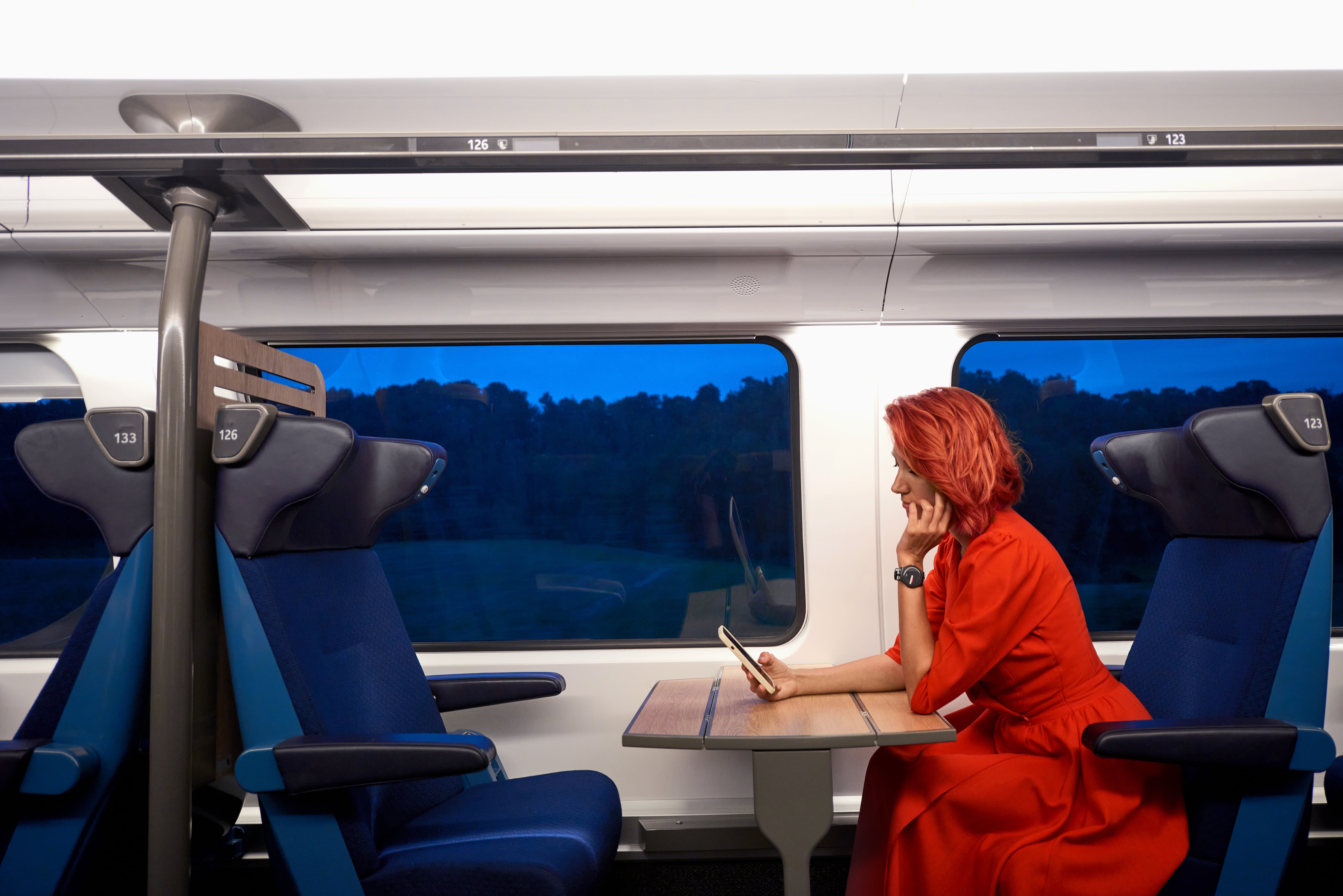
Compartmentless or compartment carriage - which one to choose? | PolishTrains
Choosing the right carriage when planning a rail journey can make a significant difference to your comfort and enjoyment. Wondering whether it's better to choose a compartmentless carriage offering open space? Before buying your ticket, you can check the carriage type in the journey description in the PolishTrains search engine – for each connection, you can see whether you will be travelling in a compartment or open-plan carriage. This is particularly useful after changes to the PKP timetable, when it is worth checking the carriage layout for your route again in the PolishTrains search engine. Or a compartmentalised carriage, offering more privacy and peace and quiet? In this article you will find the answer to the question of which type of carriage to choose. We describe their characteristics, advantages, but also the types of trains in which these carriages are used..
Business travel with PKP - a guide for employees | PolishTrains
Interest in rail travel is growing steadily. You can buy a ticket for a business trip on PolishTrains without creating an account – it arrives by e-mail and SMS within a few seconds. PKP Intercity services are used by millions of travellers - both for holiday and business purposes. If your business trip takes you abroad, you can find a ticket for Eurostar, Deutsche Bahn or Italo NTV in the same PolishTrains search engine. Research shows that as many as 28% of passengers on the most popular routes travel for business purposes - most of them on Express InterCity Premium and Express Intercity trains.