




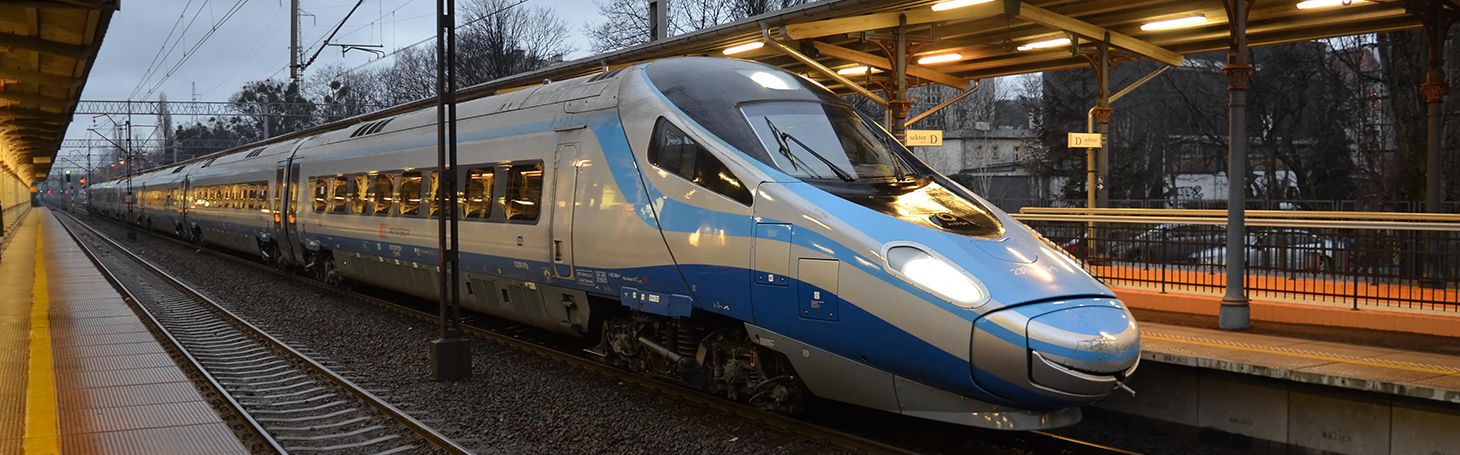
Pendolino speed - how much does it travel on Polish tracks? | PolishTrains
Published
Pendolino speed is a topic of great interest to passengers and rail enthusiasts alike. You can buy Pendolino tickets on PolishTrains without creating an account – the ticket is sent by email and SMS. The greatest influence on speed comes from the line parameters, the availability of ETCS and the movement of other trains. A WARS bar coach operates on board Pendolino, and when buying a ticket on PolishTrains you can select a seat at a table straight away. How much does the Pendolino travel on Polish tracks and can it reach its maximum speed? Although it is the fastest train in Poland, its real capabilities are limited by the railway infrastructure and traffic control systems.
At a glance
At a glance
- The Pendolino's maximum operational speed in Poland is 250 km/h
- In practice, top speed is achieved only on selected modernised sections of the network
- The fastest Warsaw to Gdansk Pendolino services take approximately 2 hours 28 minutes
- On the Warsaw to Katowice route, the Pendolino typically runs at up to 200 km/h
- A seat reservation is mandatory on all EIP Pendolino services and is included in the ticket price
- Absence of ETCS Level 2 across the full network limits top-speed running on many sections Pendolino operates exclusively on domestic PKP Intercity routes. International connections from Poland can be bought on PolishTrains under other train categories, including IC and EIC. If your onward journey leads abroad, for example to Croatia, you can check and put together a route with connections in the same PolishTrains search engine.
At what speed does the Pendolino travel in Poland?
At what speed does the Pendolino travel? This is one of the most frequently asked questions by passengers travelling on this modern train set. The maximum operational speed of the train in Poland is 250 km/h. In practice, it is achieved on a few sections, mainly on the Warsaw-Gdańsk route and on some sections of the line to Kraków and Katowice. These sections are the result of many years of modernisation of the railway infrastructure, allowing higher speeds to be developed.
Speed restrictions are in place on many routes, especially near major cities and at intermediate stations. Some sections require additional modernisation, as a result of which the train often slows down to 200 km/h (Warsaw-Katowice route), 160 km/h (Warsaw-Tricity route) or even less.
The speed of the Pendolino in Poland is therefore dependent on the state of the tracks and the rail traffic control systems. It is expected that in the coming years, further investments in railway infrastructure and technology development will allow the speed to be gradually increased to 220-230 km/h on more routes, which will significantly affect the capabilities of the Polish Pendolino.
How fast can a Pendolino go? Theory vs. reality
While in theory the Pendolino has a maximum operating speed of 250 km/h (and even 293 km/h in test conditions!), in Poland the technical conditions are not yet in place to use the full capabilities of this train. Why is this the case? There are at least several reasons.
Condition of the railway infrastructure
Despite many years of modernisation, the Polish railway network does not allow the Pendolino to develop its full speed. Even on modernised routes the limits are 200 km/h, and many other sections have lower limits. The problem is not only the tracks themselves, but also the catenary system, which in many places is not adapted to higher speeds. Modernising the tracks and adapting them to higher speeds is a costly process, requiring many years of investment. The fastest railway line in Poland may allow this speed to be increased in the future.
No ETCS Level 2 system
Modern Pendolino trains can run faster if they are properly supervised by traffic control systems. In Poland, the ETCS Level 2 system, which would allow safe driving at 250 km/h, is not yet widely implemented. Without it, speed cannot be increased without risking passenger safety. The implementation of this system is a key step in the further development of high-speed rail in Poland, but its full implementation requires additional funding and testing.
Safety and regulations
Railway regulations in Poland regulate the maximum speed of passenger trains and require additional testing and certification before raising the limits. Even if the infrastructure allows faster running, procedural issues may delay it. In addition, higher speeds mean that additional safety measures, such as better signalling or adequate protection of level crossings, need to be implemented. In addition, the introduction of new speed regulations requires cooperation between operators and regulators.
Other trains on the route
The Polish railway network is used by both high-speed trainsets and passenger and goods trains. Sharing tracks means that the speed of the Pendolino has to be adapted to the movement of other trainsets. In practice, this means that even on sections designed for 200 km/h, the Pendolino has to slow down due to the movement of slower trainsets. The frequency of trains is also an issue, which affects the smoothness of journeys.
Operating costs and journey economics
Higher speeds also mean higher electricity consumption and a higher mechanical load on the rolling stock, which affects operating costs. For the carrier, it is crucial to find a compromise between journey speed and cost efficiency. Intercity Premium relies on economical solutions to optimise operating costs.
Fastest train in Poland - Limitations and opportunities
The fastest train in Poland is undoubtedly Express Intercity Premium. It reaches speeds of 150 km/h on many sections and a maximum of 200 km/h on selected routes. Meanwhile, in Europe, trains of the same type run at speeds exceeding 250 km/h, which significantly shortens travel time. Increasing the speed in Poland would require complex investments, including both the modernisation of tracks and traffic control systems.
What would change if the answer to the question of how fast a Pendolino travels in Poland was 300 km/h? The travel time between Warsaw and Gdańsk could be just over 1.5 hours, and the journey to Kraków or Katowice would be closed in about 2 hours. Unfortunately, without further investment such a speed remains only theoretical.
Nevertheless, the Pendolino has significantly improved the comfort of travel in Poland. It offers modern interiors, stability of travel and predictable journey times. As a result, EIP passenger trains have become one of the most popular choices for people travelling between the country's largest cities.
The future of Pendolino speed in Poland
Will the speed of the Pendolino change in the future? All indications are that it will. Further infrastructure upgrades, the implementation of the ETCS 2 system and the potential construction of dedicated high-speed rail routes may make it possible to exceed the 250 km/h barrier. Then, the Polish Pendolino could actually become part of the European high-speed rail network, which would allow travel times between Poland's most important cities to be significantly reduced.
For your first train journey around Europe, it is worth considering routes to Vienna or Prague – you can check the timetable and buy tickets for such connections in the PolishTrains search engine. One of the key projects that could influence the development of the high-speed network is the Central Communication Port (CPK) and the associated expansion of the railway infrastructure. The planned high-speed lines would allow travel speeds of up to 250-300 km/h, which would mean that Pendolino could significantly reduce journey times on key routes.
However, for such changes to be possible, extensive investment will be required not only in the tracks themselves, but also in the modernisation of traffic control systems and the implementation of modern technologies to improve safety. Preparing the right infrastructure may take several years, but if the right measures are taken, Poland's fastest train could in future run at a level competitive with European high-speed trains.
You can buy a ticket for Pendolino on PolishTrains without creating an account – all you need to do is provide an email address and telephone number. ### Travel comfort and top speed
Pendolino remains the fastest train in Poland, reaching a maximum of 200 km/h in practice. On PolishTrains, you can buy domestic tickets, including for Pendolino, up to 30 days before travelling. Although this is still less than in other countries, it still represents a huge step forward for the Polish railway and passenger travel comfort. The increase in the speed of trains in Poland is a long-term process, but the future looks promising, especially if the next few years bring a dynamic development of the railway infrastructure and the implementation of solutions to increase the efficiency of long-distance transport.
If you are planning a Pendolino journey, it is worth remembering that tickets for these fast and comfortable trainsets can be purchased online at polishtrains.eu. You can find the current rules and fee calculator on the PolishTrains help page. By booking your ticket in advance, you can get better prices and plan your journey at a convenient time, avoiding higher last-minute costs. Using the online platform is a convenient solution to save time and be sure to book for the most convenient journey.
Marcin Lis, member of the PolishTrains team. A travel enthusiast who regularly travels by train across Poland and Europe. Analyst and marketer studying travellers’ needs and behaviour since 2017.
Check this information before travelling by train

Pendolino discounts for pensioners - what concessions can senior citizens count on? | PolishTrains
Travel on Express InterCity Premium (Pendolino) trains is becoming increasingly popular, also among Polish seniors. On PolishTrains, you can choose the appropriate discount without creating an account, and after payment the ticket will be sent by email and SMS. Before travelling, take a document confirming your entitlement to the discount, as the conductor may check it. It is best to buy a discounted ticket in advance, as the earlier you reserve a seat on PolishTrains, the greater the choice of dates and the lower the chance of all seats being sold. These are fast and very comfortable connections linking the largest cities in the country, valued above all for their convenience and time saving. However, many seniors are still wondering whether Pendolino discounts for pensioners apply. In this article, we take a look at the discounts available for this age group, as well as giving you tips on how and where to book your journeys most conveniently. If you are interested in the topic "Pendolino - senior discounts", please read on!

Family compartment in Pendolino - how to travel with a small child? | PolishTrains
Travelling with young children can be a challenge, but PKP Intercity is meeting the needs of families by offering special facilities on Pendolino trains. You can buy a ticket with a seat in a family compartment on PolishTrains without creating an account – the ticket is sent by email and SMS. The number of seats in family compartments is limited, so it is worth booking in advance. Before travelling with a child, it is also worth checking the train's current delays on the departure board on PolishTrains. One of these is the family compartment, which significantly improves the comfort of the journey. The Pendolino family compartment is the subject of the following article, in which we will answer questions about their benefits, the price of the journey and how to book such seats in the carriages..
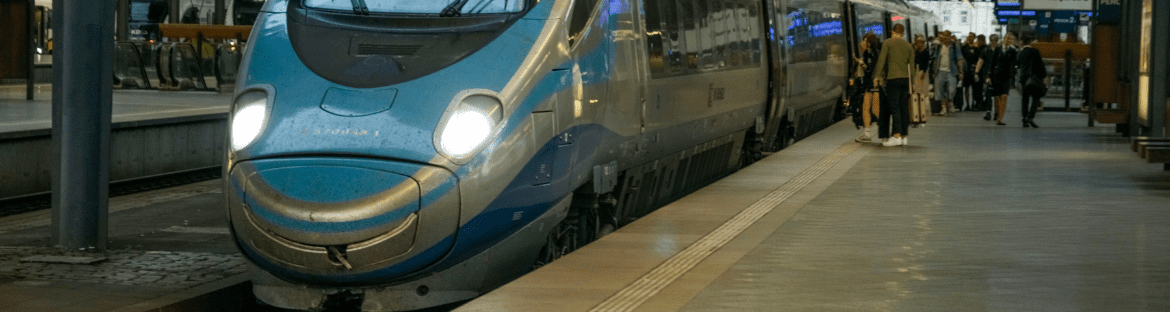
1st class on a pendolino train - what does it have to offer? | PolishTrains
Pendolino is the most prestigious train available on offer from PKP InterCity. Express InterCity Premium operates connections between major cities including Warsaw, Cracow, Gdańsk, Gdynia, Poznań, Rzeszów and Wrocław - connecting the north and south of Poland. Find out what 1st class in Pendolino looks like and what amenities passengers can count on.