
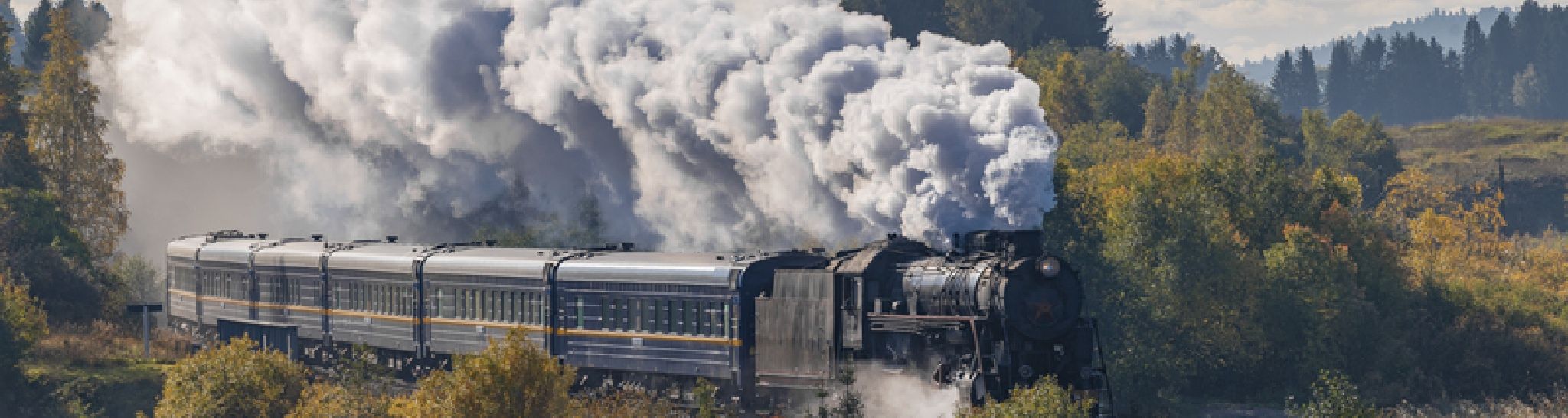
How did the steam railway transform Poland and the world? | PolishTrains
The invention of the steam railway changed the history of land transport forever. The intensive development of railways made it much cheaper and faster to transport goods or people. The beginning of railways was the horse railway, which had many disadvantages. It was not until steam locomotives and later diesel and electric locomotives led to rail transport looking the way it does today.
At a glance
At a glance
- Poland's first railway line opened in 1845 between Warsaw and Grodzisk Mazowiecki
- Wolsztyn engine shed is one of Europe's most important working steam facilities with regular steam-hauled services
- The Wolsztyn Steam Locomotive Parade has been held annually since the early 1990s, usually in late April or May
- Around a dozen operational steam locomotives remain in Poland, mainly on narrow-gauge heritage lines
- The transcontinental railways in the USA, Russia and Australia transformed trade, settlement and warfare
- The best rail connection to Wolsztyn is via Poznan, reachable from Warsaw in approximately 2.5 hours by EIP
What significance did the steam railway have for Poland and the world?
Modes of communication have been refined over the centuries. Land transport was dominated by horse-drawn carts, travelling on dirt or cobbled roads. The greatest enemy of such routes was water - in summer, spring and autumn the roads were washed away, and in winter ice destroyed their surface. New solutions were sought. The railway, which changed the whole world, turned out to be revolutionary.
It was an important part of the commercial and industrial infrastructure in the African colonies and Australia. The transcontinental railway influenced the Civil War and the revolution in Russia. European nations were quick to recognise the strategic importance of trains - one manifestation of the rivalry between countries was the search for new rail technology.
Railways definitively supplanted shipping - previously the most advanced mode of transport. The main advantages of the new solution? It was much easier to build inter-urban tracks than to dig a river canal. In addition, attaching or detaching wagons to a steam locomotive took much less time than manoeuvring a barge and tug. Train travel was not hampered by flooding or drought - unlike river transport.
History of steam railways around the world
Two Englishmen - Richard Trevithick and George Stephenson - are considered to be the fathers of the steam railway (or railways in general). The former built a locomotive that was technically perfect and also equipped with safety valves. His invention was so good that it was ahead of its time - it was unsuitable for the (wooden) tracks of the time.
Stephenson used some of Trevithick's technical solutions. His innovative idea was to use different tracks. Previously, the wagon's flat wheel moved inside a grooved rail (this was to prevent derailment). The English inventor reversed the action - Stephenson instead provided the wheel with a handrail, formed a flat rail (resembling a thick bar).
The golden age of steam railways
For more than a century, steam was the basis of railways (to produce it, energy sources such as coal, wood, peat moss, straw, sugar cane stalks or cotton waste were used) - the basis of steam locomotives. Unquestionably, between 1850 and 1920, the steam railway was the main means of land transport. By the end of the 19th century, the length of railway lines worldwide had already exceeded 800,000 km. Old lines were continually being extended or new ones built. And how did this happen?
The first railway line - the Stock and Darlington Railway - started in 1825. At first, horses were to be used to operate the carriages. George Stephenson proposed using steam locomotives. His idea was used on the first passenger railway line, opened in 1830 - the Liverpool and Manchester Railway.
After that, things developed rapidly. People became enthralled with steam railways. Trains ran on longer and longer routes. They carried millions of passengers and tonnes of freight every year. Railways came sooner in some countries and later in others - the decisions were usually up to the rulers. Some railway lines, such as Potsdam-Berlin, were only used by the rulers for Sunday trips out of town. Sometimes, however, the establishment of railways was decided by the people, such as in France - at that time a group of industrialists won the administration's agreement to build a horse railway and, two years later, to use steam locomotives. The authorities and the public were simply put in front of a fait accompli.
As far as the United States was concerned, the first steam locomotive was imported here in 1832 (the famous "John Bull"). Shortly afterwards, the Americans developed their own locomotive. Within 10 years, the American railway network had grown several times.
Twilight of the steam railway
Steam locomotives were the symbol of the modern railway for almost 100 years. This only changed when electric and diesel traction were introduced. A formidable competitor to the steam locomotive was the electric counterpart, first presented in 1879 at the Berlin Craft and Industrial Exhibition. As the decades went on, electric locomotives eclipsed the steam railway. Above all: they were more efficient, had greater power and operating performance, and did not pollute the environment as much.
Steam locomotives, however, were produced vigorously in Europe until the Second World War. In the 1930s, as many as 125 European factories were building steam locomotives, including the German factories of Henschelund Sohn, Borgis, Schwarzkopf, the English factory North British Loc Co. and the American factories Baldwin, American Locomotive Co.
The good fortune of the steam railway gradually came to an end. The fate of steam locomotives was sealed by the Germans during the Second World War, when they stole these machines and subsequently lost them and destroyed most of the railway traction. The loss of such a large number of steam locomotives was not a problem for the Allies, as diesel locomotives were beginning to take the lead in America and were being mass produced. The phasing out of steam railways in western Europe took place in the 1950s and 1960s. In Poland, this came much later (steam locomotives were still being produced here in the mid-20th century).
Steam locomotives in Poland
The first railway line in Poland was built in 1845. It was a suburban section of the future Warsaw-Vienna line. The first route on it was between Warsaw and Grodzisk Mazowiecki, with a length of about 30 km.
At present, 13 working steam locomotives running on narrow gauge tracks (so-called narrow gauge locomotives) have survived in Poland. As many as 10 of them were produced by the locomotive factory in Chrzanów. The oldest Polish operational narrow gauge steam locomotive is located in Poznań - that is the Borsig steam locomotive from 1925. There is also an interesting steam locomotive from Sochaczew (year of construction: 1929) and from Żnin (1938). The other active steam locomotives stationed in Poland were produced quite late, in the 1950s.
Thereare also many historic steam locomotives in Poland, treated as exhibits, e.g. in Paczków, Mrągowo, Kościerzyna. Others are treated as monuments, e.g. in Praszka, Zduńska Wola, Nakło nad Notecią.
Historical locomotives from Wolsztyn
Poland is a special country. In a small town in the Wielkopolska region, Wolsztyn, there is the only working steam locomotive depot in Europe. The historic locomotive from Wolsztyn and the entire steam locomotive depot are a world-wide rarity and a great heritage of Polish culture. It houses historic steam locomotives, which are eagerly visited by railway enthusiast tourists from all over the world. The most important of these are: freight steam locomotives of German construction, the heaviest steam locomotive built in 1957 for the Ty51-223 PKP, the fireless steam locomotive TKb b4 (built in 1912), which appeared in the film "The Pianist" or "City from the Sea", Poland's oldest steam locomotive Ok22-31 (1929), the incredibly fast steam locomotive Pm36-2 ("Beautiful Helena") from 1937.
This place is made up, among other things, of an eight-station depot with workshop facilities and a turntable (dating from 1908), and a museum about the history of the junction and the steam locomotive depot. In the museum rooms, tourists can see the former equipment of the stationmaster's office and ticket office, the steam locomotive depot, steam locomotive equipment, communication devices and equipment for securing railway traffic (equipment for signal boxes, shaft systems, lamps, indicators, freight crossings).
The local steam locomotives sometimes run on the Poznań-Wolsztyn railway line. The main task of the Wolsztyn steam locomotive depot is tourist and recreational activities. At the end of April and the beginning of May, every year (since 1991), the so-called Parade of Steam Locomotives is organised here, attracting tourists from all over Europe.