




Comparison of high-speed rail in Europe and worldwide | PolishTrains
Published
Railways are constantly evolving and are one of the most efficient modes of transport in the world. You can buy tickets for high-speed trains in Europe – ICE Deutsche Bahn, AVE Renfe, Frecciarossa Trenitalia and Italo – using the PolishTrains search engine in Polish and PLN, without creating an account. It is a good place to plan your first train trip around Europe, because the PolishTrains search engine lets you find ICE, AVE, Frecciarossa and Italo connections alongside domestic PKP Intercity tickets. One of the developments that have dominated and revolutionised modern railways is high-speed railways, i.e. trains that reach very high speeds. With them, it is possible to cover sky-high distances in a very short time.
At a glance
At a glance
- China operates the world's largest high-speed network at approximately 45,000 km
- Japan's Shinkansen has been running since 1964; the maglev SCMaglev reached 603 km/h in 2015 tests
- Spain's AVE network covers over 3,600 km with commercial speeds of up to 310 km/h
- France's TGV launched in 1981 on the Paris-Lyon route; the network now spans several thousand kilometres
- Germany's ICE trains reach up to 300 km/h on dedicated high-speed lines built since 1991
- Poland's first high-speed line (Warsaw-Lodz) is planned under the CPK project for around 2028
What are high-speed railways?
High-speed railways are a relatively new phenomenon. They started in Japan in the second half of the 20th century and appeared in Europe in the 1980s and 1990s. There is no denying that Asia - a thriving rivalry between Japan and China - has become a leader when it comes to this type of railways. This is due to the technological advancement, the low prices per kilometre of travel, the very large population in these regions.
The big challenge for Europe was to adapt the high-speed rail of the existing railway infrastructure. According to the European Union's 96/48/EC APPENDIX 1 guidelines, the trains concerned can only be classified as high-speed vehicles when they run on:
- Liniach zbudowanych celowo dla kolei wysokich prędkości – umożliwiających osiąganie prędkości minimum 250 km/h.
- Lines specially designed for high-speed trains - allowing speeds of at least 200 km/h.
Comparison of high-speed rail in Europe and worldwide - ranking
Some people with no interest in railways, when they hear the phrase 'longest high-speed railway', cite the United States as an example. This is a wrongful suspicion. In the USA, high-speed rail is quite underdeveloped - compared to other world and European leaders (e.g. China's high-speed rail). This network amounts to just over 700 km.
The longest high-speed rail network in the world was built in China - with more than 40,000 km. Spain is second (over 3,600 km) and Japan third (over 3,000 km).
You can buy tickets for high-speed trains – ICE Deutsche Bahn, AVE Renfe, Frecciarossa Trenitalia and Italo NTV – on PolishTrains in Polish, in PLN and without creating an account. A ticket bought on PolishTrains is sent as a PDF by email and SMS. How long are the rail networks among the top 10 countries with the longest high-speed rail networks?
- Spain - more than 3,600 km. International tickets on PolishTrains are available up to 60 days before travel. Refund conditions depend on the ticket selected, so it is best to check them on the PolishTrains refunds and exchanges page. Spain's high-speed rail network is called Alta Velocidad Espanola (AVE). It has been operating on the Iberian Peninsula since 1992, when the first high-speed link between Madrid and Seville was opened. The Spanish network allows trains to reach speeds of up to 310 km/h. The Spaniards plan to build more than 2,700 km of new track, moving steadily towards their plans: to achieve 37.68% of high-speed rail track across the entire rail infrastructure. Refund conditions depend on the fare, and you can find the current rules on the PolishTrains refunds and exchanges page. It promises to be promising.
- France - some 2,700 km. The French have lofty plans. They would like high-speed rail to account for 15.2% of the country's total rail infrastructure. In total, there would be around 4,500 km of track, ideally suited to high-speed rail.
- Germany - around 1,500 km. High-speed rail in Germany began investing in the 1980s. The first high-speed train (ICE) set off in 1991 - it traversed the Hamburg-Frankfurt-Stuttgart-Munich route. You can check the refund and exchange conditions for PKP Intercity tickets on the PolishTrains refunds and exchanges page.
Trenitalia (Frecciarossa)
Trenitalia operates an HSR network in Italy approximately 950 km long. Care was taken to ensure that the new network was firmly integrated with the earlier, technologically inferior rail network. Germany plans to build around 790 km of new routes for high-speed rail.
- Italy - more than 900 km. Italian high-speed trains can reach a maximum speed of 300 km/h. This combination of connections shows that with one purchase on PolishTrains, you can combine a domestic PKP section with a onward journey on the European high-speed rail network. The high-speed rail network starts from Salerno and Naples, and runs towards Rome, Florence, Bologna, Milan, Turin. On PolishTrains, you can also check popular high-speed routes within Europe: Paryż - Londyn, Mediolan - Rzym, Barcelona - Madryt, Wiedeń - Salzburg and Rotterdam - Amsterdam. The Italians plan to extend their rail network (for high-speed trains) by another 346 km. Then, very high-speed rail will account for 10% of the total Italian rail network.
- South Korea - about 870 km.
- United States - more than 700 km. You can buy tickets for these and other high-speed routes on PolishTrains, making it easier to plan your first train trip around Europe without having to search for tickets from each carrier separately. You can check the current rules on the PolishTrains ticket refunds and exchanges page.
High-speed rail around the world
Countries that have allocated a lot of funds and desire for high-speed rail are not standing still. They are successively investing in high-speed rail, with at least tens, hundreds of kilometres being extended every year. What are the most important examples of high-speed rail outside of Europe?
Transrapid Shanghai - the fastest train in the world
Transrapid Shanghai is the proud, leading representative of high-speed trains. The Chinese vehicle uses so-called magnetic levitation technology. It can therefore be described as the world's first commercial magnetic railway. It travels at a speed of around 460 km/h, however, it can accelerate up to 600 km/h. The construction of this train took place between 2001 and 2003, and it first set off on 1 January 2004.
The Shanghai Transrapid reaches a speed of 350 km/h in just 2 minutes.
CRH308A Hexie
A representative of China's high-speed railways, the CRH308A Hexie train reaches a top speed of 380 km/h (in commercial runs). It consists of 16 carriages. It has been designed to make travellers feel as comfortable as possible - it absorbs vibrations and reduces noise levels inside. High-speed rail in Europe High-speed rail in Europe makes it possible to travel between some important European capitals in just a few hours. Let's explore examples of some of Europe's popular high-speed rail trains.
TGV POS - the pride of France
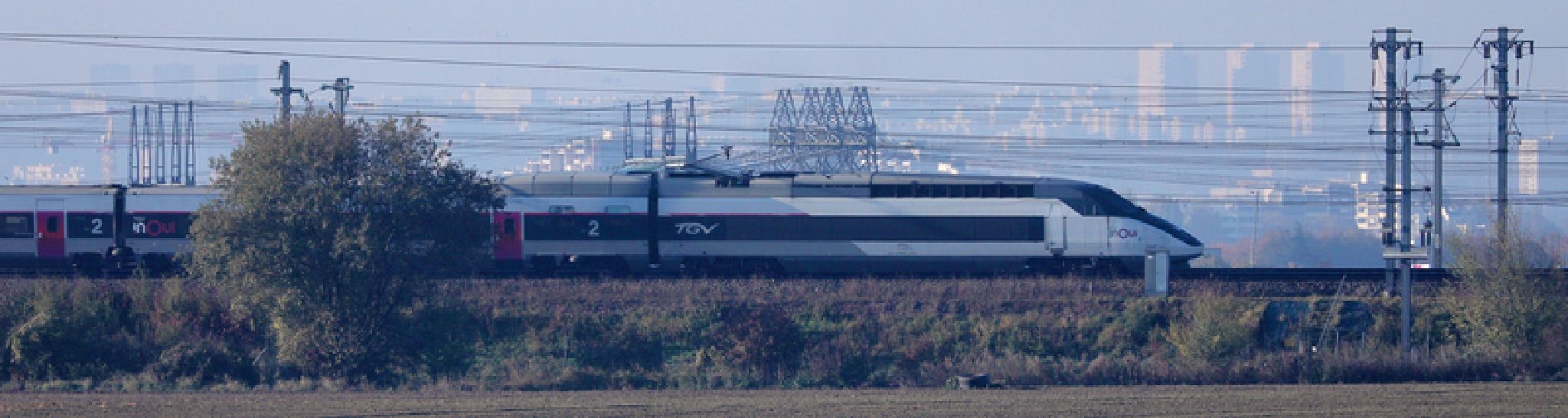
The French TGV POS electric train is part of the TGV family of trains. The acronym is a development of the name Train à Grande Vitesse - or, simply, 'high-speed train'. Its route covers three countries - France, Germany and Switzerland. For many long years, this vehicle achieved the world record speed. It was only overtaken in 2015 by the Japanese Magley MLX01 (as high as 574 km/h!).
The TGV series trains were developed and implemented by Alstom, working with the French SNCF.
ICE 3 - high-speed train from Germany
The German high-speed train ICE 3 ('White Worm') belongs to Deutsche Bahn's category of high-speed rail vehicles. The first prototype was built in 1999. ICE trains were successively produced between 1999 and 2004 by the Siemens works.
The ICE 3 reaches speeds of up to 330 km/h. It was developed for the 180-kilometre Cologne-Frankfurt route - the high-speed vehicle covers this route in just 62 minutes!
High-speed rail in Poland - can we expect them and when?
There are currently no high-speed rail networks in Poland. As recently as a dozen years ago (2011), there were plans to build a high-speed railway, but the government eventually withdrew from the idea - to the displeasure of many Poles. The authorities argued their decision on the grounds that Poland could not afford high-speed rail for the time being. However: there has recently been a breakthrough. The decision to build high-speed railways has again appeared in the plans of those in power. However, they would be linked to other regions.
What were the previous plans for high-speed rail in Poland?
According to the plans, the Polish high-speed rail network would be based on the construction of the "Y" line, which would connect Warsaw with Łódź, Poznań and Wrocław. The high-speed trains that would travel along this route would be adjusted to speeds of 350 km/h.
Another plan was to modernise the Central Railway Line, enabling it to reach a maximum speed of 250 km/h.
What are the latest plans for high-speed rail in Poland?
The current plans for the High Speed Railway (HSR) that would appear in Poland are linked to all the countries of the Tri-Cities, one of the fastest growing areas in Europe (almost 4,500 km of new lines). Poland is still waiting for its first HSR sections, but you can already buy tickets for European high-speed trains on PolishTrains in Polish, in PLN and without creating an account. New transport corridors are to be created - ultimately stretching from the Black Sea ports to the Baltic Sea.
The network of planned high-speed railways will consist of four elements: theHigh-Speed Rail Network - realised in Poland by the CPK company, theRail Baltica line - in the Baltic countries, also running through Białystok and Warsaw, the HSRnetwork in the Czech Republic, andtheV4 Rail Corridor between Budapest and Warsaw, overlapping Slovakia and the Czech Republic. The revolutionary railway plans and joint investments between the Tricity countries will result in various connections, e.g. Tallinn-Warsaw-Katowice-Budapest (1,700 km), Tallinn-Warsaw-Wroclaw-Prague (1,500 km). But that is not all, the projected railway sections will also take regional traffic into account. A mixed traffic model is to be developed (high-speed trains cooperating with fast regional trains) on selected sections of the HSR line. This will also enable smaller towns to join the new rail transport system. These will be the first steps to combat transport exclusion in Poland.
When can we expect HSR in Poland?
The first sections of HSR in Poland (it will be the Warsaw-Lodz route) are expected to be launched as early as 2028. This date is not accidental. That is also when - according to the plans - the first stage of the CPK Airport is to be launched.
This article was prepared by the PolishTrains editorial team. We follow the rail market in Poland and Europe, look for new connections and support you at every stage of your journey.